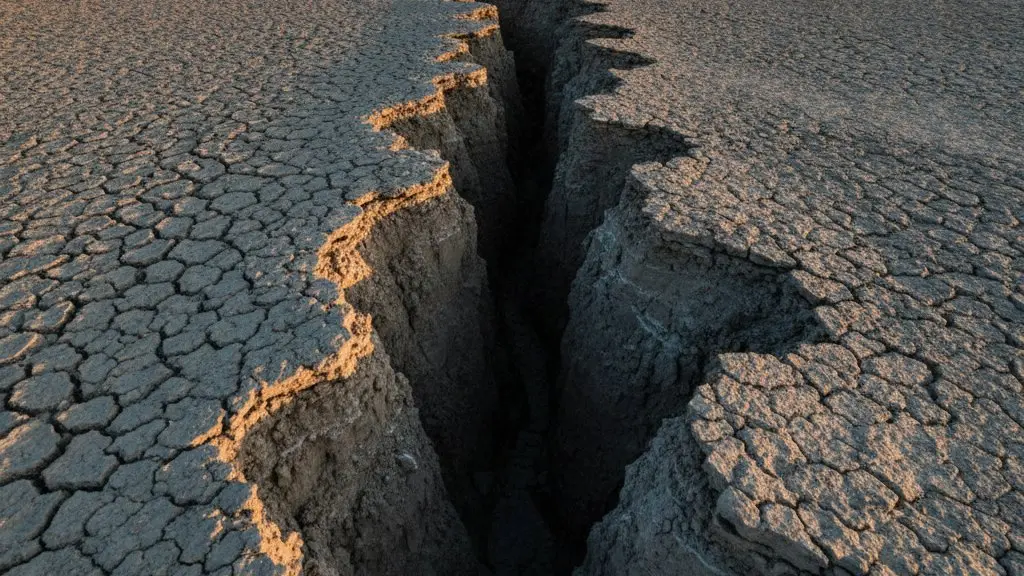
Earthquakes feel like the ground betraying a basic promise. Solid land is supposed to stay put. When it does not, the experience is disorienting precisely because it violates something we never think to question. Yet the underlying cause is not mysterious. Most earthquakes are the result of a slow, relentless process finally letting go, and the physics is surprisingly graspable.
The harder question is usually not why an earthquake happens, but why one quake barely rattles the windows while another levels neighbourhoods. That comes down to a handful of factors that have less to do with the shaking itself than with where and how it reaches people.
Stress, faults, and sudden slip
The Earth’s outer shell is broken into large slabs called tectonic plates, and these plates are slowly moving, driven by heat churning in the planet’s interior. They move at roughly the pace fingernails grow, which sounds harmless, but they do not slide smoothly past one another. Along the boundaries and fractures between them, called faults, rock catches and locks together while the broader plates keep pushing.
Because the plates keep moving but the fault is stuck, stress accumulates in the rock, like bending a stick further and further. Eventually the rock cannot hold, and it slips abruptly along the fault. That sudden release is the earthquake. The stored energy radiates outward as seismic waves, and it is those waves shaking the ground that we feel. The U.S. Geological Survey describes this build-and-release cycle as the source of the great majority of earthquakes worldwide.
This is why earthquakes cluster where they do. The most seismically active regions sit along plate boundaries, which is why certain coastlines and mountain belts experience frequent quakes while the middle of a stable plate is comparatively quiet. It also links earthquakes to other plate-boundary phenomena such as volcanoes and the slow building of mountains, all part of the same restless machinery that broader https://pqrnews.com/category/science/ treats as one connected system.
What magnitude really measures
Earthquake size is usually reported as a magnitude, and this is where intuition often misleads people. Modern magnitude scales are logarithmic, meaning each whole number up the scale represents a large multiplication in the energy released, not a simple one-step increase. A quake one unit higher is not slightly stronger; it is dramatically more powerful. This is why a small-sounding numerical gap separates a quake people barely notice from one capable of catastrophic damage.
Magnitude describes the energy of the event at its source, but it is not the same as how strongly the ground shakes at any given place. That is where a second idea, intensity, comes in: intensity describes the actual shaking and its effects at a specific location, which can vary widely for the same earthquake depending on distance and local conditions. Confusing the two is a common source of misunderstanding when a quake is in the news, a distinction worth keeping in mind for anyone following https://pqrnews.com/category/world/ coverage of a disaster.
Why some quakes do far more harm
Two earthquakes of similar magnitude can produce completely different outcomes, and the reasons are mostly about circumstances. Depth is a major factor. A quake that ruptures close to the surface delivers its energy to the ground above with less distance to weaken along the way, so shallow quakes often shake harder locally than deep ones of the same magnitude. Proximity matters for the obvious reason that shaking diminishes with distance from the source.
The ground itself is decisive too. Solid bedrock transmits shaking differently than soft, loose or waterlogged soils, which can amplify the motion and, in some cases, temporarily behave almost like a liquid, a process that undermines whatever is built on top. And then there is what humans have put there: building design and construction quality make an enormous difference to whether structures withstand shaking or collapse. This is why the same magnitude can be survivable in one place and devastating in another, a reality that ties seismology to https://pqrnews.com/category/business/ decisions about construction standards and to public policy.
Why prediction is so hard, and preparation is not
People often ask why, with all our instruments, earthquakes still seem to strike without warning. The honest answer is that predicting the exact time, place and size of a specific earthquake remains beyond current science. Researchers can map where quakes are likely over long spans and estimate probabilities, but the precise moment of a slip is not something anyone can reliably call in advance.
What is very possible, and where the real progress lies, is preparation. Understanding that stress builds along known faults lets engineers design buildings to flex rather than fail, lets planners avoid the worst ground, and lets early-warning systems detect the first waves and buy people precious seconds. The science cannot stop the plates from moving, but understanding the mechanism turns a terrifying mystery into a hazard that can be planned for. To see how PQR News covers earth science, visit our https://pqrnews.com/about-pqr-news/ page.
Sources
Related from Science

How CRISPR Gene Editing Actually Works
CRISPR lets scientists cut DNA at a chosen spot with unusual precision. The tool was borrowed from a defence system bacteria have…

How Climate Change Drives Rising Sea Levels
Warmer oceans and melting ice are lifting the sea, but the two causes work in very different ways. Here is the physics…
Get PQR News in your inbox
Daily premium coverage, free. Independent · Source-cited.