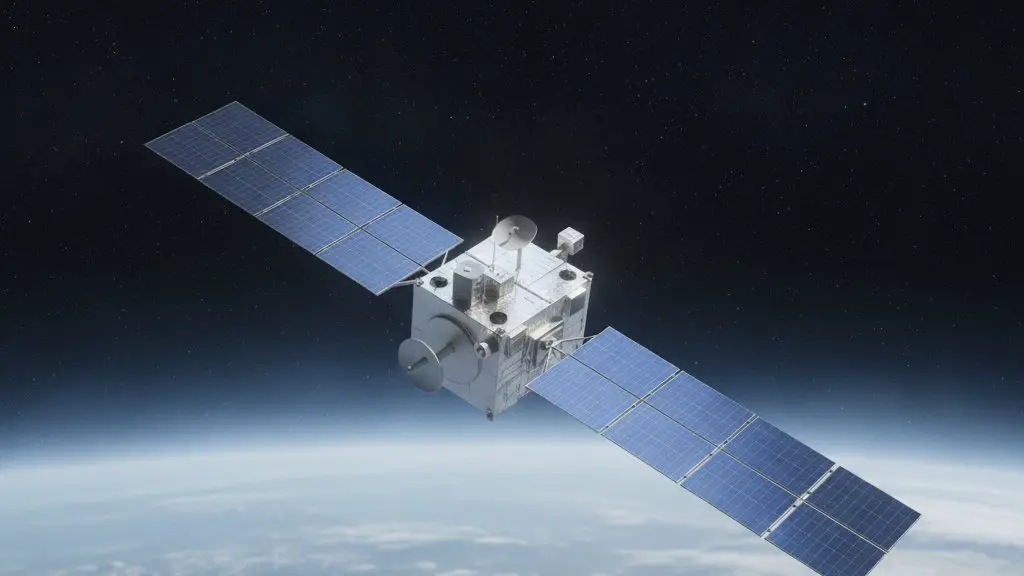
You glance at a blue dot on a map and it knows where you are, to within a few paces, almost anywhere on Earth. It is so ordinary now that the achievement behind it goes unnoticed. That dot is the end point of a chain that runs from atomic clocks aboard satellites thousands of kilometres overhead, through a correction for the warping of time itself, down to a cheap chip in a phone that never says a word back.
The Global Positioning System is one of those pieces of infrastructure so reliable it has become invisible, and the way it actually works is more elegant than the magic it feels like. For readers curious about the science of technology they carry every day, it repays a closer look.
Position from timing
The core idea of GPS is to turn time into distance. Each satellite in the system continuously broadcasts a radio signal that says, in effect, “I am satellite X, here is my exact position, and here is the precise time I am sending this.” Those signals travel at the speed of light, which is fast but finite and, crucially, known.
Your receiver picks up a signal and compares the time stamped on it with the time the signal arrived. The tiny delay between the two, multiplied by the speed of light, gives the distance to that satellite. Knowing you are a certain distance from one satellite places you somewhere on the surface of an imaginary sphere around it. That is not yet a location — but it is the first constraint.
The technique is called trilateration, and it is worth being clear that it is not triangulation, which uses angles. GPS uses distances. Add a second satellite and you are on the intersection of two spheres; add a third and the possibilities narrow to essentially two points, one of which is absurd, such as far out in space. The principle is simple geometry; the difficulty is doing it with the fantastic precision that useful accuracy demands.
Why you need four satellites
Three distances sound like enough to fix a point in three dimensions, and in pure geometry they would be. GPS needs a fourth, and the reason exposes the system’s central engineering problem: clocks.
The whole method depends on measuring time differences of extraordinary smallness, because light covers vast distances in a fraction of a second. The satellites can afford superb clocks. Your receiver cannot — a phone contains an ordinary, comparatively imprecise clock, and even a tiny error in it would throw the distance calculations off badly. The elegant fix is to treat the receiver’s clock error as a fourth unknown, alongside the three coordinates of position. With signals from four satellites, the receiver has enough information to solve for all four at once, in effect correcting its own cheap clock against the satellites’ precise ones every time it computes a fix. This is why a good GPS lock quietly gives your device a far better sense of the time than its internal clock alone ever could, a link to precise timekeeping that national standards bodies study closely. The same timing signals underpin far more of the internet and power grids than most people realise.
Where Einstein comes in
Here the story takes a genuinely surprising turn. For GPS to be as accurate as it is, its designers had to account for Einstein’s theory of relativity — not as a curiosity, but as an engineering necessity. Two effects pull in opposite directions.
Special relativity predicts that the satellites’ clocks, moving fast relative to the ground, tick slightly slower than clocks below. General relativity predicts the opposite and larger effect: clocks higher up in the weaker gravity of orbit tick slightly faster than clocks on the surface. The two do not cancel; there is a net difference between a satellite clock and an Earth-bound one, and although it is minuscule, the precision GPS requires means that ignoring it would cause position errors that grow rapidly and quickly render the system useless for navigation. So the satellites’ clocks are deliberately adjusted to compensate. It is one of the clearest everyday demonstrations that relativity is not abstract theory but working physics, a point space agencies including NASA often use to illustrate the practical reach of Einstein’s ideas.
What GPS is, and is not
One persistent misconception is worth dispelling, because it matters for privacy. GPS receivers only listen. Your phone does not transmit anything back to the satellites; it silently receives their broadcasts and does the maths locally. GPS on its own therefore does not, and cannot, track you — the satellites have no idea you exist. Location tracking happens when a separate app or network on your device chooses to send your computed position elsewhere, which is a different matter entirely.
It is also worth knowing that GPS is one system among several. Other powers operate their own satellite-navigation constellations, and Europe’s, run by the European Space Agency and its partners, is among them; modern receivers often use several at once for better accuracy. The US government’s GPS service remains the most widely known, a piece of public infrastructure freely available to the world. That a system this intricate — atomic clocks, orbital geometry and relativity working in concert — has faded into the background of daily life is a quiet measure of how thoroughly it succeeded. Understanding it restores a little of the wonder, and that is the spirit of this coverage, described on our about page.
Sources
Related from Technology

What the GDPR Actually Requires, in Plain Terms
Europe's data-protection law reshaped how the internet handles personal information far beyond the EU's borders. Behind the cookie pop-ups is a set…

How Car Key Programming Improves Vehicle Security
Electronic key programming and immobilizer systems are now central to modern car security — here is how they work and why keeping…

What a Data Breach Actually Involves, Step by Step
"Data breach" is a headline word that hides a wide range of very different events. Understanding what actually happens — and what…
Get PQR News in your inbox
Daily premium coverage, free. Independent · Source-cited.