

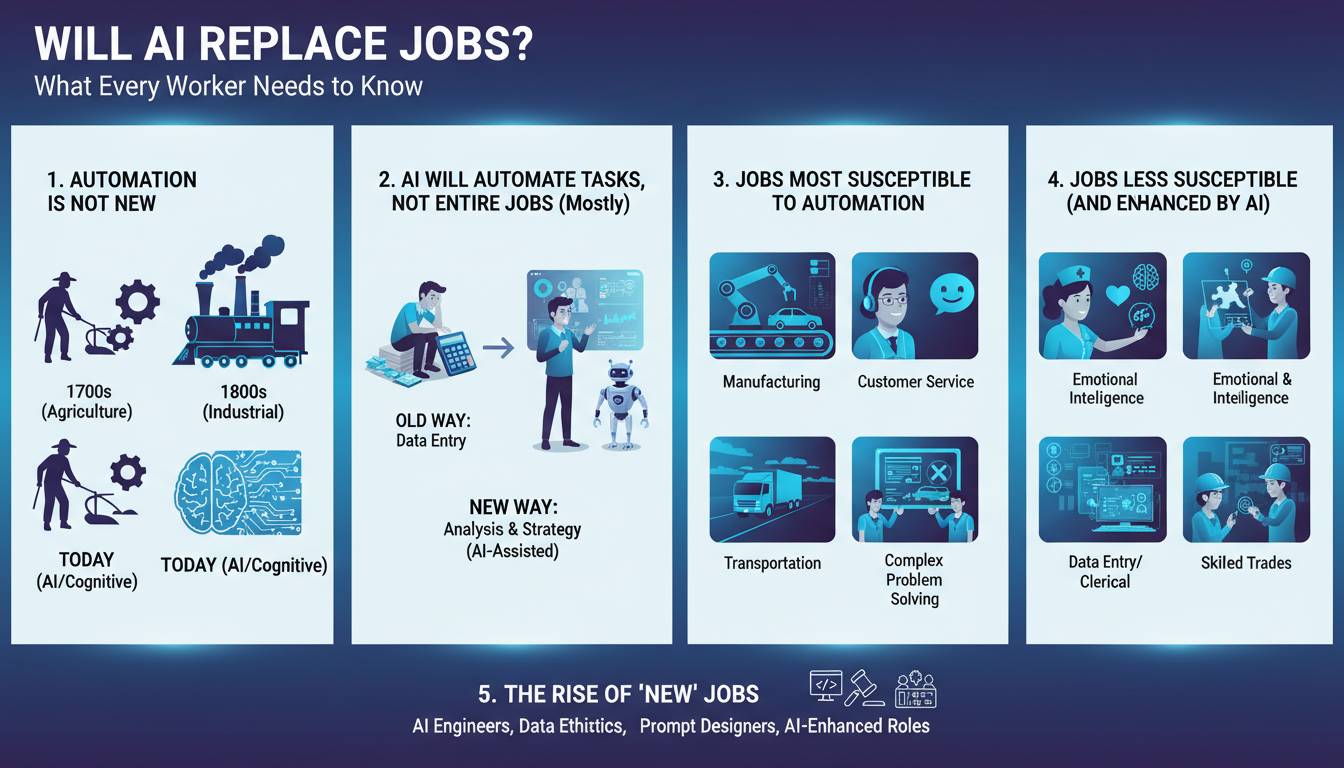
Artificial intelligence is no longer a futuristic concept—it’s reshaping the modern workplace in real time. From automated customer service chatbots to sophisticated algorithms that screen resumes, AI tools are already performing tasks once reserved for human workers. The question on millions of minds is simple: will AI replace my job? The answer is more nuanced than a simple yes or no. While AI will undoubtedly automate certain tasks and transform entire industries, it will also create new opportunities and reshape how we work rather than simply eliminating jobs. Understanding which roles are vulnerable, which remain secure, and how to adapt is essential for every worker navigating this technological shift.
The Current State of AI in the Workplace
The workplace integration of AI has accelerated dramatically since 2022, with generative AI tools like ChatGPT entering mainstream consciousness. Research from Goldman Sachs estimates that AI could automate approximately 25% of current work tasks in the United States, affecting roughly 300 million jobs globally (Goldman Sachs Research, March 2024). This isn’t science fiction—it’s happening now across sectors ranging from finance to healthcare to manufacturing.
The McKinsey Global Institute’s analysis indicates that by 2030, roughly 70% of companies will have adopted at least one type of AI technology, fundamentally changing how businesses operate (McKinsey & Company, June 2024). The World Economic Forum’s Future of Jobs Report 2023 projects that AI will displace 85 million jobs globally by 2025, while simultaneously creating 97 million new positions—a net positive but one that requires significant workforce retraining (WEF, May 2023).
What makes the current wave different from previous technological shifts is the breadth of cognitive tasks AI can perform. Unlike industrial automation that primarily affected manual labor, modern AI systems can analyze data, generate written content, assist with legal research, and even help diagnose medical conditions. This expansion into knowledge work means the disruption will affect white-collar professions previously considered safe from automation.
Which Jobs Are Most at Risk
Certain职业 categories face higher vulnerability to AI automation due to the nature of their tasks. Administrative and clerical positions rank among the most exposed, particularly roles involving data entry, scheduling, and basic document preparation. The Bureau of Labor Statistics tracks employment trends showing faster decline in these categories compared to other sectors, with administrative support occupations projected to see continued contraction (BLS Occupational Outlook Handbook, 2023-2033).
Financial services face significant disruption as AI excels at processing numerical data and detecting patterns. Roles in bookkeeping, accounting, and basic financial analysis are increasingly handled by software that can process transactions faster and with fewer errors than human workers. A 2023 report from the Brookings Institution found that financial analysts, insurance underwriters, and mortgage brokers face particularly high automation risk (Brookings, September 2023).
Customer service and support roles are experiencing rapid transformation through AI-powered chatbots and virtual assistants. While complex customer issues still require human empathy and judgment, routine inquiries—historically a major employment category—are increasingly automated. The customer service sector employs millions of Americans, making this shift particularly impactful for workforce numbers.
Entry-level creative and content positions also face disruption. AI image generators, text processors, and video creation tools can now produce marketing materials, basic articles, and social media content that previously required human creators. However, original creative work requiring unique artistic vision or deep strategic thinking remains more resistant to automation.
Which Jobs Remain More Secure
Not all occupations face equal risk from AI advancement. Healthcare practitioners—particularly those requiring direct patient interaction—maintain strong job security due to the irreplaceable nature of human empathy, physical examination skills, and complex decision-making in unpredictable situations. While AI assists with diagnosis and administrative tasks, the therapeutic relationship between provider and patient remains fundamentally human.
Skilled trades and manual occupations show resilience against AI replacement. Electricians, plumbers, carpenters, and similar trades require physical dexterity, situational adaptation, and on-site problem-solving that current robotics cannot replicate effectively. The infrastructure investments in the United States are actually increasing demand for these trades, with the BLS projecting robust growth in construction and extraction occupations through 2033 .
Education and training roles benefit from the inherently relational nature of learning. While AI can provide personalized content delivery, the role of teachers in motivating students, recognizing emotional struggles, and adapting pedagogy to individual needs persists. The Council for Economic Research notes that education sector employment has grown consistently even as other sectors experienced automation pressures (CED, January 2024).
Management and leadership positions require strategic thinking, interpersonal influence, and organizational vision that AI systems cannot replicate. Senior roles involving complex stakeholder management, organizational culture building, and high-stakes decision-making remain distinctly human domains. Similarly, highly specialized professionals in fields like strategic consulting, certain legal specialties, and scientific research continue to leverage AI as tools rather than be replaced by them.
How AI Is Creating New Job Categories
The narrative of AI as a pure job destroyer ignores the substantial new employment it generates. Prompt engineering—the craft of effectively communicating with AI systems to achieve desired outputs—has emerged as an entirely new profession. Companies seek professionals who can bridge human intent with AI capability, with Indeed reporting a significant increase in job listings requiring these skills since 2023 (Indeed Hiring Lab, February 2025).
AI ethics and governance roles have expanded substantially as organizations confront the practical challenges of deploying AI responsibly. Data scientists, machine learning engineers, and AI trainers remain in high demand, with the computing and mathematics sector projecting faster-than-average job growth . Companies require professionals who can ensure AI systems operate fairly, transparently, and within regulatory boundaries.
Emerging roles in human-AI collaboration represent a significant employment category. Rather than AI replacing workers entirely, many organizations are implementing hybrid models where humans and AI work alongside each other. This requires new positions focused on workflow optimization between human and machine, AI performance monitoring, and continuous improvement of human-AI team dynamics.
The renewable energy and climate technology sectors are experiencing job growth largely driven by AI-enabled efficiency improvements. Wind and solar energy operations, smart grid management, and electric vehicle infrastructure development all create positions that didn’t exist a decade ago—sectors where AI serves as an enabling technology rather than a replacement threat.
Essential Skills Workers Need to Develop
Adapting to AI’s workplace presence requires intentional skill development across several domains. Technical literacy—the ability to understand AI capabilities and limitations—has become valuable even in non-technical roles. Workers who can effectively collaborate with AI tools, interpret their outputs, and integrate them into workflows gain significant productivity advantages over those who cannot.
Critical thinking and analytical skills assume heightened importance when AI handles routine data processing. The ability to evaluate AI-generated recommendations, identify potential errors or biases, and make sound judgments based on incomplete information distinguishes valuable human workers from those easily replaced by algorithmic alternatives.
Creativity and innovative problem-solving remain distinctly human strengths that AI struggles to replicate. Workers who develop capabilities in designing novel solutions, thinking laterally about challenges, and approaching problems without predefined templates provide irreplaceable value. Strengthening these skills through deliberate practice career development makes workers more resilient to automation.
Interpersonal and emotional intelligence capabilities translate across industries and resist technological replacement. Skills in negotiation, conflict resolution, team leadership, and client relationship management require the empathic understanding and spontaneous adaptation that current AI systems cannot master. Investing in these capabilities provides long-term career security regardless of technological advancement.
Real-World Examples of Workforce Adaptation
The manufacturing sector offers instructive examples of successful workforce transitions. General Motors has implemented AI and robotics extensively while maintaining employment through reskilling programs that transition workers into higher-value roles supervising automated systems. The company’s approach demonstrates that technology adoption and workforce preservation can coexist when organizations invest in transition support .
The financial services industry shows similar adaptive patterns. JPMorgan Chase deployed AI for document processing and research analysis, initially raising concerns about job displacement. However, the company reports that freed humanCapacity has been redirected toward client relationship management and complex advisory services that generate higher revenue and require irreplaceable human judgment (JPMorgan Chase, Q4 2024 Earnings Call).
Healthcare provides perhaps the most encouraging example of augmentation over replacement. Mount Sinai Health System implemented AI diagnostic tools that analyze medical imaging with high accuracy. Rather than reducing radiologist employment, the system enabled radiologists to focus on complex cases and patient communication, actually increasing job satisfaction while improving patient outcomes (Mount Sinai case study, NEJM AI, 2024).
Steps Workers Can Take Now
Workers seeking to future-proof their careers should take deliberate actions starting immediately. Assess current role vulnerability by examining which tasks in your position involve routine, programmable work versus those requiring human judgment, creativity, or relationship-building. Positions heavy on routine cognitive tasks face higher risk than those centered on complex interpersonal interaction.
Develop AI collaboration capabilities by learning to use relevant AI tools in your field. Understanding how to effectively prompt AI systems, review their outputs critically, and integrate them into daily workflows positions you to work alongside rather than be displaced by these technologies. Online platforms Coursera, Udemy, and LinkedIn Learning offer industry-specific AI training.
Pursue continuous learning in your industry that emphasizes strategy, creativity, and relationship management over procedural tasks. Professional certifications and advanced credentials that develop high-level competencies provide more security than commodity skills easily replicated by AI systems. The ROI on developing differentiated expertise consistently exceeds investment in easily automatable competencies.
Consider lateral moves into emerging fields where AI creates demand rather than threat. Roles in AI ethics, data annotation, human-machine teaming, and emerging technology sectors offer growth opportunities. Workers willing to pivot strategically often find improved career prospects compared to those attempting to defend positions in contracting fields.
Frequently Asked Questions
Will AI replace most jobs by 2030?
While AI will significantly transform many occupations, widespread total job replacement remains unlikely by 2030. Most experts predict AI will automate specific tasks within jobs rather than eliminate entire positions, requiring workers to adapt their responsibilities rather than face wholesale unemployment. The transition will be gradual, with certain sectors experiencing more disruption than others.
Which specific jobs are safest from AI replacement?
Jobs requiring high emotional intelligence, complex interpersonal interaction, physical dexterity in unstructured environments, and creative problem-solving remain most secure. Healthcare providers, skilled tradespeople, educators, senior managers, and specialized professionals face lower immediate risk. However, continuous skill development is necessary even in these fields as AI capabilities expand.
How quickly will AI impact blue-collar jobs?
Blue-collar jobs face a more complex timeline than white-collar positions. Manufacturing and logistics automation continues gradually, but physical work in unstructured environments—like construction or maintenance—remains technically challenging for robotics. The impact varies significantly by sub-sector, with predictable, repetitive physical tasks facing faster automation than varied skilled work.
Can I learn new skills to make myself AI-proof?
Complete immunity to AI disruption doesn’t exist, but developing skills in AI collaboration, complex problem-solving, creativity, and emotional intelligence provides the strongest protection. Workers who combine domain expertise with technology literacy and uniquely human capabilities position themselves advantageously. Lifelong learning is now essential rather than optional.
What industries will AI impact first?
Administrative, financial services, customer service, and content creation sectors face the earliest significant impact due to the routine nature of tasks involved. Healthcare, education, and skilled trades will experience more gradual transformation with augmentation rather than replacement as the primary model. Geographic and regulatory factors also influence adoption timelines.
Should I change careers because of AI?
Career changes make sense if your current position involves predominantly routine cognitive tasks with limited human interaction requirements. However, thoughtful adaptation within your current field—developing AI collaboration skills and emphasizing human-centric capabilities—often provides better outcomes than dramatic career pivots. Assess your specific situation rather than reacting to general anxiety about AI.
Conclusion
The question “will AI replace jobs” deserves an honest answer: AI will replace certain tasks, automate specific roles, and dramatically reshape most industries—but it will not render human work obsolete. The workers who thrive will be those who understand AI as a tool to master rather than a threat to fear. They will develop capabilities in critical thinking, creativity, emotional intelligence, and AI collaboration that leverage distinctly human strengths.
The transition won’t be painless. Entire categories of routine work will contract, requiring displaced workers to retrain and adapt. Organizations bear responsibility for supporting this transition through investment in workforce development. Policy makers must address the societal challenges of automation through education reform, transition support programs, and thoughtful regulation.
For individual workers, the actionable path forward is clear: assess which aspects of your role involve routine tasks vulnerable to automation, develop skills in working alongside AI systems, strengthen capabilities in creativity and relationship-building that AI cannot replicate, and commit to continuous learning as an ongoing career requirement. The future of work belongs to those who adapt.













Leave a comment