

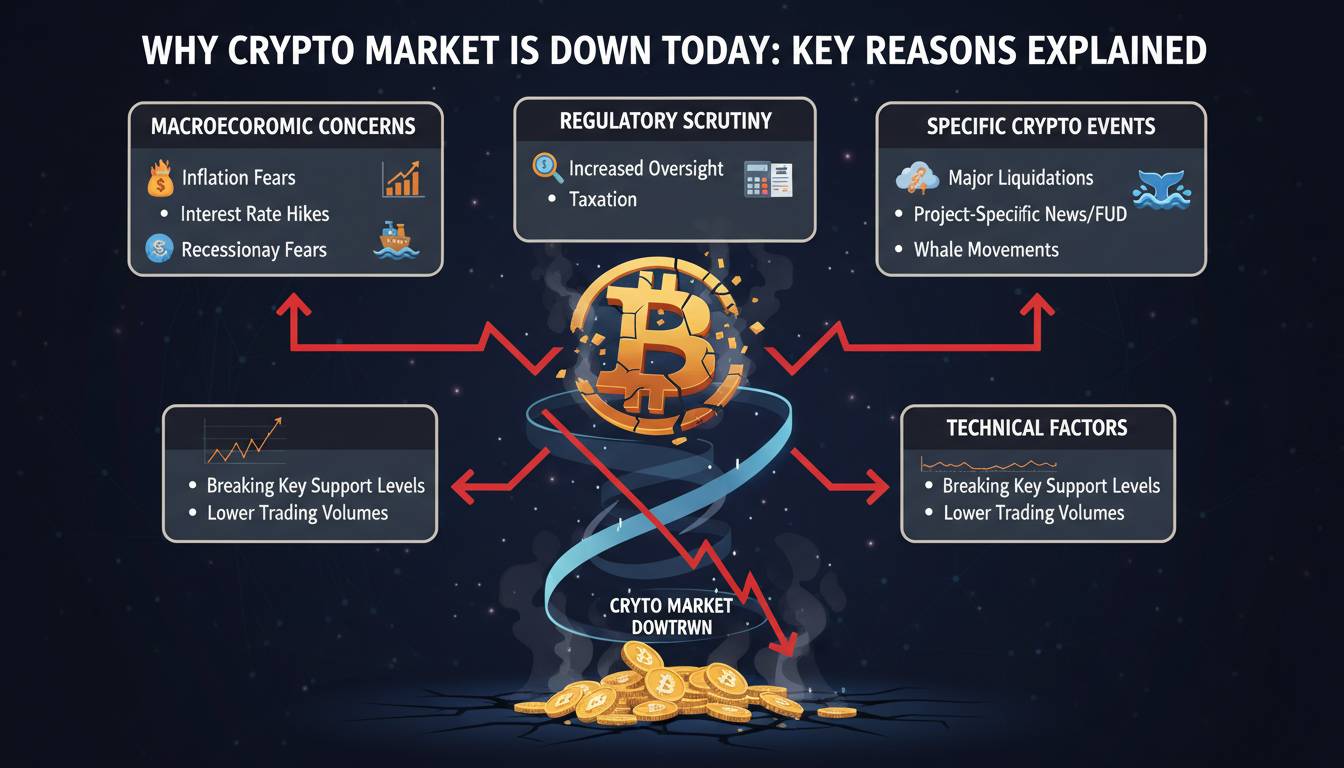
The cryptocurrency market experiences frequent volatility, with prices fluctuating based on a complex interplay of macroeconomic conditions, regulatory developments, market sentiment, and technical factors. Understanding why the crypto market declines on any given day requires examining multiple interconnected variables that drive investor behavior and asset valuations across digital markets.
Key Insights
- Cryptocurrency prices are heavily influenced by macroeconomic conditions, particularly Federal Reserve policy and interest rate decisions
- Regulatory announcements from major economies can trigger significant market sell-offs within hours
- Market sentiment indicators often signal downturns before fundamental news breaks
- Technical factors including liquidation cascades and support level breaches accelerate declines
- Institutional capital flows through ETFs and trading platforms significantly impact daily price action
The crypto market’s daily movements reflect a maturation process where digital assets increasingly align with traditional financial markets while maintaining unique volatility characteristics driven by 24/7 trading, leverage accumulation, and retail-dominant participation patterns.
Macroeconomic Factors Driving Crypto Declines
Federal Reserve Policy and Interest Rates
The Federal Reserve’s monetary policy decisions represent one of the most significant drivers of cryptocurrency market movements. When the Fed signals hawkish policy or implements interest rate hikes, risk assets across the board—including cryptocurrencies—typically experience downward pressure.
Higher interest rates make yield-bearing assets like Treasury bonds and savings accounts more attractive relative to non-yielding assets like Bitcoin and Ethereum. The correlation between crypto assets and traditional risk assets strengthens during periods of monetary tightening, meaning crypto markets now respond more directly to Fed policy than in previous market cycles.
Inflation data releases, particularly the Consumer Price Index (CPI) and Personal Consumption Expenditures (PCE), directly impact crypto valuations. Higher-than-expected inflation readings often trigger immediate sell-offs as markets price in more aggressive Federal Reserve responses. Conversely, cooling inflation data can spark rallies as investors anticipate potential rate cuts.
Dollar Strength and Global Currency Movements
The U.S. Dollar Index (DXY) maintains an inverse relationship with cryptocurrency prices. When the dollar strengthens against major currencies, Bitcoin and altcoins typically decline as global investors shift away from risk-on assets toward dollar-denominated holdings.
This dynamic became particularly pronounced during 2022 and portions of 2023 when aggressive Fed rate hikes propelled the dollar to multi-decade highs, weighing heavily on crypto valuations. Emerging market currencies experiencing instability also impact crypto markets as investors in those regions reduce exposure to digital assets during periods of local currency stress.
Regulatory Concerns and Market Impact
Enforcement Actions and Policy Announcements
Regulatory announcements consistently trigger sharp crypto market declines. When the Securities and Exchange Commission (SEC) or Commodity Futures Trading Commission (CFTC) announces enforcement actions or signals increased scrutiny, markets often react negatively within minutes.
The SEC’s repeated rejection of Bitcoin ETF applications throughout 2022 created significant selling pressure, as institutional investors remained unable to access crypto through regulated vehicles. Conversely, the January 2024 approval of Bitcoin ETFs triggered one of the most significant bull runs in crypto history, demonstrating the direct correlation between regulatory clarity and market performance.
Global regulatory developments also impact prices significantly. China’s continued crackdown on cryptocurrency mining and trading activities in 2021 removed substantial hash rate from the network while forcing major exchanges to cease operations, contributing to the market downturn that year. European Union markets awaiting the Markets in Crypto-Assets (MiCA) regulation experienced similar uncertainty-driven selling during the deliberation period.
Banking Sector Concerns
The connection between traditional banking and cryptocurrency companies became dramatically apparent in March 2023 when Silicon Valley Bank (SVB), Silvergate Bank, and Signature Bank collapsed. These institutions had significant exposure to cryptocurrency companies, and their failures triggered immediate market panic.
Crypto-native banks had served as crucial bridges between traditional finance and digital assets, providing banking services to exchanges, mining operations, and venture capital firms. The closure of Silvergate’s SEN network and the collapse of other crypto-friendly institutions created concerns about continued access to banking services, prompting selling across all major cryptocurrencies.
Market Sentiment and Psychology
Fear and Greed Index Movements
Cryptocurrency market sentiment oscillates between extreme fear and extreme greed, often moving rapidly in response to news events. The Crypto Fear & Greed Index, which measures market sentiment using volatility, momentum, social media, and survey data, frequently signals tops before major corrections and bottoms before recoveries.
When the index approaches “Extreme Fear” levels, it often indicates capitulation selling has occurred and potential buying opportunities emerge. Conversely, “Extreme Greed” readings typically precede pullbacks as markets become overextended. Day-to-day movements in sentiment indicators can explain significant portions of daily price action, particularly during periods of low trading volume.
Social Media Influence and Sentiment Analysis
Twitter/X sentiment, Reddit discussion trends, and Google search volume for cryptocurrency-related terms correlate strongly with intraday price movements. Viral posts from influential accounts—whether accurate or not—can trigger cascading buy or sell orders as the market reacts in real-time to narrative shifts.
During major market events, coordinated social media campaigns can amplify moves significantly. Pump-and-dump schemes continue to target smaller altcoins, creating artificial volatility that spills over into broader market sentiment. The gamified nature of retail crypto trading, heavily concentrated on platforms like Reddit’s r/cryptocurrency and Twitter, creates feedback loops that accelerate both gains and losses.
Technical Market Factors
Liquidation Cascades and Leverage Cycles
The pervasive use of leverage in cryptocurrency trading amplifies both gains and losses dramatically. When prices move against leveraged positions, automated liquidation systems trigger forced selling that can create cascading declines far exceeding the original catalyst.
During major corrections, liquidations frequently exceed billions of dollars within single 24-hour periods. The liquidation of long positions at support levels creates additional selling pressure that breaks through technical support, triggering further liquidations in a self-reinforcing cycle. This dynamic explains why crypto crashes often occur faster than traditional equity market declines.
Perpetual futures contracts, which dominate crypto trading volume, allow traders to maintain leveraged positions indefinitely with funding rate payments. When funding rates become excessively negative—as they did during previous bear markets—it signals crowded long positions vulnerable to rapid unwinding.
Support and Resistance Breaches
Technical analysis plays a more prominent role in crypto markets than traditional financial markets due to the 24/7 nature of trading and the younger demographic of participants. When key moving averages, Fibonacci retracement levels, or round-number price points break, automated selling algos and technical traders enter positions that accelerate moves.
The 200-week moving average for Bitcoin has historically served as a critical support level during bear markets. Breaches below this level, as occurred in 2022, trigger significant capitulation as investors with longer time horizons reassess positions. Similarly, the $20,000, $30,000, and $40,000 price levels for Bitcoin have historically acted as strong resistance or support, with breaches creating momentum-driven moves.
Institutional Flows and ETF Dynamics
Exchange-Traded Fund Impact
The introduction of spot Bitcoin ETFs in January 2024 fundamentally changed how institutional capital enters cryptocurrency markets. These products provide regulated exposure to Bitcoin without requiring direct custody or blockchain interaction, opening crypto markets to traditional investment platforms and retirement accounts.
Net inflows into Bitcoin ETFs directly correlate with price appreciation, as newly created ETF shares require corresponding Bitcoin purchases by authorized participants. Conversely, outflows from these products create selling pressure that impacts spot prices. The concentration of ETF trading among a few major providers means that their allocation decisions can move markets significantly.
On-Chain Metrics and Whale Behavior
Blockchain data provides transparency into large-holder behavior that impacts prices significantly. When “whale” wallets—addresses holding significant Bitcoin—move coins to exchanges, it typically signals intent to sell, creating preemptive selling pressure from smaller traders monitoring on-chain data.
Exchange reserves, which measure the amount of cryptocurrency held on trading platforms, indicate potential selling pressure. Rising exchange reserves often precede price declines as investors prepare to sell, while declining reserves suggest accumulation and potential price support.
Network hash rate, while not directly impacting prices, reflects mining sector health. During prolonged bear markets, hash rate declines as unprofitable miners exit the network, potentially creating supply-side concerns for the subsequent recovery.
Global Economic Conditions
Equity Market Correlation
Cryptocurrency correlations with traditional equity markets increased significantly since 2020, particularly during periods of market stress. When the S&P 500 experiences significant declines, cryptocurrency markets typically follow, as institutional investors manage portfolio risk across asset classes.
This correlation complicates crypto’s role as a portfolio diversifier but also explains price movements during macro-driven sell-offs. The COVID-19 crash in March 2020, the rate-hike driven sell-off in 2022, and various debt ceiling concerns all showed crypto declining alongside equities, suggesting that “safe haven” narratives remain subordinated to macro risk management.
Geopolitical Events and Flight to Safety
Geopolitical instability, including armed conflicts, trade wars, and political crises, impacts cryptocurrency prices through multiple channels. Initial reactions often see “flight to safety” flows into dollar-denominated assets and, historically, Bitcoin—though this safe haven narrative has been tested during recent conflicts.
Prolonged geopolitical crises typically weigh on risk assets including cryptocurrencies, as investors assess secondary economic impacts including energy prices, supply chain disruptions, and inflationary pressures. The sanctions environment following major geopolitical events also impacts cryptocurrency trading as regulators increase scrutiny of cross-border transactions.
Frequently Asked Questions
Why does crypto drop so much faster than stocks?
Cryptocurrency markets drop faster than traditional stocks due to several structural factors: 24/7 trading without market pauses, higher retail participation and subsequent emotional trading, pervasive leverage that amplifies moves through liquidation cascades, and fewer circuit breakers or trading halts that might slow declines in traditional markets.
How do interest rate hikes affect cryptocurrency prices?
Interest rate hikes affect crypto markets by making yield-bearing assets more attractive relative to non-yielding cryptocurrencies, strengthening the U.S. dollar which inversely correlates with crypto prices, and signaling reduced risk appetite among institutional investors who allocate to crypto as a growth asset.
Can regulatory news cause immediate crypto crashes?
Yes, regulatory announcements can trigger immediate and severe crypto crashes. The SEC’s enforcement actions, ETF rejection decisions, and statements about cryptocurrency classification have historically caused multi-billion dollar market capitalization declines within hours of announcement. This reaction stems from uncertainty about future market access and potential compliance costs.
Is the crypto market currently correlated with the stock market?
Cryptocurrency markets maintain elevated correlation with equity markets, particularly the technology-heavy Nasdaq and growth stocks. This correlation increases during periods of market stress and decreases during crypto-specific events. Recent ETF approvals have somewhat diversified the investor base, but macro factors continue driving significant correlation.
What indicators suggest a crypto market bottom?
Indicators suggesting crypto market bottoms include extreme fear readings on sentiment indices, declining exchange reserves indicating accumulation, reduced social media discussion suggesting reduced speculative trading, and capitulation events where long-term holders sell at significant losses. No single indicator guarantees bottoms, but combinations historically signal opportunity.
How long do crypto bear markets typically last?
Historical crypto bear markets have lasted between 12 and 18 months from peak to trough, though this varies based on the triggering event and broader economic conditions. The 2014 Mt. Gox aftermath lasted approximately 13 months, the 2018 bear market lasted approximately 12 months, and the 2022 cycle lasted approximately 12 months from peak to initial recovery signals.
Conclusion
The cryptocurrency market’s daily movements reflect a sophisticated interplay of macroeconomic forces, regulatory developments, technical trading factors, and evolving market psychology. Understanding why crypto markets decline on any given day requires examining multiple variables simultaneously rather than attributing movements to single causes.
As the cryptocurrency market matures, its integration with traditional financial systems deepens, meaning that Federal Reserve policy, equity market performance, and regulatory developments from major economies increasingly explain price movements. However, unique crypto-specific factors including leverage cycles, on-chain dynamics, and sentiment-driven retail trading continue creating volatility patterns distinct from traditional asset classes.
For investors navigating crypto markets, maintaining awareness of both macro conditions and crypto-specific indicators provides the most comprehensive view of potential risks and opportunities. The market’s 24/7 nature and rapid response to news require vigilance that differs significantly from traditional market participation, while the fundamental drivers—adoption, regulation, and technological development—continue evolving at an accelerating pace.













Leave a comment