

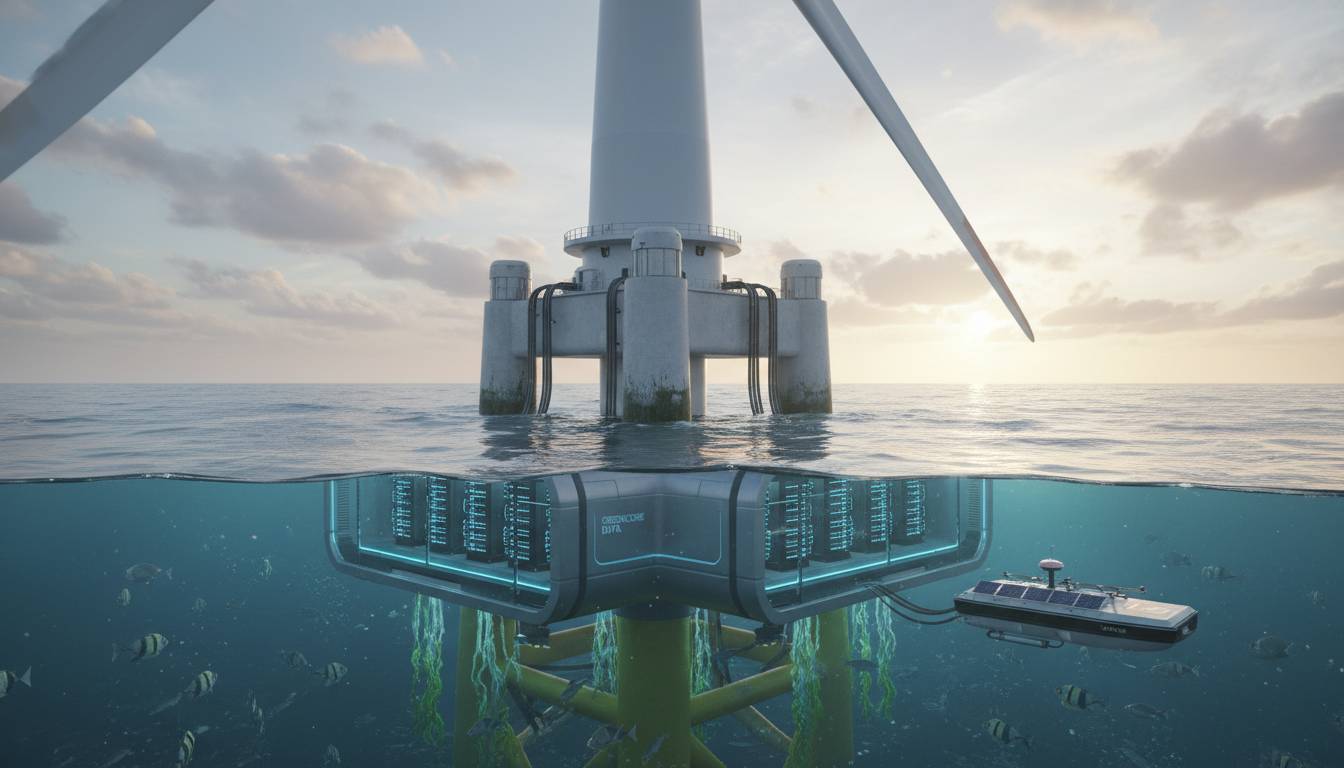
There’s a startup working on something that sounds like science fiction: putting data centers on the seafloor next to offshore wind turbines. The idea is simple—wind farms already have transmission infrastructure, they sit in the ocean where land is expensive, and turbines generate electricity that would otherwise travel miles to reach anything on shore. Why not put the data centers right there?
This approach tackles two problems at once. Data centers consume enormous amounts of electricity and take up huge amounts of land. Offshore wind farms have plenty of space and already need to connect to the grid. Matching them together isn’t just clever engineering—it’s a practical attempt to solve real constraints in how we build digital infrastructure.
The Technology Behind Underwater Data Centers
The technical setup involves modular units installed on the seafloor within wind farm boundaries. These modules house standard server hardware with sealing systems that keep salt water out while allowing heat to dissipate into the ocean. Power comes directly from nearby turbines, which avoids transmission losses that typically occur when electricity travels long distances from generation to consumption.
The cooling advantage is significant. Seawater provides natural thermal regulation, which can reduce cooling energy consumption by up to 40 percent compared to traditional air-conditioned facilities. That directly improves power usage effectiveness—a key metric for how efficiently a data center uses electricity.
These modular installations can scale incrementally as demand grows, avoiding the massive upfront capital that conventional data center projects require.
This builds on earlier submarine data center experiments by major tech companies but advances the concept by specifically targeting co-location with offshore wind farms. The result is a circular system: turbines generate clean electricity that powers computing, and server heat simply dissipates into the surrounding ocean.
Environmental Impact and Sustainability Benefits
The environmental benefits extend beyond energy efficiency. Traditional data centers can consume hundreds of acres and often require grid upgrades that take years and billions of dollars to complete. Offshore wind farms already have transmission infrastructure in place, so the marginal footprint of adding data center modules is essentially zero.
The carbon reduction potential is substantial. Combining renewable energy consumption with optimized cooling creates an operational profile that approaches carbon neutrality—a goal most conventional facilities don’t reach, even with renewable energy certificate purchases. This direct integration is more authentic than buying offsets to balance out grid electricity use.
There’s also the water savings. Traditional cooling towers can consume millions of gallons of water daily. The ocean provides an essentially unlimited heat sink without freshwater consumption. For coastal regions facing water scarcity, this matters.
Market Potential and Industry Adoption
The market opportunity is driven by projected growth in data center demand from cloud computing, AI, and connected devices. Global data center energy consumption could double by 2030, making sustainable solutions necessary for companies facing regulatory and stakeholder pressure on environmental performance.
Major tech companies have expressed growing interest in direct renewable energy partnerships as they pursue carbon neutrality commitments. Procuring electricity from co-located installations offers more certainty about actual power sources than traditional renewable energy purchasing arrangements.
The startup has secured early-stage funding and begun initial deployment planning with wind farm developers. Commercial-scale operations remain years away. The technical challenges of maintaining servers in marine environments are significant but appear manageable based on recent demonstration projects.
The main barriers now are regulatory frameworks that haven’t adapted to combined offshore infrastructure, and the substantial capital requirements for developing both wind generation and data center capacity simultaneously.
Challenges and Future Development
Significant obstacles remain before underwater data centers achieve widespread commercial deployment. The marine environment creates ongoing challenges—salt water and ocean currents require specialized engineering and potentially more frequent maintenance than land-based facilities. Ensuring consistent server performance over time requires careful design and quality manufacturing, which adds to costs.
Regulatory coordination is another hurdle. Offshore wind development and data center infrastructure typically fall under different regulatory frameworks and permitting processes. Navigating approvals involving maritime agencies, energy regulators, and environmental authorities—often without clear precedent for combined projects—will be essential.
The future depends on outcomes of early demonstration projects and whether major cloud providers commit to long-term offtake agreements. Successful initial deployments could catalyze rapid expansion, with multiple projects potentially entering development within the next five years if technical viability and economic performance meet expectations.
Conclusion
Putting data centers beneath offshore wind turbines is a genuine attempt to solve two problems at once: the massive energy consumption of digital infrastructure and the need to expand renewable capacity without using more land. By leveraging ocean environments and existing wind farm infrastructure, this approach offers a pathway to reducing the carbon intensity of data centers while avoiding land use conflicts that constrain traditional development.
Commercial deployment is still on the horizon. But the concept has generated enough interest from investors, developers, and potential customers to warrant serious consideration. The coming years will determine whether this scales from interesting idea to mainstream solution—but the basic logic of co-locating power generation and computation offshore appears sound.
Frequently Asked Questions
What startup places data centers under offshore wind turbines?
Several companies are developing this technology. The concept involves modular data center units on the seafloor within offshore wind farm boundaries, connected directly to turbine power generation.
How do underwater data centers stay cool?
They use seawater to dissipate heat. This eliminates traditional air conditioning, potentially reducing cooling energy by 30-40 percent compared to land-based facilities.
Why are data centers being placed near wind turbines?
Direct access to renewable energy without transmission losses, utilization of existing offshore infrastructure, conservation of land resources, and avoidance of lengthy grid connection permitting.
Are underwater data centers environmentally friendly?
They’re among the most environmentally friendly approaches under development. Benefits include renewable energy use, no freshwater consumption for cooling, minimal land footprint, and superior power usage effectiveness.
What are the main challenges facing this technology?
Equipment reliability in marine environments, regulatory frameworks that don’t accommodate combined offshore infrastructure, high initial capital costs, and the need for demonstrated long-term operational reliability.
When will these data centers become commercially available?
Commercial-scale deployments are likely several years away. Early commercial projects could begin operations within three to five years if demonstrations prove successful and regulations evolve to support this approach.
















Leave a comment