

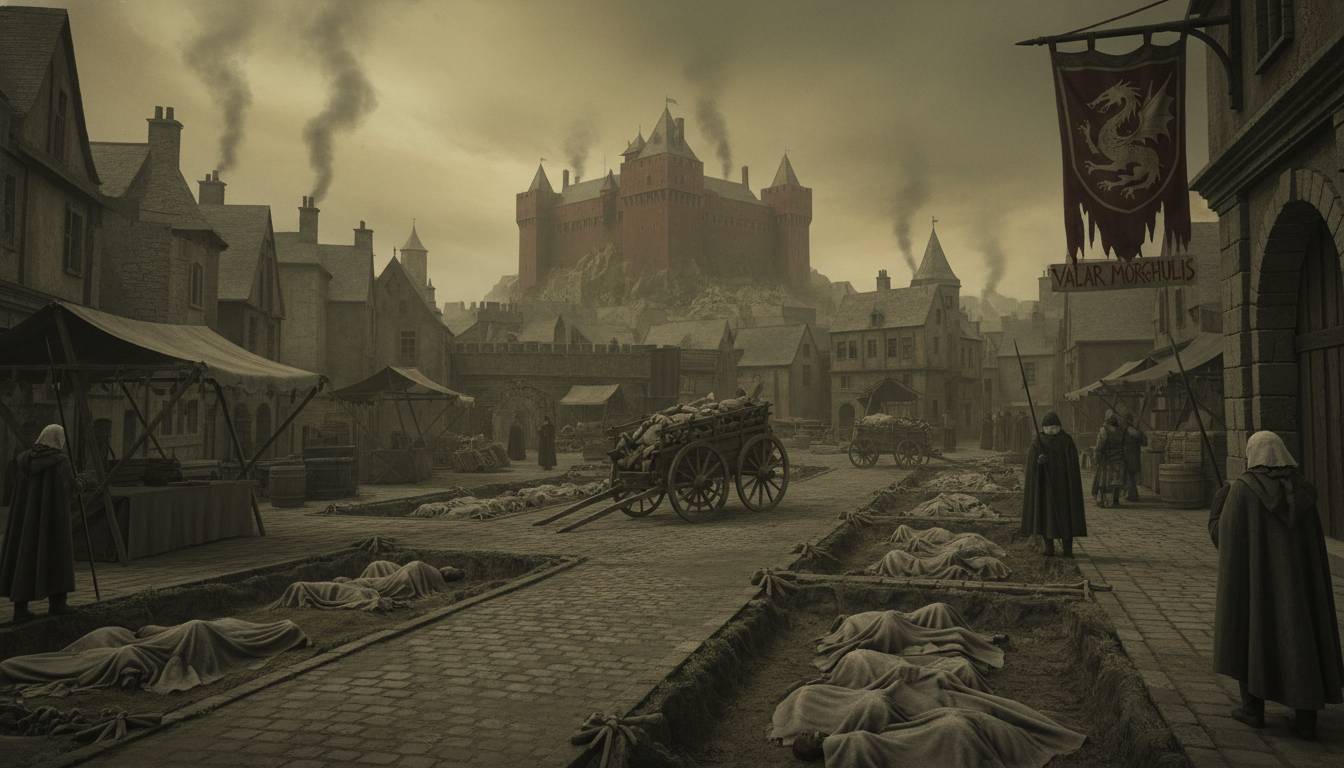
Here’s what happened. Around 132 years after Aegon Targaryen conquered Westeros, a deadly disease swept across the continent during the reign of King Aegon III—also called “the Dragonbane,” which should tell you something about his luck. The timing was brutal. The realm was still recovering from the Dance of the Dragons, that brutal civil war between Aegon’s mother Rhaenyra and his uncle Aegon II. The Targaryens were bleeding out, and then this plague hit.
Contemporary accounts describe high fever, dark blotches on the skin, and people basically drowning in their own lungs. It moved fast—springtime, when everyone was out and about, trading and traveling. By summer, roughly one-third of Westeros was dead. That’s the Black Death numbers. Nobody was safe. Lords in their castles, peasants in their hovels, everyone got it.
Queen Jaehaera Targaryen died. She was young—maybe twelve, maybe fourteen, history isn’t clear—and she was the last living descendant of Rhaenyra’s line. Her death left Aegon III without an heir and without a queen, just a bunch of traumatized courtiers and a kingdom full of corpses. The Small Council lost members too. Governance basically collapsed while people were too busy dying or burying the dead to run the realm.
This is where things get interesting for Targaryen history. With fewer relatives running around, the succession problem got worse instead of better. You’d think fewer claimants means less fighting, but it meant the family was riding a single thread. Every death mattered more. Every marriage became desperate.
The great houses noticed. They’d lost people too, but the ones who survived suddenly had more room to maneuver. Regional lords started flexing muscles they hadn’t needed to flex when the crown was strong and the Targaryens had dragons. This is part of why the Blackfyre Rebellions happened later—everything got more unstable, more volatile.
George R.R. Martin has said he draws from real history, and the Black Death is obviously the model here. That 14th-century pandemic killed somewhere between 30 and 60 percent of Europe. Same scale, same social chaos, same “what do we do now” aftermath. Survivors demanded better wages. Religious people questioned everything. The old order cracked open, and new stuff grew in the gaps.
The TV show never showed any of this. The books mention it in passing when characters talk Targaryen history, but it’s not a major storyline. Probably the right call—visualizing a plague is hard, and Game of Thrones already had plenty of death. But understanding this sickness helps explain why Aegon III’s reign was so grim and why the Targaryens spent the next century barely holding on.
The plague left marks that lasted generations. The crown had to rely more on local lords because there weren’t enough people to govern directly anymore. That decentralization set up a lot of conflicts we’d see later. And the cultural memory of it—songs, stories, collective trauma—shaped how Westerosi thought about catastrophe for a hundred years.
So yeah, the Great Spring Sickness matters. It’s not as famous as the Red Wedding or the Battle of the Trident, but it killed way more people and arguably caused more long-term damage to the world of Game of Thrones.














Leave a comment