

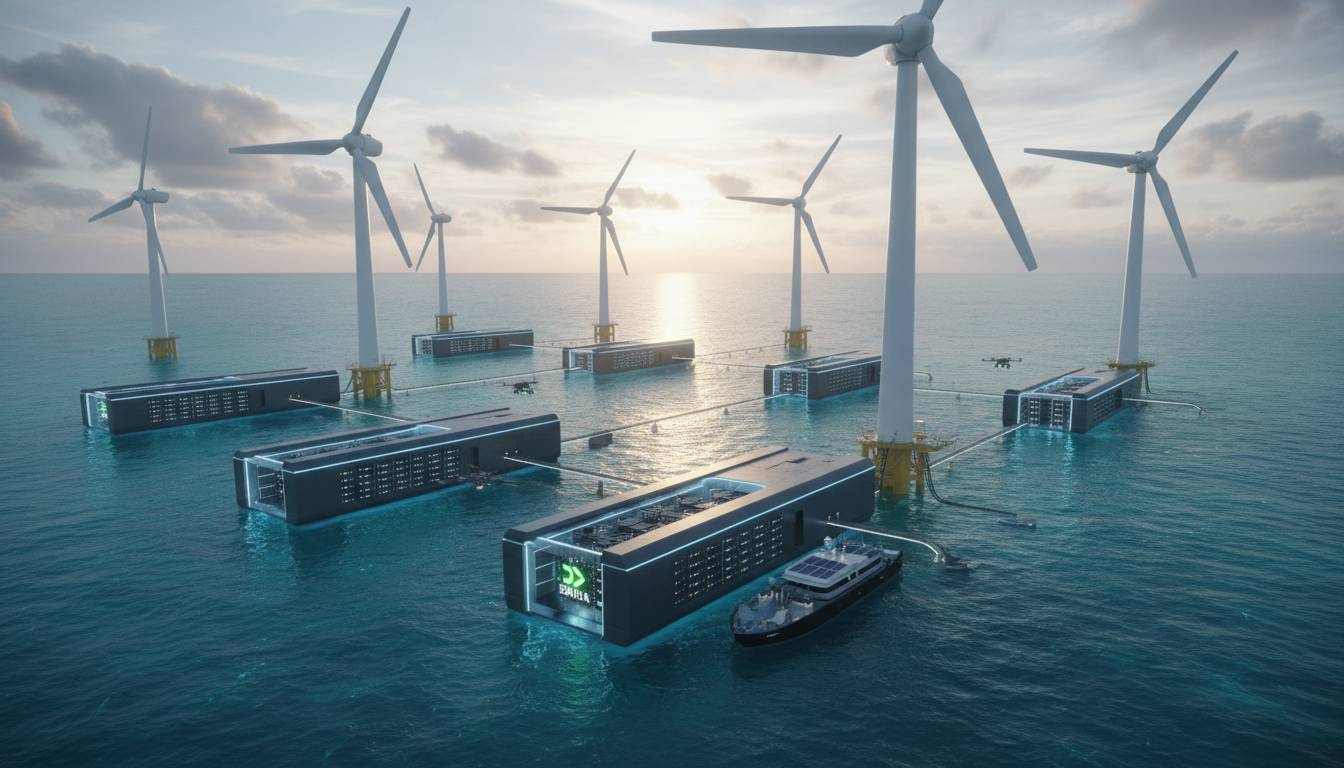
A startup wants to put data centers underwater, directly beneath offshore wind turbines. The idea is straightforward: use the cold ocean for cooling and tap the wind farm’s power directly, avoiding the costs of building transmission lines to shore. It’s an attempt to tackle two problems at once—data centers guzzling electricity and the broader push to build more renewable energy capacity.
The timing matters because data centers now eat up about 1-2% of global electricity, and that share is climbing as AI and cloud services expand. Pairing underwater computing with offshore wind isn’t just clever engineering; it’s also a way to make both industries look better to investors and regulators who are increasingly worried about energy consumption.
The Proposal: Combining Two Offshore Industries
The plan involves dropping modular data center units onto the seabed underneath offshore wind installations. These underwater facilities would use cold ocean water for cooling, cutting the massive energy bills that come with running traditional land-based data centers. Being right next to the turbines means a direct hookup to renewable power, so no transmission losses or expensive grid connections back to shore.
The technical setup calls for sealed, pressure-resistant containers holding standard computing gear adapted for underwater use. These modules would connect to the wind farm’s grid through specialized underwater cables built for both high-capacity data and power. Microsoft tested something similar with Project Natick, proving underwater data centers can actually work.
Offshore wind is expanding fast along the U.S. coast. The Bureau of Ocean Energy Management has identified large areas suitable for wind development, with projects totaling dozens of gigawatts in various planning stages. This growth creates a natural opening for co-location strategies that get more value out of each offshore installation.
Technical Feasibility and Engineering Considerations
The engineering challenges are real but not impossible. Water cools efficiently—ocean temperatures at the right depths stay consistent year-round, which beats land-based facilities that deal with seasonal swings and increasingly extreme weather.
The underwater modules need to withstand pressure, resist saltwater corrosion, and stay sealed. They also need to accommodate maintenance, though the sealed environment might mean less frequent human intervention. Remote monitoring and automation would handle daily operations, with dive teams or remotely operated vehicles handling physical inspections.
Connectivity is another hurdle. Underwater data centers need high-capacity fiber optic lines to onshore networks, adding routing and protection complexity. But offshore wind farms already run cables to shore, so shared infrastructure could cut costs.
Environmental groups have questions. Marine ecosystems could be disturbed during installation and by structures in the water column. Proponents argue that well-designed installations could create artificial reef environments that boost local marine life, but that needs real validation through impact studies.
The Data Center Energy Challenge
Traditional data center development is hitting walls. Land-based facilities need lots of real estate, massive cooling systems, and power delivery that strains local grids. Some regions are already maxed out—there’s simply no room for new facilities because the grid can’t handle more load.
Offshore wind farms cover huge marine areas but must transmit electricity to population centers through expensive grid infrastructure. Using that power on-site for data centers could improve wind project economics by guaranteeing a customer for some of the electricity generated. This arrangement might lower the cost of electricity for both the wind farm and the data center.
The environmental wins go beyond efficient power use. Underwater data centers don’t need cooling towers or other systems that guzzle freshwater. The smaller land footprint preserves natural habitats that would otherwise be cleared for traditional data center campuses. Major tech companies have made sustainability commitments, so this fits.
Offshore wind costs have dropped about 70% over the past decade, making it competitive with fossil fuels. Combined with expanding renewable energy mandates, offshore wind will likely power much of the electricity demand growth in coastal regions.
Regulatory Pathway and Development Timeline
The proposal faces serious regulatory obstacles. Offshore wind in U.S. waters needs permits from multiple federal and state agencies—BOEM, the Army Corps of Engineers, and various environmental reviews. Adding data center infrastructure adds seabed use permits, underwater cable rules, and more environmental review.
FERC and state utility commissions would need to handle power purchase agreements and grid interconnection rules. How electricity from offshore wind gets divided between direct power sales, retail markets, and behind-the-meter consumption by co-located data centers—these questions aren’t settled in current regulations.
Industry watchers say pilot projects could launch in the next three to five years, with full commercial deployments following after a decade of demonstration and regulatory work. That timeline fits with projected growth in both offshore wind capacity and data center demand.
Competitive Landscape and Industry Response
The concept joins a field of other sustainable data center approaches. Microsoft Project Natick proved underwater deployment works, though the company hasn’t announced commercial plans. Other efforts have explored abandoned mines, arctic locations, and island facilities.
Offshore wind developers are interested—co-location could mean new revenue streams and better project economics. Major energy companies involved in offshore wind have started talking with tech firms about integrated projects. Those talks remain early-stage.
Environmental organizations are cautiously supportive but want rigorous review. The potential freshwater and land savings are clear wins, though marine ecosystem concerns need real scientific evaluation.
Conclusion
Putting data centers under offshore wind turbines is a bold attempt to solve the overlapping challenges of data center energy use and renewable energy development. Combining two resource-heavy industries in one offshore location offers real benefits: better energy efficiency, less freshwater use, and smarter use of offshore infrastructure.
The technical and regulatory hurdles are substantial, though. But the alignment of industry interests, environmental pressure, and policy support for both offshore wind and sustainable tech creates fertile ground for new approaches. As the concept develops, stakeholders across tech, energy, and environmental sectors will be watching to see if this integration actually delivers.
Frequently Asked Questions
What is an underwater data center?
An underwater data center is a computing facility housed in sealed, pressure-resistant modules on the ocean floor. These facilities use natural cold water for cooling, which cuts energy use compared to land-based data centers. Microsoft’s Project Natick first demonstrated this was possible through experimental deployments.
How would data centers benefit from co-location with offshore wind turbines?
Several advantages: direct access to renewable power without transmission losses, free cooling from ocean water, and shared infrastructure like cables and permitting. Wind farms also have established offshore expertise and regulatory relationships that could speed up data center deployment.
What are the main challenges facing this proposal?
The main hurdles are engineering requirements for underwater deployment, a maze of federal and state regulations, environmental review processes, and the need for demonstration projects to prove the concept works. The relatively untested nature means investors will need confidence before committing serious money.
Has this been tried before?
Microsoft’s Project Natick tested underwater data center prototypes and showed that sealed computing modules can operate reliably underwater. However, no commercial-scale underwater data centers currently operate beneath offshore wind turbines—this would be the first real application of co-location.
When might we see this implemented?
Industry experts suggest pilot projects in three to five years, with commercial deployments following within a decade. The actual timeline depends on regulatory approval, successful technology demonstrations, and investment commitments from both tech and energy companies.
What are the environmental implications?
Potential benefits include less freshwater consumption, reduced pressure to develop land, and efficient use of renewable energy. Environmental concerns involve impacts on marine ecosystems from seabed disturbance and industrial structures in the water. Any major deployment would require comprehensive environmental impact assessments.















Leave a comment