

Managing your money doesn’t have to be complicated. Whether you’re trying to pay off debt, build an emergency fund, or simply understand where every dollar goes, a solid budgeting method can transform your financial life in just a few months. The key is finding an approach that fits your lifestyle and sticking with it long enough to see results.
In this guide, we’ll explore the most effective and beginner-friendly budgeting methods, break down exactly how to implement each one, and help you choose the approach that works best for your unique situation. You’ll walk away with actionable steps to start saving today—no finance degree required.
Why Budgeting Matters for Financial Health
Before diving into specific methods, it’s worth understanding why budgeting is the foundation of financial wellbeing. Without a clear picture of your income and expenses, making informed decisions about your money becomes nearly impossible.
A budget serves three critical functions. First, it provides visibility. When you track every dollar that enters and leaves your accounts, you eliminate the guesswork that leads to overspending. Second, it enables intentionality. Rather than reacting to whatever bills arrive, you proactively decide how your money will work for you. Third, it creates accountability. Writing down your spending habits reveals patterns you might otherwise miss, allowing you to make adjustments before small problems become large ones.
Research from the National Financial Capability Studies Program indicates that individuals who maintain a budget are significantly more likely to report feeling confident about their financial situation. They also demonstrate higher rates of emergency fund establishment and retirement savings participation. The correlation is clear: budgeting isn’t about restriction—it’s about empowerment.
The good news? You don’t need sophisticated tools or extensive knowledge to start. Several proven methods require nothing more than a pen and paper or a free smartphone app.
The 50/30/20 Rule: Your First Budget Framework
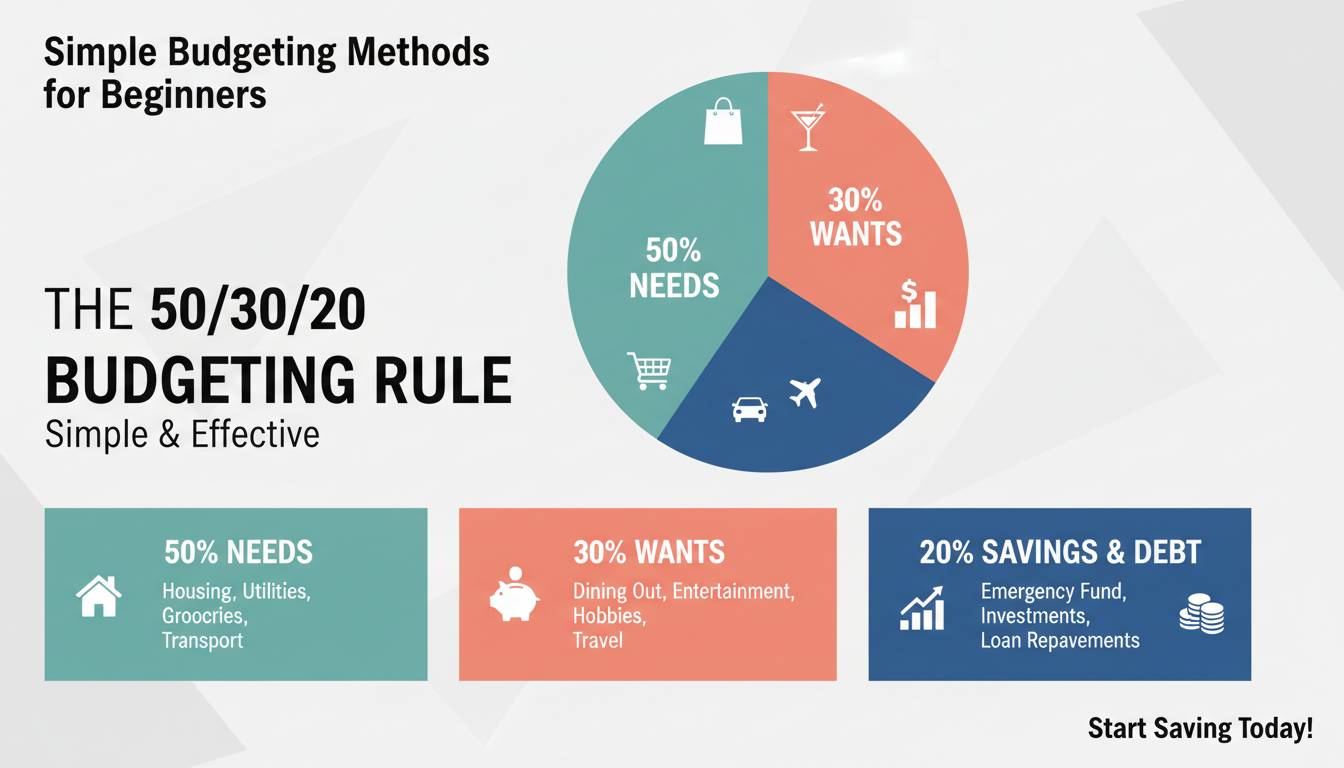
If you’re brand new to budgeting, the 50/30/20 rule offers an excellent starting point. This framework provides simple percentages that guide how you allocate your after-tax income, eliminating the need for detailed expense tracking from day one.
Under this method, you divide your income into three categories. Fifty percent goes toward needs—housing, utilities, groceries, insurance, minimum debt payments, and transportation to work. Thirty percent covers wants—entertainment, dining out, hobbies, subscriptions, and non-essential shopping. The remaining twenty percent funds savings and debt repayment beyond minimums, including emergency fund contributions, retirement account deposits, and extra payments toward high-interest debt.
To implement this, calculate your monthly after-tax income and multiply by each percentage. If you earn $4,000 monthly after taxes, your needs budget equals $2,000, wants equal $1,200, and savings reach $800. From there, subtract your fixed expenses from the needs category first. If housing and utilities consume $1,400 of that $2,000, you have $600 remaining for groceries, gas, insurance, and other necessities.
The 50/30/20 rule works beautifully for beginners because it requires minimal maintenance. You don’t need to track every coffee purchase or subscription renewal. Instead, you simply ensure your spending stays within each category’s boundaries. When wants threaten to exceed 30%, you make conscious choices about what to trim. When needs climb too high, you explore ways to reduce fixed costs through refinancing, switching providers, or finding cheaper alternatives.
One limitation worth noting: this percentage-based approach assumes your income covers all three categories comfortably. If you’re living paycheck to paycheck, needs may consume far more than 50% of your income. In those cases, the framework still provides a goal to work toward, even if immediate implementation requires adjustment.
Zero-Based Budgeting: Every Dollar Has a Job
Zero-based budgeting represents a more hands-on approach where your income minus expenses equals zero. This doesn’t mean spending every penny—it means assigning every single dollar a specific purpose before the month begins.
The process starts with listing all income sources for the month, including salary, side earnings, and any other money you expect to receive. Next, you allocate funds to every category, working through fixed expenses first (rent, car payment, insurance premiums), then moving to variable categories (groceries, gas, utilities), and finally assigning money to savings goals and debt payoff.
The critical difference between zero-based budgeting and other methods is the explicit job assignment. Rather than categories with flexible balances, each dollar has a specific role. The $50 remaining in your entertainment budget isn’t just “extra money”—it’s explicitly designated for weekend activities. When you spend it, you move that dollar to another category or leave it zero. Nothing floats freely.
This method gained widespread attention through Dave Ramsey’s financial teaching, but the concept itself predates his work. The mathematical precision creates several benefits. You cannot accidentally overspend because every dollar already has a destination. Unexpected expenses force you to make intentional trade-offs rather than simply dipping into unspecified funds. And the planning process itself builds financial awareness that improves decision-making over time.
To start, gather your last three months of bank and credit card statements. Identify spending patterns and categorize each expense. Then, using a worksheet or budgeting app, build your month-ahead budget assigning amounts to each category until your income minus allocations equals zero.
The primary challenge is time investment. Zero-based budgeting typically requires 30-60 minutes weekly to plan and adjust. For some, this maintenance feels empowering. For others, it becomes burdensome. If you find the process exhausting after a few months, the 50/30/20 rule or other methods might suit your personality better.
The Envelope System: Physical Budgeting at Its Finest
For those who struggle with digital tracking or feel disconnected from their spending, the envelope system offers a tactile solution. This method assigns cash to different spending categories, physically dividing money into labeled envelopes.
Start by establishing your budget categories—groceries, gas, entertainment, dining out, personal care, and any other variable expense. Each pay period, withdraw the allocated cash for each category and place it in corresponding envelopes. Throughout the month, you spend only from the envelope designated for that purpose. When an envelope empties, spending stops in that category until the next period.
The envelope system’s power lies in its immediacy. Digital numbers feel abstract. Holding physical cash creates visceral awareness of spending that motivates restraint. Studies in behavioral economics consistently show that people spend less when using cash versus cards. The pain of handing over tangible money exceeds the frictionless swipe of a credit card.
Modern implementations often hybridize this approach. You might maintain physical envelopes for groceries and gas while using budgeting apps for fixed expenses. Some banks even offer sub-account features that simulate envelope functionality within your existing checking account. Regardless of implementation, the core principle remains: visible, limited pools of money for each spending category.
To implement successfully, start with two or three categories where you historically overspend. Master those envelopes before expanding to additional areas. Keep envelopes in a secure but accessible location. And establish a clear refill schedule—weekly, bi-weekly, or monthly—to maintain momentum.
Pay Yourself First: Automating Your Savings
The pay yourself first method flips traditional budgeting on its head. Rather than budgeting what’s left after spending, you spend what’s left after saving. This approach prioritizes future you over current wants, leveraging automation to make saving inevitable.
Implementation begins with determining how much you want to save. Financial experts commonly recommend 15-20% of income, but any amount works when starting. Set up automatic transfers to savings accounts, retirement funds, or investment platforms immediately after receiving your paycheck. Only after these transfers occur do you pay bills and cover expenses with remaining money.
The psychological benefit proves as valuable as the financial one. When saving happens automatically, you eliminate the willpower struggle that derails many budgets. There’s no decision to make each month because the transaction occurs without conscious effort. You learn to live on less without feeling deprived.
This method pairs excellently with the 50/30/20 rule or zero-based budgeting. Use one of those frameworks to determine your savings target, then automate the transfer. The combination provides structure while capturing automation’s ease.
The primary consideration is ensuring your automated savings target is realistic. If you commit to 20% savings but your expenses require 90% of income, the automatic transfer will cause bounced payments and financial stress. Start with a smaller percentage—perhaps 5-10%—and increase gradually as expenses decrease or income increases.
Digital Tools: Apps That Simplify Budgeting
Technology has transformed budgeting from spreadsheet drudgery to streamlined digital management. Numerous apps now automate expense categorization, track spending in real-time, and provide insights that manual methods cannot match.
Popular options include Mint, which connects to your bank accounts and automatically categorizes transactions with no cost to users. YNAB (You Need A Budget) employs zero-based budgeting principles with educational resources and user-friendly interfaces, though it requires a subscription. Personal Capital offers robust tracking combined with investment oversight, making it particularly valuable for those building wealth alongside budgeting.
When selecting an app, consider several factors. First, security matters—ensure the app uses bank-level encryption and two-factor authentication. Second, compatibility with your financial institutions matters—confirm the app connects to your specific banks and credit card companies. Third, cost matters—free options exist, but premium features often justify subscription prices for serious budgeters.
Most apps offer free trials. Experiment with two or three before committing. The best app is one you’ll actually use consistently, so prioritize simplicity and user experience alongside features.
Common Budgeting Mistakes to Avoid
Even with excellent methods available, beginners frequently encounter pitfalls that undermine their efforts. Awareness of these mistakes helps you sidestep frustration and maintain momentum.
The first error involves overcomplication. New budgeters sometimes create elaborate category systems with dozens of line items. This complexity becomes unsustainable within weeks. Start simple. Master basic tracking before adding nuance.
第二个 mistake 是未能调整。预算不是设定后遗忘的静态文档。生活方式变化、收入波动和新出现的情况需要持续调整。如果某类别持续超支,请调查原因并相应修改。
第三个错误是过于严格。预算应该是授权工具,而不是限制的来源。如果给自己太小,您将经历“作弊”并完全放弃。允许灵活性和偶然的乐趣。
最后,许多人预算为“完美”月份,但现实生活并不完美。紧急情况,意外费用和不可预见的成本是正常的。建立应急基金 – 甚至是小型的 – 缓冲这些干扰。
常见问题
初学者应该使用哪种预算方法?
这取决于您的个性和财务状况。 50/30/20 法则非常适合刚起步且不想追踪每一美元的人。 零基预算为您提供最大的控制权,但需要更多时间。 如果您喜欢动手操作,信封系统效果很好,而自动化的“首先为自己付费”方法非常适合那些难以存钱的人。
我应该多久检查一次预算?
每周至少一次简短检查 – 大约15-20分钟即可。 这使您可以发现超支趋势并在为时已晚之前进行调整。 许多预算人员还会在每个月初进行一次更彻底的审查,以计划该月。
如果我的收入不稳定该怎么办?
对于不稳定的收入,请使用“最低收入”预算。 仅根据您保证的金额进行计划 – 侧翼收入可以分配给储蓄或债务偿还,而不是常规支出。 建立更强大的应急基金以弥补较弱的月份。
我应该从预算中节省多少?
财务专家通常建议节省15-20%的收入。 但是,如果您是初学者,请从任何可管理的金额开始 – 即使是5%。 随时间增加。 自动化储蓄,使其成为不可避免的。
我需要预算应用程序吗?
不,但它们有帮助。 预算应用程序可以自动化乏味的任务,例如费用分类和支出跟踪。 许多初学者发现它们使预算更易于访问。 但是,您可以使用纸和笔或简单的电子表格成功。
如果我超支该怎么办?
深呼吸。 一次超支不会破坏您的预算。 调整下个月 – 从其他类别转移资金或减少支出以弥补差异。 避免完全放弃。 预算是一种技能,需要时间来发展。
结论
预算不必复杂或令人畏惧。 正确的系统可以将您 finanally混乱的混乱变成清晰,有意的计划。 无论您选择50/30/20规则,零基预算,信封系统,首先为自己付款,还是这些的组合,最重要的是开始。
从今天开始。 写下您的收入,列出您的费用,并选择一个会吸引您的系统。 从小处着手,如果需要,请进行调整。 您建立得越多,您的财务未来就越安全。 立即开始 – 您的储备会谢谢您。













Leave a comment