

We all know the struggle—you’re racing against the clock, juggling footnotes, titles, in‑text citations, and the dreaded Works Cited page. Yet, MLA format has become the default for many humanities disciplines—and honestly, once you get the hang of it, it’s kinda like biking. Maybe you’ll wobble at first, but then you cruise. This quick reference guide is here to make that ride smoother—highlighting essential formatting rules, citation examples, and just enough conversational imperfection to feel like a friendly tutor rather than a stiff manual.
Core Formatting Foundations
Ease into MLA formatting by first aligning your document to these basics—you might trip up if you forget something obvious!
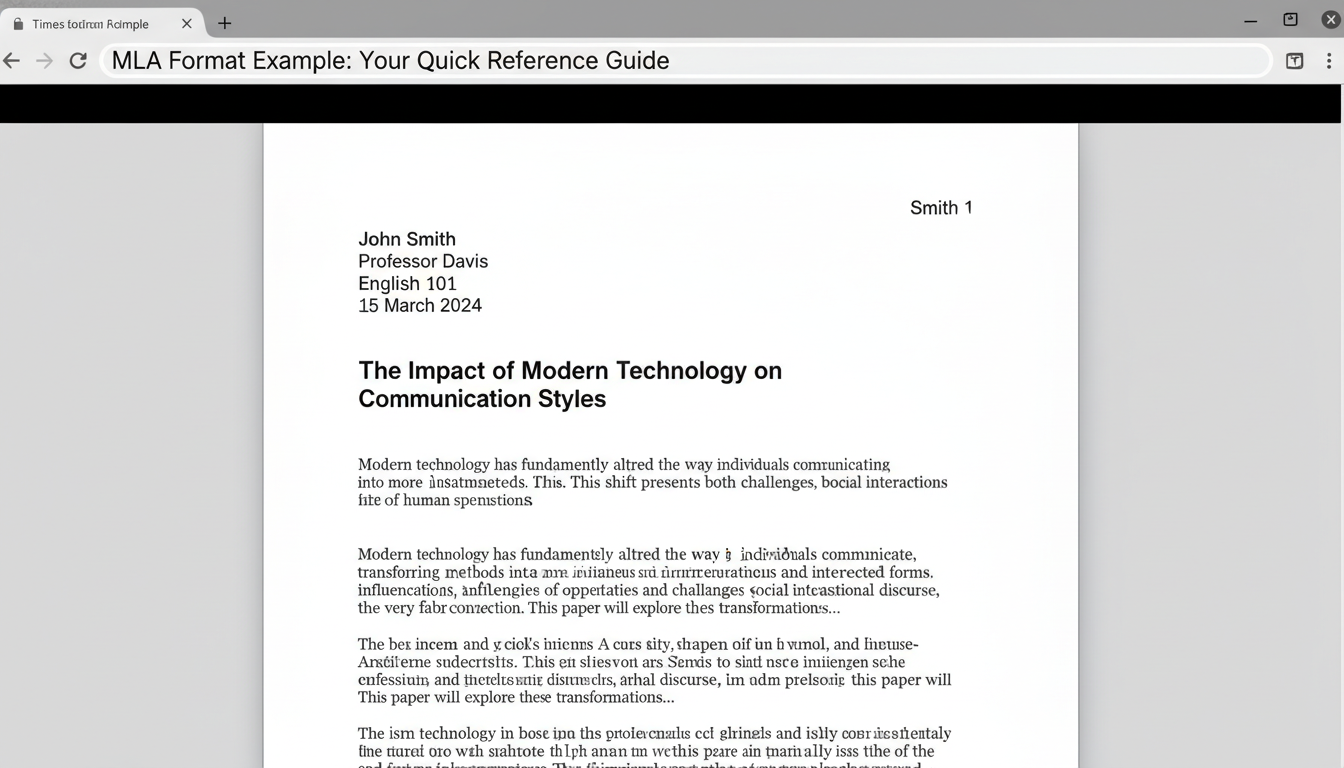
Document Setup Essentials
- Use an easily readable font, like 12‑point Times New Roman (Arial or Georgia are usually acceptable too) .
- Set 1‑inch margins on all sides and double-space your entire paper .
- Indent the first line of each new paragraph by half an inch .
- On the first page, include a four‑line MLA heading (your name, instructor, course, and date), followed by a centered title using title‑case capitalization .
Headers and Page Numbers—Don’t Skip These
Keep your last name and page number in the header, right‑aligned, starting from page one . This consistent reminder is simple but essential.
Works Cited Page Layout
Create a distinct “Works Cited” page, centered at the top. Continue double-spacing, use hanging indents for entries, and stick to 1‑inch margins—yes, even here .
Citation Basics: The Core Elements
Beyond formatting, knowing what goes into each citation is kind of like learning the ingredients for a recipe. Here’s what to remember:
The Nine Core Elements (from Purdue OWL)
An MLA entry is built from these building blocks, in this specific order:
- Author
- Title of source
- Title of container
- Other contributors
- Version
- Number
- Publisher
- Publication date
- Location (page number, URL, DOI)
In practice, you don’t use all nine every single time. But once you recognize that structure, adapting to different kinds of sources becomes easier.
Examples of Common Citations
To avoid sounding like a robot, let’s walk through a few real‑world examples with a bit of commentary.
Book Citation
Format: Last Name, First Name. Title of Book. Publisher, Year.
Example: Brown, Thomas. Academic Writing Essentials. Oxford UP, 2022 .
Here you italicize the book title and drop traditional words from the publisher (UP stands for University Press). Nice and clean.
Journal Article (Print)
Format: Last Name, First Name. “Title of Article.” Journal Name, vol. Volume, no. Issue, Year, pp. pages.
Example: Johnson, Maria. “The Impact of Citation Management on Research Productivity.” Journal of Academic Research, vol. 15, no. 3, 2023, pp. 234–250 .
Easily read, tight, and academically pleasing without being stuffy.
Website Page
Format: Last Name, First Name. “Title of Webpage.” Website Name, Day Month Year, URL.
Example: Smith, John. “How to Cite Websites in MLA Format.” Citation Guide, 15 Mar. 2023, www.citationguide.com/mla‑websites. Accessed 20 Nov. 2024 .
Note: If author or publication date is missing, start with the title; add an access date if the content is likely to change .
In‑Text Citations
- If you mention the author in text, just include page number in parentheses: Elizondo states that… (154).
- Otherwise, (Elizondo 2) if no mention in text .
Here’s the simplest rule: mention the author naturally in the sentence and only add page number later. Otherwise, full parentheses with name and location.
Real-World Context & Practical Tips
Let’s talk about the world beyond the theory—because most of us write on laptops, and maybe even collaborate. Here are a couple of insights that aren’t in the Handbook but reflect real writing scenarios.
Templates Are Your Friends (Until They’re Not)
Scribbr offers an MLA template for Word and Google Docs—handy, especially when deadlines loom . But don’t rely solely on it—double-check every element; these tools sometimes slip up with commas or italics.
Common Mistakes to Watch For
Ignoring container titles, or quoting them incorrectly. Book titles get italics, article titles get “quotation marks”—not the other way around .
Using “March 15, 2023” instead of MLA’s “15 Mar. 2023” format. The abbreviated month style is easy to miss but super MLA .
“MLA’s simplified nine‑element structure gives writers flexibility—learn the pattern, and citation becomes more instinctive.” — Citation expert
That quote nails it. Learn the building blocks, and everything flows.
Quick Checklist Before You Hit Submit
- Font, margins, spacing, header, Works Cited page—check every box.
- Each entry follows the nine‑element structure, with commas/periods in correct spots.
- Titles styled correctly: books italicized, articles in quotes.
- Dates in Day Month Year with abbreviations (e.g., 15 Mar. 2023).
- URLs without http:// or https://—just www.example.com .
Conclusion
Rolling through MLA formatting doesn’t need to be a slog. Stick to clean formatting guidelines—1‑inch margins, double spacing, indented paragraphs—and build citations from those nine recognized elements. Keep book titles italicized, article titles in quotes, trim “http://” from URLs, and use short month formatting. Templated tools can help, but real clarity comes from knowing the structure. With that practice, your citations—or “Works Cited” page—will feel like second nature. Happy writing, and may the commas always be where they belong.
FAQs
What is the current MLA edition?
The MLA Handbook is now in its 9th edition, published in 2021. It modernized citation rules to be more streamlined and flexible. You should rely on it for the most up‑to‑date MLA guidance .
Should I include URL protocols like “https://” in citations?
Nope. MLA style advises omitting “http://” or “https://”. Just use the domain beginning with “www.” .
When should I include an access date for online sources?
If a website’s content is likely to change or doesn’t show a clear publication date, add an accessed date at the end of the citation. That gives context in the Works Cited entry .
Do I always need a title page in MLA format?
Usually not. The standard practice is a header on the first page with your name, instructor, course, and date. A title page is only necessary if your instructor asks for one or it’s a group project .
How do I cite a source without an author?
Start with the title in quotation marks (or italics if it’s a container), followed by container, date, and so on. In in‑text citations, use a shortened form of the title in parentheses .
Are MLA citation generators reliable?
They’re helpful for saving time, but you should always double‑check automatic citations. Templates and generators may misplace punctuation or formatting—knowing the rules helps you catch errors .













Leave a comment