

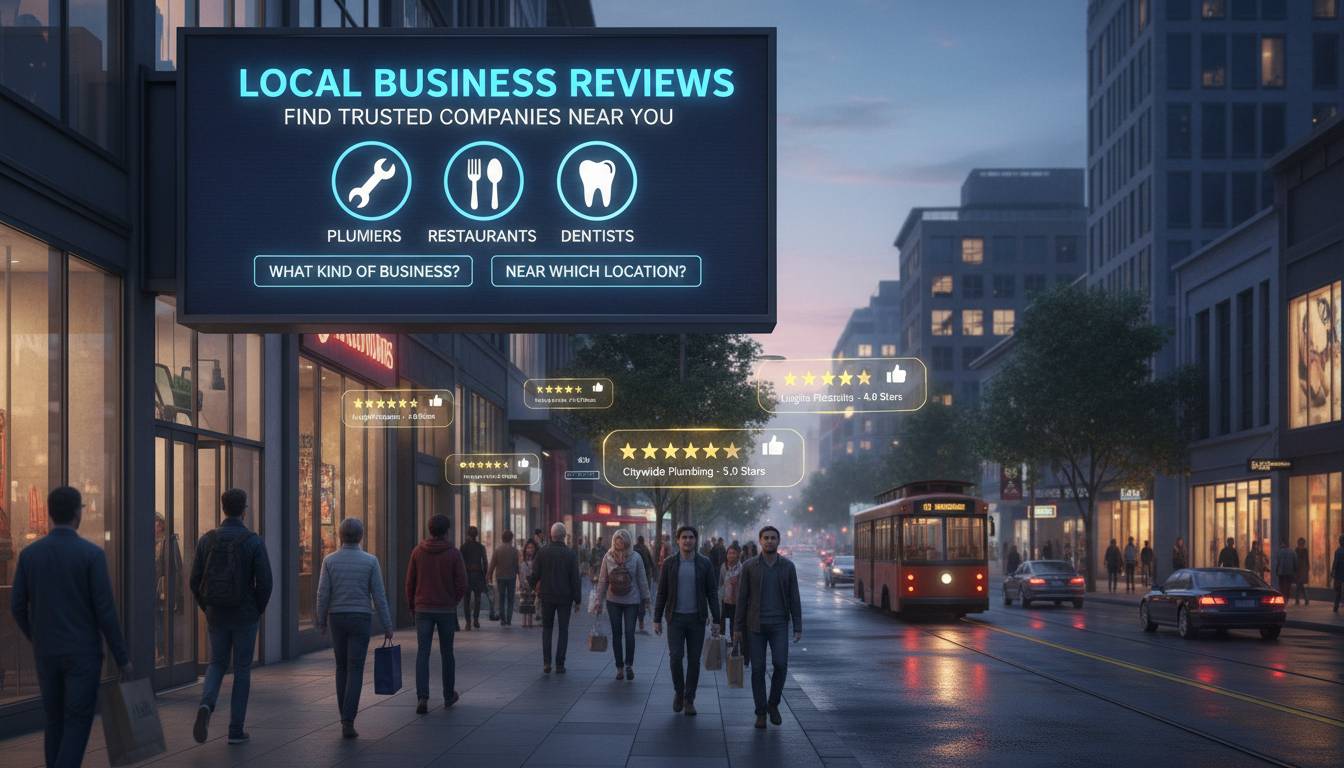
Finding reliable local service providers—whether you need a plumber, dentist, mechanic, or restaurant—can feel like navigating a maze of options. Local business reviews have transformed how consumers discover and evaluate companies in their communities. These crowd-sourced evaluations offer insights that traditional advertising cannot match, providing real customer experiences that help you make informed decisions about where to spend your money.
This comprehensive guide explains how local business reviews work, where to find them, how to evaluate their authenticity, and strategies for leveraging them effectively. Whether you’re a consumer seeking trusted services or a business owner looking to understand review ecosystems, this article provides practical knowledge backed by how these platforms actually function.
Why Local Business Reviews Matter in Your Decision-Making
Local business reviews have become a critical factor in consumer decision-making. Research consistently shows that the vast majority of consumers read reviews before contacting or visiting a local business. These reviews function as modern word-of-mouth, extending recommendations far beyond your immediate social circle to encompass thousands of other customers who have experienced a business firsthand.
The power of local reviews stems from their authenticity. Unlike promotional materials created by businesses themselves, reviews come from actual customers who have used products or services. This peer validation carries significant weight because people trust other consumers more than marketing messages. A five-star rating from dozens or hundreds of verified customers signals reliability in a way that no advertisement ever could.
Beyond trust, reviews provide specific information that helps you evaluate whether a business meets your particular needs. You can learn about pricing transparency, response times, professionalism, quality of work, and customer service nuances that generic ratings cannot capture. A plumber with stellar reviews mentioning fair pricing and clean workmanship differs from another with similar overall ratings but complaints about hidden fees.
For businesses, reviews create accountability. Companies know that customer experiences will be publicly documented, incentivizing them to maintain service quality and address problems promptly. This dynamic improves the overall marketplace, benefiting consumers and ethical business owners alike.
Major Platforms for Finding Local Business Reviews
Several platforms have established themselves as go-to sources for local business reviews, each offering distinct features and user bases. Understanding their differences helps you choose the most useful platform for your specific needs.
Google Reviews appears most prominently in search results, making it often the first stop for consumers. When you search for “plumber near me” or “best pizza in [city],” Google displays business listings with aggregate star ratings and review counts. The platform’s ubiquity—it powers search for millions of businesses—makes reviews accessible regardless of where you begin your search. Google Reviews also integrates with Google Maps, showing reviews alongside location information, hours, and directions.
Yelp built its brand specifically around local business reviews, focusing on restaurants, retail, and personal services. The platform emphasizes detailed, narrative reviews over simple star ratings, encouraging users to share full experiences. Yelp’s algorithm attempts to highlight the most useful reviews, prioritizing those from active contributors who demonstrate local knowledge. The platform also offers business owners tools to respond to reviews, creating dialogue between customers and companies.
Facebook Business Pages incorporate reviews as part of a business’s social presence. While not exclusively a review platform, the review feature has gained traction because users can see reviews alongside the business’s posts, photos, and engagement metrics. This integration appeals to users already familiar with Facebook’s interface, and reviews appear directly within the social media experience.
Industry-specific platforms serve niches where specialized expertise matters. Healthgrades and Zocdoc host physician reviews; Angi (formerly Angie’s List) focuses on home services; TripAdvisor dominates travel and hospitality; and wedding-focused platforms like The Knot include vendor reviews. These specialized contexts often feature more detailed evaluation criteria relevant to specific service categories.
Better Business Bureau offers a different model, functioning as a nonprofit that accredits businesses meeting ethical standards and catalogs complaints. BBB ratings reflect complaint history and resolution, providing insight into how businesses handle problems rather than merely aggregating satisfaction scores.
How to Evaluate the Quality and Authenticity of Reviews
Not all reviews carry equal weight, and savvy consumers learn to assess review quality rather than simply counting stars. Several factors indicate whether reviews provide reliable information or warrant skepticism.
Review volume and recency matter significantly. A business with 500 reviews over three years offers more data than one with 50 reviews clustered in a single month. Consistent review activity suggests ongoing operations, while sudden spikes—particularly before holidays or after negative press—might indicate review manipulation. Most platforms display review dates, allowing you to focus on recent experiences that better reflect current business practices.
Reviewer profiles often reveal authenticity. Detailed reviewer accounts with friends, photos, and historical review activity suggest real users. Profiles with no other activity or generic usernames warrant more caution. Some platforms verify purchases or visits, adding credibility to claims. Google, for instance, marks reviews from users who have been verified through various means.
Content quality distinguishes helpful reviews from useless ones. The most valuable reviews describe specific experiences: what service was provided, what the process was like, timeline, pricing, and outcome. Vague praise (“Great service!”) or criticism (“Terrible experience!”) without details offers limited guidance. Look for reviews that explain why a reviewer felt positively or negatively, as these explanations help you determine whether their priorities align with yours.
Response patterns from business owners indicate engagement and professionalism. Businesses that respond thoughtfully to reviews—both positive and negative—demonstrate customer service orientation. Responses that address specific concerns, apologize for problems, and offer solutions suggest owners who take feedback seriously. Conversely, defensive or combative responses to criticism may indicate poor customer relations.
Balance and patterns across multiple reviews reveal trends. Isolated negative reviews happen to excellent businesses, but patterns emerge when you read dozens of experiences. Consistent complaints about the same issues (late arrivals, billing disputes, quality problems) likely reflect genuine business weaknesses. Similarly, consistent strengths across many reviewers indicate reliable characteristics.
Be aware of review manipulation, which unfortunately exists. Fake positive reviews inflate ratings, while fake negative reviews—sometimes planted by competitors—create unfair penalties. Warning signs include reviews using identical language, reviews posted immediately after negative ones (creating artificial balance), and reviewers with no history on the platform. Sophisticated manipulation exists, but the patterns above help identify most concerning cases.
The Process of Leaving Effective Reviews
Consumers who take time to write thoughtful reviews contribute to healthier review ecosystems. Effective reviews help future customers and provide valuable feedback to businesses. Understanding what makes reviews useful maximizes your impact.
Be specific about your experience. Detail what service you received, when, and what made the experience notable. “Had my HVAC system serviced by [Technician Name] when it stopped cooling. They arrived within the promised window, diagnosed a refrigerant leak, and explained all options clearly. The repair took about 90 minutes and has worked perfectly since” provides far more value than “Great service, highly recommend.”
Include relevant context that helps others in similar situations. Mention pricing if you were comfortable with it (or if it surprised you negatively), timeline, communication quality, and any follow-up. If you sought estimates from multiple companies, noting comparisons helps others budget appropriately.
Be fair and accurate. Review what actually happened rather than projecting frustrations from unrelated experiences. Avoid hyperbole that undermines credibility. If a business made an error but corrected it professionally, acknowledging that resolution provides balanced perspective.
Follow platform guidelines regarding appropriate content. Most platforms prohibit threats, harassment, personal attacks on business owners, and off-topic content. Reviews violating these guidelines get removed, wasting your effort.
Consider your intent. Reviews work best when they help other consumers make decisions. If you had an extreme experience—an exceptional encounter worth celebrating or a genuinely problematic one requiring warning others—your review provides the most value. Everyday transactions that meet expectations rarely require formal reviews unless you’re particularly motivated to contribute.
Common Pitfalls When Using Local Business Reviews
Consumers frequently make mistakes when relying on local business reviews, leading to suboptimal decisions. Understanding these pitfalls helps you extract maximum value from review platforms.
Overweighting star ratings while ignoring content causes problems. Two businesses with 4.2-star averages may differ dramatically—one with mostly 5-star reviews from loyal customers, another with a mix of 5-star and 1-star reviews indicating inconsistency. Reading content reveals which scenario you’re actually considering.
Ignoring industry context leads to unrealistic expectations. A restaurant receiving 4-star reviews describing excellent food but slow service reflects different priorities than a similarly-rated emergency dental clinic where speed matters critically. Matching your priorities to what reviewers valued helps select the right business for your specific situation.
Focusing exclusively on extreme reviews creates distorted perceptions. The loudest voices—delighted champions and angry detractors—may not represent typical experiences. Mid-range reviews often better describe what average customers experience.
Failing to cross-reference platforms can miss important information. A business might have excellent Google reviews but unresolved BBB complaints, or strong overall ratings but recent deterioration. Checking multiple sources provides more complete pictures.
Ignoring business responses loses valuable information. How a company responds to criticism reveals customer service philosophy. Professional responses to difficult situations demonstrate accountability; defensive or dismissive responses predict future problems.
The Future of Local Business Reviews
Local business review ecosystems continue evolving, shaped by technology changes, consumer behavior shifts, and platform innovations. Several trends are reshaping how reviews function.
Verification technologies increasingly confirm that reviewers actually visited businesses. Platforms experiment with purchase verification, location tracking, and other methods to ensure review authenticity. These efforts combat manipulation while raising barriers for legitimate reviewers in some cases.
Artificial intelligence plays growing roles in moderation and presentation. AI helps identify fake reviews, summarize review content, and personalize recommendations based on user preferences. However, AI moderation sometimes removes legitimate reviews incorrectly, creating ongoing tension between authenticity efforts and review access.
Video and photo reviews gain prominence as smartphone capabilities improve. Visual evidence creates compelling proof of service quality—before/after examples, walkthroughs, and real-time documentation add credibility that text cannot match. Platforms increasingly accommodate multimedia content.
Review solicitation practices evolve as businesses recognize review importance. Requesting reviews from satisfied customers becomes standard practice, though ethical boundaries exist between legitimate solicitation and manipulation. Platforms adjust algorithms to account for this reality, sometimes discounting reviews obtained through aggressive solicitation.
Integration with other services continues deepening. Voice assistants, messaging platforms, and AI chatbots increasingly incorporate review data into recommendations. The fundamental value—peer experiences informing decisions—extends across more touchpoints in consumer journeys.
Frequently Asked Questions
How do I know if a local business review is fake?
Look for patterns suggesting manipulation: multiple reviews posted in short timeframes, similar language across different reviewers, reviews lacking specific details about services, and reviewer profiles with no history. Legitimate reviews typically describe specific experiences with particular details that future customers would find useful.
Should I only trust businesses with 4.5 stars or higher?
Star ratings provide useful starting points but shouldn’t be your sole decision factor. Some excellent businesses have lower ratings due to small sample sizes, a few dissatisfied customers, or serving difficult clienteles. Compare rating patterns, read recent reviews, and assess whether complaints relate to issues that matter for your needs.
Can business owners manipulate their reviews?
Some attempt this through various schemes, but platforms actively detect and penalize manipulation. Warning signs include suspicious review spikes, coordinated language, and responses that seem automated. The presence of critical reviews—alongside positive ones—generally indicates more authentic rating systems.
How important are business responses to reviews?
Business responses matter because they demonstrate how the company handles customer feedback. Thoughtful responses to negative reviews—acknowledging problems, explaining solutions, offering follow-up—suggest good customer service. Defensive or dismissive responses may predict future problems.
Which review platform should I trust most?
Google offers the broadest coverage and integrates with search, making it a strong starting point. Yelp provides more detailed review content for restaurants and personal services. Industry-specific platforms offer specialized expertise. Cross-referencing multiple platforms gives the most complete picture.
How can I leave a review that actually helps others?
Be specific about what happened, include relevant details (timing, pricing, service received), explain why you felt positively or negatively, and keep your review focused on the actual experience. Photos and specific examples make reviews more helpful to others making decisions.
The post Local Business Reviews: Find Trusted Companies Near You appeared first on PQR News.











Leave a comment