

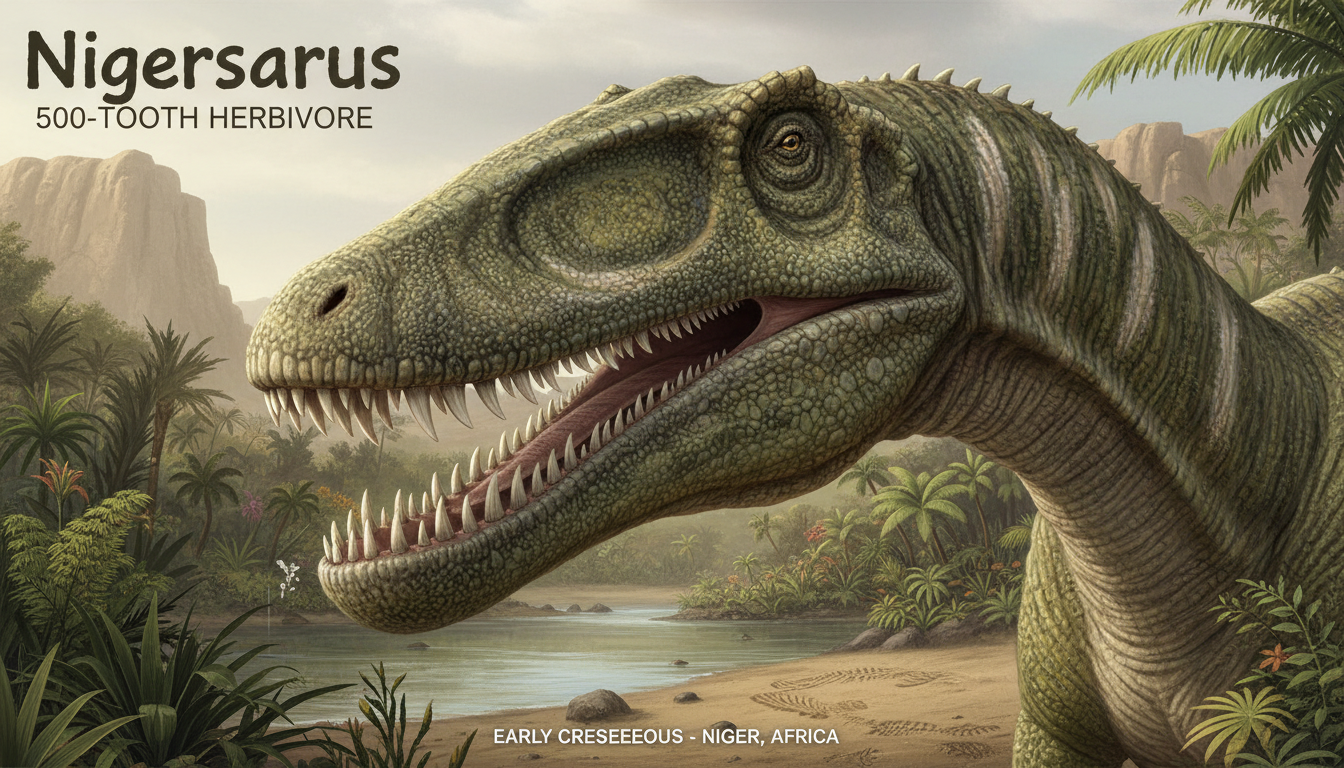
So, here’s the quirky twist: among the mightiest prehistoric creatures stands a comparatively modest sauropod sporting over 500 teeth—and yes, you read that right. Meet Nigersaurus taqueti, the oddball of dinosaurs for its razor-like dental conveyor belt and vacuum-like muzzle. It lived roughly 115–105 million years ago in what’s now Niger’s Elrhaz Formation .
Nigersaurus wasn’t your run-of-the-mill long-necked dinosaur with a lofty reach. Rather, it ambled along floodplains, grazing on low-lying foliage—a bit like a Mesozoic lawnmower—and its bizarre dental setup made it a marvel of evolutionary adaptation .
A Jaw-Dropping Anatomy (Literally)
The Marvel of the Muzzle
Its head, ironically light and delicate, housed an extraordinarily wide and square muzzle. This broad jaw was equipped for efficient grazing—and it was stuffed full of teeth. The skull was so air-filled and thin that in some cases, light could shine through the bones .
Dental Batteries and Quick Replacements
Here’s the real spectacle: Nigersaurus housed up to 68 columns of teeth in its upper jaw and about 60 in the lower, giving it over 500 teeth in total . Under each active tooth lay around nine replacements, forming what experts call “dental batteries”—a rare trait in sauropods, more commonly seen in hadrosaurs and ceratopsians .
Rapid Renewal System
Those numerous teeth didn’t just sit there—they wore down fast. Soft vegetation, sand, and silica from ancient plants demanded a speedy dental solution. Remarkably, Nigersaurus replaced its teeth every two weeks or so—possibly every 14 days—making it one of the fastest tooth-replacing vertebrates known .
Feeding Strategy: Grazing Genius
A Ground-Level Browser
Unlike other sauropods that stretched their necks skyward, Nigersaurus stayed close to the ground. Its short neck and downward-facing head suited a grazing lifestyle, cropping vegetation within roughly one meter of the ground .
Shearing, Not Chewing
The jaw function mirrored a scissor-like action. Teeth slid past each other, acting less like molars and more like blades that sheared plant material. This “nipping” was perfectly suited for processing tough, abrasive plants like horsetails, ferns, and early flowering vegetation .
“It’s something that really takes the cake for amazing cranial adaptations in this group, the long‑necked dinosaurs… it’s just a majestic example of evolution.”
— Paul Sereno on the marvel of Nigersaurus’s unusual skull
Life in the Cretaceous Landscape
A Lush Habitat, Now Desert
Today’s Sahara might be a vast desert, but 110–120 million years ago, the region was a vibrant floodplain rich with plants and water. Nigersaurus roamed these riparian environments, which supported a diverse ecosystem that included other herbivores like Ouranosaurus, Lurdusaurus, and multiple theropods plus crocodylomorphs .
A Common Herbivore of Its Time
Despite its unique features, Nigersaurus wasn’t rare in its world. The Elrhaz Formation shows it as one of the most common megaherbivores, second only to Lurdusaurus. Fossils are plentiful compared to other species of the same era .
Scientific Significance: More Than Just a Dinosaur Oddity
Pushing Paleontological Techniques
The skull of Nigersaurus was among the first reconstructed using CT scans to digitally piece together delicate fossils—some of which were almost translucent. This earned the species a place in scientific history, beyond its quirky teeth .
Evolutionary Insights
Its dental battery, lightweight skeleton aided by air sacs, and unique posture illustrate how sauropods diversified feeding strategies despite common ancestry. Nigersaurus exemplifies how dinosaurs exploited ecological niches in unexpected ways .
Challenging Sauropod Stereotypes
Before Nigersaurus, most sauropods were assumed to dine in the treetops. This ground-grazing creature disrupted that narrative, revealing the versatility of sauropod feeding habits and prompting a reassessment of dinosaurine ecology .
Conclusion: Tiny Herbivore, Monumental Impact
Nigersaurus may be modest in size, but it’s undeniably monumental in paleontological significance. With a 500‑tooth conveyor system, vacuum-cleaner muzzle, and lightning-fast dental turnover, it embodies evolutionary innovation. Its story enriches our understanding of dinosaur diversity and ecological adaptation.
Whether you’re picturing it grass‑grazing like a Mesozoic cow or marveling at its fragile yet efficient skull, Nigersaurus reminds us that evolution doesn’t always strive for grandeur—sometimes, it thrives in ingenious subtlety.
FAQs
What was Nigersaurus’s size and weight?
Nigersaurus measured about 9 to 14 meters long and weighed around 2 to 4 tons, roughly comparable to a modern elephant .
How often did it replace its teeth?
Its teeth were replaced extremely rapidly—roughly every 14 days—helped by its stacked dental batteries .
What did Nigersaurus eat?
It grazed on low-growing vegetation—such as ferns, horsetails, and early flowering plants—close to the ground, using its scissor-like bite to shear rather than chew .
Where were its fossils discovered?
Fossils came from the Elrhaz Formation in Gadoufaoua, Niger—its name literally means “Niger lizard”—first noted in the 1970s and officially named in 1999 .
Why is it called the “Mesozoic cow”?
It earned this nickname because of its grazing behavior on ground-level vegetation—a surprising trait for a sauropod, reminiscent of how cows feed today .
How did scientists reconstruct its skull?
Using CT scans, researchers digitally combined thin and fragile skull fragments—some nearly translucent—to reconstruct its structure, pioneering a modern approach in paleontology .











Leave a comment