

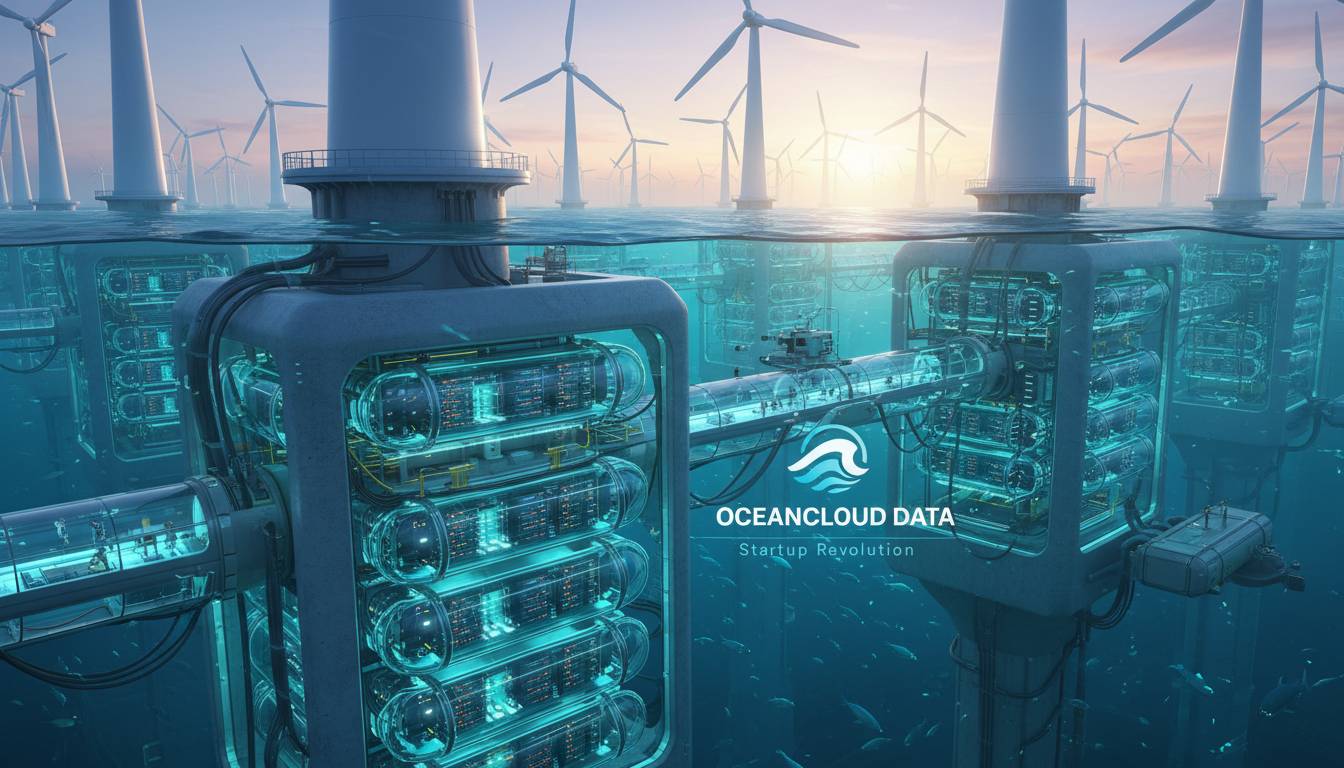
Two massive industries are converging on an unexpected solution to a very real problem: where to put all the servers the world needs. Startups and tech giants are now exploring a radical approach—sticking data centers underwater, right beneath offshore wind turbines. The ocean provides natural cooling while the turbines provide clean power. It’s a simple idea that addresses several pain points at once, and it’s starting to get real attention.
AI workloads are driving explosive growth in data center electricity demand. Traditional land-based facilities guzzle water and energy just to keep servers from overheating. Companies are running out of options in crowded regions where real estate is expensive and environmental regulations are tightening. The offshore approach isn’t just a novelty—it’s starting to look like a genuine alternative.
How Underwater Data Centers Work
The basic concept is straightforward: the ocean stays cold, so use that cold to cool servers. Microsoft tested this with Project Natick, dropping a shipping container full of computers off the Scottish coast in 2018. It stayed submerged for nearly two years and worked fine. The stable underwater temperature meant the servers ran without the massive air conditioning systems that typically consume 30-40% of a data center’s electricity.
The engineering involves sealing containers with nitrogen to keep out moisture and salt. Heat from the servers radiates through the container walls into the surrounding water—no fans, no mechanical cooling, just passive heat transfer. Power and data run through underwater cables connected to the mainland or directly to nearby wind turbines. The modular design means companies can add more pods as needed, without the years-long construction timelines of traditional data centers.
Co-locating with offshore wind farms creates an obvious synergy. Data centers can tap into the same grid connections serving the turbines, cutting out transmission losses and avoiding the need for separate power infrastructure. Wind farms get a steady, predictable customer for their electricity. It’s a mutually beneficial setup that both industries are paying attention to.
Why Startups Are Pursuing This Model
The economics are shifting. Global data center electricity consumption is on track to hit 1,000 terawatt-hours per year by 2026, according to the International Energy Agency. Land-based facilities in hot climates need enormous amounts of water for evaporative cooling—a serious problem in drought-stricken regions facing increasing regulatory pushback. Underwater installations avoid water consumption entirely and get consistent cooling regardless of whether it’s summer or winter.
For startups, there’s a practical advantage: speed. Building a conventional data center takes 18-36 months and requires finding suitable land near fiber networks and power lines. Offshore pods can be built in factories and deployed in months, often using wind farm infrastructure that’s already there or planned. In fast-moving sectors where companies need computing capacity now, that time savings matters.
The sustainability angle doesn’t hurt either. Big tech companies have made carbon neutrality commitments, and partnering with offshore data centers gives them a concrete way to show progress. Wind-powered computing with zero direct emissions looks good to customers and investors increasingly focused on environmental impact.
Key Players and Projects
Microsoft’s Project Natick is still the most recognizable name in this space, though the company hasn’t committed to commercial deployment. The 2018 Scotland test ran for almost two years and actually showed lower failure rates than land-based servers—probably because of the stable temperature, lack of oxygen, and minimal human handling.
European startups are moving forward with commercial products. Reilable, a Finnish company, makes modular submarine data center units for shallow coastal waters. They deployed their first commercial unit in 2023 and is expanding across the Baltic Sea. Data4, a French firm, is exploring floating data center designs that could work alongside North Sea and Atlantic wind farms.
In the US, the growing offshore wind industry along the East Coast is sparking interest. The massive wind projects planned off New York, New Jersey, and Massachusetts could eventually support data centers serving the Northeast’s dense population. No major US deployments have been announced yet, but industry watchers expect movement as the regulatory picture clarifies.
Challenges and Technical Limitations
This isn’t a simple solution. The ocean is harsh—salt corrodes metal, organisms foul surfaces, and storms and ship traffic pose real risks. Engineering around these problems adds cost and complexity. When something fails underwater, fixing it requires divers or remotely operated vehicles, which takes far longer than walking into a server room.
Capital costs are higher than traditional facilities, though supporters argue the total cost of ownership works out over time. Few contractors have the specialized vessels and expertise needed for underwater installation. The regulatory process involves multiple federal and state agencies and can delay projects for years. In the US, offshore wind permitting has already faced extensive delays, which affects any plans for co-located data centers.
Connectivity is another consideration. Certain applications need millisecond response times, and the physical distance from population centers introduces latency—however minor—compared to edge data centers in cities. Offshore facilities may suit batch processing, storage, and AI training workloads better than real-time applications.
The Future of Offshore Computing
Analysts see potential for real growth. Wood Mackenzie projects floating data center capacity could reach 3 gigawatts by 2030. AI’s continued expansion will drive demand for new capacity, with some estimates suggesting AI workloads could consume 15-25% of data center electricity by 2030.
The wind farm and data center partnership seems likely to deepen. Wind developers want long-term power purchase agreements for revenue stability, and data centers offer predictable, continuous loads that align well with wind generation patterns. Some proposed developments market themselves as integrated clean energy campuses—computing powered by wind, marketed explicitly to environmentally-conscious customers.
Regulatory frameworks are slowly adapting. European countries with established offshore wind industries have created pathways for marine data centers. The US is developing its approach through pilot programs, but policy lags behind technology. Early commercial successes will likely determine how quickly things move.
Conclusion
Data centers under offshore wind turbines represent a genuinely interesting convergence of renewable energy and digital infrastructure. The approach tackles real problems—cooling efficiency, sustainability demands, and land scarcity in prime locations. Significant obstacles remain, but demonstrated viability from major tech experiments and well-funded startups entering the space suggest this won’t fade away as a curiosity.
As AI and cloud computing keep driving computing demand upward, the offshore model offers a way to scale without completely contradicting decarbonization goals. Whether it becomes mainstream or stays a niche alternative depends on the next few years of regulatory decisions and commercial deployments. It’s worth watching.
Frequently Asked Questions
What companies are building underwater data centers?
Microsoft’s Project Natick project remains the most prominent research effort, with a test deployment off the Scottish coast. European startups including Finland’s Reilable and France’s Data4 have moved toward commercial products, targeting Baltic and North Sea waters where offshore wind infrastructure is already established.
How do offshore wind farms work with data centers?
Offshore data centers connect directly to electrical infrastructure serving adjacent wind turbines, cutting transmission losses and avoiding duplicate power lines. The proximity also means data centers can draw renewable electricity while the ocean provides natural cooling.
What are the benefits of underwater data centers?
Key advantages include natural cooling from stable ocean temperatures, no water consumption for evaporative systems, minimal land use, and direct access to offshore renewable energy. The marine environment also appears to produce lower server failure rates than traditional facilities.
Are underwater data centers energy efficient?
Yes. The passive cooling system removes the massive electricity draw of traditional air conditioning, potentially reducing energy use by 30-40%. When powered by wind, these facilities can operate with minimal carbon emissions.
What are the challenges of subsea data centers?
Main obstacles include corrosion, difficult repair access, high upfront costs, complex permitting, and slightly limited connectivity compared to land-based facilities. The ocean environment demands specialized engineering and maintenance procedures.
When will offshore data centers become common?
Commercial deployments exist in Europe now. Broader adoption probably sits five to ten years away, depending on regulatory development—particularly in the US—and the track record of early commercial projects. As offshore wind farms expand, co-located data centers will likely become more common.














Leave a comment