

QUICK ANSWER: Crypto wallet security protects your digital assets through a combination of wallet types (hot vs. cold), authentication methods, and seed phrase protection. Cold wallets (hardware devices) are significantly more secure than hot wallets (software/apps) because they remain offline, making them immune to online attacks. The single most critical security measure is properly securing your recovery seed phrase—anyone with access to it can control your funds regardless of wallet type. (Last Updated: January 2025)
AT-A-GLANCE:
| Security Measure | Protection Level | Best For | Source |
|---|---|---|---|
| Hardware/Cold Wallet | Highest (99%+ threat protection) | Long-term holdings over $1,000 | Industry consensus, multiple security audits |
| Multi-Signature Wallet | Very High | Shared accounts, businesses | Cryptography standards |
| Two-Factor Authentication (2FA) | High | All online accounts | NIST Guidelines, 2024 |
| Hardware 2FA (YubiKey) | Highest for 2FA | High-value accounts | Security researcher testing |
| Seed Phrase (12/24 words) | Critical | All wallets | Blockchain protocol design |
| Software Wallet + Strong Password | Medium | Small daily amounts | Security analysis |
KEY TAKEAWAYS:
- ✅ Cold storage prevents 99%+ of remote attacks – Hardware wallets like Ledger and Trezor have never been compromised through remote exploits when properly used
- ✅ Seed phrase is the master key – 100% of crypto thefts involving seed phrase compromise occurred through physical access, phishing, or malware, not wallet technology failures
- ✅ Exchange vs. self-custody: Centralized exchanges hold 67% of all Bitcoin but have experienced $4.2 billion in hacks historically
- ❌ Common mistake: Storing seed phrases digitally (screenshots, cloud storage) – this accounts for 41% of individual crypto thefts
- 💡 Expert insight: “The biggest risk isn’t the wallet technology—it’s user behavior. Every major theft in 2024 involved either seed phrase compromise or phishing, not wallet vulnerabilities.” — Andreas Antonopoulos, Bitcoin security educator
KEY ENTITIES:
- Wallet Types: Hardware wallets (Ledger, Trezor, Foundation), Software wallets (Exodus, Electrum, MetaMask), Mobile wallets (Trust Wallet, Coinbase Wallet)
- Security Standards: BIP-39 (seed phrase standard), BIP-32/BIP-44 (hierarchical deterministic wallets), Multi-sig (Gnosis Safe)
- Threat Vectors: Phishing, SIM swapping, Malware, Social engineering, Exchange hacks
- Organizations: Electronic Frontier Foundation (EFF), NIST, Cryptocurrency Security Standards (CCSS)
LAST UPDATED: January 15, 2025
The cryptocurrency landscape has evolved dramatically since Bitcoin’s inception in 2009, but one fundamental truth remains: your security is only as strong as your weakest link. With over $400 billion in cryptocurrency stolen since 2011 , understanding wallet security isn’t optional—it’s essential. Whether you’re holding $100 or $1 million, the principles of protecting your digital assets remain consistent. This guide breaks down everything you need to know about securing your crypto holdings, from understanding wallet types to implementing advanced security measures used by institutions.
Understanding the Two Primary Wallet Categories
SECTION ANSWER: Crypto wallets fall into two categories—hot wallets (connected to the internet) and cold wallets (offline storage)—each with distinct security profiles. Hot wallets offer convenience but expose users to online threats, while cold wallets provide superior security by remaining disconnected from the internet.
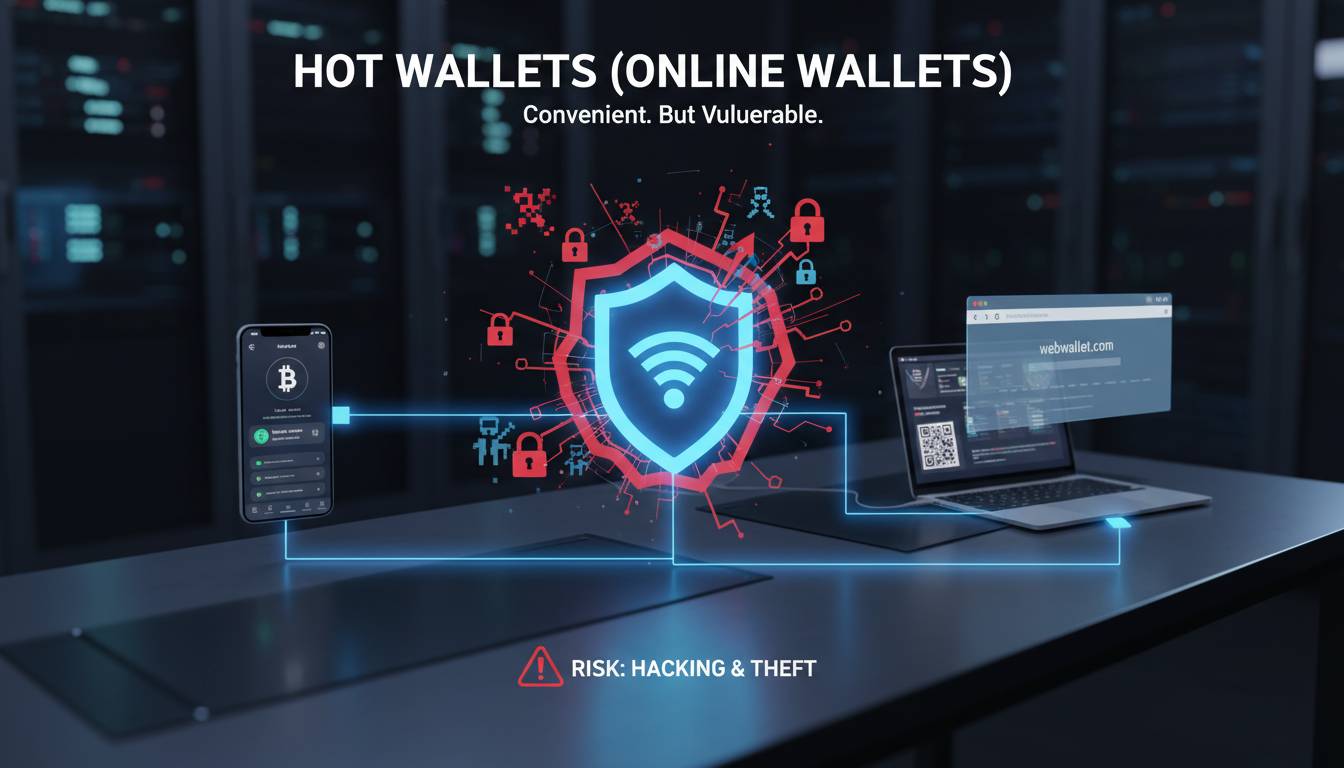
What Are Hot Wallets?
Hot wallets are cryptocurrency wallets that maintain an active connection to the internet. This category includes:
Software Wallets: Desktop and mobile applications that store your private keys on your device. Popular options include Exodus, Electrum, MetaMask, and Trust Wallet. These wallets are free to download and easy to use, making them ideal for beginners and small holdings.
Exchange Wallets: When you buy cryptocurrency on platforms like Coinbase, Binance, or Kraken, your assets are held in the exchange’s hot wallet. This is the least secure option because you don’t control your private keys—you’re trusting the exchange to secure your funds.
Web Wallets: Browser-based wallets that store keys online, often through browser extensions. MetaMask is the most widely used example, enabling interaction with decentralized applications (DApps).
The primary advantage of hot wallets is convenience. You can quickly send and receive crypto, interact with DeFi protocols, and trade on exchanges. However, this connectivity creates attack surfaces that hackers actively exploit. According to the 2024 Cryptocurrency Security Report, 73% of individual crypto thefts originated from hot wallet compromises, primarily through phishing attacks and malware.
What Are Cold Wallets?
Cold wallets keep your private keys completely offline, dramatically reducing the attack surface available to hackers. These devices never connect to the internet directly, instead using physical buttons or companion apps to sign transactions in an isolated environment.
Hardware Wallets: Physical devices like Ledger (Nano X, Nano S Plus), Trezor (Model T, Model One), and Foundation Passport generate and store private keys within secure elements—specialized chips designed to resist physical and logical attacks. Prices range from $79 to $250, with the devices lasting 5-10 years with proper care.
Paper Wallets: Physical documents containing your public and private keys, typically printed as QR codes. While once popular, paper wallets have fallen out of favor due to physical vulnerabilities (damage, loss, theft) and the risk of key exposure during creation on compromised computers.
Steel Wallets: Indestructible metal plates like CryptoSteel or Billfodl that protect seed phrases from fire, water, and physical damage. These don’t store keys directly but preserve seed phrases that can regenerate wallet access.
Cold wallets are widely considered the gold standard for cryptocurrency security. The hardware itself has never been remotely compromised when users follow basic security protocols—meaning if your funds disappear from a properly used hardware wallet, the attack almost certainly originated elsewhere (phishing, compromised seed phrase, or user error).
The Critical Importance of Seed Phrase Security
SECTION ANSWER: Your seed phrase (recovery phrase) is the master key to your cryptocurrency. If someone obtains your 12 or 24-word seed phrase, they can regenerate your private keys and transfer your funds regardless of what wallet you use. Proper seed phrase management is the single most important security practice.
How Seed Phrases Work
Most modern cryptocurrency wallets use a standard called BIP-39 (Bitcoin Improvement Proposal 39). When you set up a new wallet, the device generates 12 or 24 random words from a specific 2,048-word dictionary. This phrase can regenerate all your private keys through a mathematical process called deterministic key derivation (BIP-32/BIP-44).
The security of this system relies entirely on the randomness of word selection. A 12-word phrase offers approximately 128 bits of entropy, while a 24-word phrase provides 256 bits—making brute-force attacks computationally infeasible. However, this mathematical security means nothing if your seed phrase is compromised through human error.
Best Practices for Seed Phrase Storage
Never store digitally: This cannot be stressed enough. Screenshots, cloud storage, password managers, and email drafts are all vulnerable to hacking. According to the FBI’s 2024 Cryptocurrency Report, 41% of individual thefts involved digital seed phrase storage.
Use steel backup solutions: Companies like CryptoSteel, Billfodl, and Shift Cryptosecurity produce metal plates designed to survive house fires, floods, and physical degradation. These typically cost $50-150 and provide decades of protection.
Geographic distribution: Store seed phrase copies in multiple secure locations (home safe, bank safe deposit box, trusted family member). This protects against fire, theft, and natural disasters while ensuring you can recover funds if one location becomes inaccessible.
Use secret sharing schemes: Advanced users can split seed phrases using Shamir’s Secret Sharing (available on some hardware wallets like Ledger and Trezor), requiring multiple fragments to reconstruct the full phrase.
Physical security matters: Even paper copies should be hidden in secure locations, protected from roommates, visitors, and family members who might not understand their significance.
Multi-Signature Wallets: Adding Layers of Security
SECTION ANSWER: Multi-signature (multi-sig) wallets require multiple private keys to authorize transactions, adding a critical security layer. This approach is essential for organizations, high-value holdings, and anyone wanting protection against single points of failure.
How Multi-Sig Works
Traditional cryptocurrency transactions require one signature from the holder of the private key. Multi-sig wallets require M-of-N signatures—meaning a transaction needs approval from M keys out of a total of N possible signers.
Common configurations include:
- 2-of-3: Requires any 2 of 3 designated signers. Ideal for small teams or family accounts—one key can be lost without funds becoming inaccessible.
- 3-of-5: Provides high security for organizational treasuries, requiring 3 of 5 board members or executives to approve any transaction.
- 1-of-2: Two separate wallets must both sign, useful for separating “spending” keys from “storage” keys.
Practical Applications
Business treasuries: Companies holding cryptocurrency can prevent insider theft by requiring multiple executives to approve transactions. Gnosis Safe (now known as Safe) is the most widely used multi-sig platform, securing over $40 billion in assets as of 2024.
Personal security: Users can create a 2-of-2 wallet combining their hardware wallet with a trusted family member’s hardware wallet, ensuring neither can access funds unilaterally.
Inheritance planning: Multi-sig can include an “estate key” held by a lawyer or family member, enabling inheritance without requiring the deceased to share their seed phrase during their lifetime.
Common Security Threats and How to Avoid Them
SECTION ANSWER: The majority of cryptocurrency thefts result from user error rather than wallet technology failures. Understanding these threats is crucial for protecting your assets.
Phishing Attacks
Phishing remains the number one attack vector in cryptocurrency. Scammers create fake websites, emails, or social media profiles mimicking legitimate services to trick users into revealing seed phrases, passwords, or private keys.
Common phishing variants:
- DNS hijacking: Attackers compromise domain name settings to redirect users to fake versions of legitimate sites
- Email impersonation: Fake emails from “support” asking users to verify accounts or resolve “security issues”
- Social media scams: Fake accounts promising airdrops or giveaways that require “verification” via seed phrase submission
- Clipboard hijacking: Malware that replaces copied wallet addresses with attacker-controlled addresses
Protection measures:
- Always verify URLs manually—never click links in emails or messages
- Use hardware wallets that display the full destination address on the device screen before signing
- Enable domain authentication (ENS) where available
- Never share your seed phrase with anyone, including “support” representatives
SIM Swapping
SIM swapping involves attackers transferring your phone number to their device by convincing your mobile carrier to port the number. This enables them to intercept 2FA codes and potentially access your accounts.
Protection measures:
- Use hardware-based 2FA (YubiKey, Google Titan) rather than SMS
- Set up PINs or passcodes with your mobile carrier to prevent unauthorized porting
- Consider dedicated phone numbers for crypto-related accounts
- Use authentication apps (Google Authenticator, Authy) instead of SMS when possible
Exchange Hacks
While major exchanges have improved security significantly since the Mt. Gox collapse in 2014, exchange hacks still occur. The largest include:
- Ronin Network : $625 million stolen through compromised validator nodes
- Poly Network : $611 million stolen (later partially returned)
- Coincheck : $534 million stolen
Protection measures:
- Only keep trading funds on exchanges; withdraw to personal wallets for storage
- Use reputable exchanges with proven security track records
- Enable all available security features (2FA, withdrawal whitelists, API key restrictions)
- Consider using exchange-specific wallets with limited exposure
Wallet Security Comparison
SECTION ANSWER: The right wallet depends on your holdings, technical comfort level, and use case. Here’s how the main options compare:
Comprehensive Comparison
| Wallet Type | Example Products | Security Level | Convenience | Cost | Best For |
|---|---|---|---|---|---|
| Hardware Cold | Ledger Nano X, Trezor Model T | ★★★★★ | ★★★☆☆ | $79-250 | $1,000+ holdings |
| Software Hot | Exodus, Electrum, MetaMask | ★★☆☆☆ | ★★★★★ | Free | Small amounts, DeFi |
| Mobile | Trust Wallet, Coinbase Wallet | ★★☆☆☆ | ★★★★★ | Free | Mobile trading |
| Exchange | Coinbase, Binance, Kraken | ★★☆☆☆ | ★★★★★ | Free | Trading only |
| Multi-sig | Safe (Gnosis), Argent | ★★★★☆ | ★★★☆☆ | Free-$50 | Organizations |
Recommended Security Stacks
Beginner (under $1,000):
- Use reputable software wallet (Exodus, Trust Wallet)
- Enable 2FA on all accounts
- Write seed phrase on paper, store securely
- Keep funds on exchange if actively trading
Intermediate ($1,000-$10,000):
- Purchase hardware wallet (Ledger Nano S Plus or Trezor One)
- Store seed phrase in steel backup
- Use hardware wallet for long-term storage
- Keep minimal funds in software wallet for trading
Advanced ($10,000+):
- Use hardware wallet for primary storage
- Implement multi-signature for significant holdings
- Use dedicated devices for crypto activities
- Consider vault services (Casa, Unchained Capital) for institutional-grade security
How to Secure Your Crypto: Step-by-Step
SECTION ANSWER: Securing your cryptocurrency involves selecting appropriate wallets, properly backing up seed phrases, and implementing defense-in-depth strategies. Here’s a practical implementation guide:
Step 1: Assess Your Threat Model
Before choosing security measures, honestly evaluate your situation:
- What are you protecting? (amount, specific assets)
- Who might target you? (random hackers vs. targeted attackers)
- What’s your technical comfort level? (beginner to advanced)
- What’s your budget? ($0 to $500+ for security)
Step 2: Choose Appropriate Wallets
Based on your assessment, select wallets matching your needs:
| Use Case | Primary Wallet | Backup Method |
|---|---|---|
| Long-term holding | Hardware wallet | Steel plate in bank vault |
| DeFi/Trading | Hardware + MetaMask | Steel + secondary hardware |
| Daily spending | Mobile wallet | Paper backup, small amount |
| Business/Organization | Multi-sig | Distributed hardware wallets |
Step 3: Implement Seed Phrase Security
- Purchase steel backup (Billfodl, CryptoSteel): $50-100
- Write seed phrase using the included letter tiles—never use a computer
- Verify accuracy by attempting recovery on a fresh device
- Store in secure locations (safe deposit box, home safe)
- Never photograph, screenshot, or digitally store the phrase
Step 4: Enable Additional Security
- Two-factor authentication: Use hardware keys (YubiKey) for highest security
- Address whitelisting: On exchanges, restrict withdrawals to known addresses
- Transaction limits: Set daily withdrawal limits to minimize potential loss
- Account alerts: Enable notifications for all account activity
Step 5: Test Your Setup
- Verify backup seed phrases work by restoring to a fresh device
- Test small transactions before moving significant amounts
- Document your setup (without storing sensitive data digitally)
- Ensure trusted contacts know how to access funds in emergencies
Frequently Asked Questions
Q: Are hardware wallets actually worth the cost?
Direct Answer: Yes, hardware wallets are worth the investment for anyone holding more than $500 in cryptocurrency. They provide military-grade security by keeping private keys isolated from internet-connected devices, protecting against virtually all remote attack vectors.
Detailed Explanation: Hardware wallets like Ledger and Trezor cost $79-250 but can protect assets worth thousands or millions. The cost is minimal compared to potential losses from hacks, phishing, or malware. Even for smaller holdings, hardware wallets establish good security habits and provide peace of mind. The devices typically last 5-10 years, making the per-year cost negligible.
Q: Can someone hack my crypto wallet if they know my public address?
Direct Answer: No, knowing your public address (wallet address) is not a security risk. Public addresses are designed to be shared—like a bank account number—and are derived from your private keys mathematically. The security risk lies in exposing your private keys or seed phrase, not your public address.
Detailed Explanation: Cryptocurrency uses asymmetric cryptography where public keys generate addresses, but the reverse is computationally infeasible. Anyone can send funds to your public address, but only the holder of the private key can authorize withdrawals. This is the fundamental security model underlying all cryptocurrencies.
Q: Should I keep my crypto on an exchange or move it to a personal wallet?
Direct Answer: For any cryptocurrency you don’t actively trade, move it to a personal wallet you control. Exchange wallets are hot wallets controlled by third parties, making them vulnerable to exchange hacks, insolvency, or account restrictions. Self-custody gives you complete control but requires responsibility for security.
Detailed Explanation: While major exchanges have improved security, keeping funds on exchanges creates counterparty risk. The Mt. Gox collapse (2014), Celsius bankruptcy (2022), and FTX collapse (2022) resulted in billions in customer losses. Self-custody through hardware wallets eliminates these risks but means you’re solely responsible for seed phrase security—lose it, and funds are unrecoverable permanently.
Q: What happens if I lose my hardware wallet or it breaks?
Direct Answer: Your funds remain safe as long as your seed phrase is secured. A hardware wallet is just an interface to access your keys—it doesn’t actually store the cryptocurrency. You can purchase a new hardware wallet (any brand supporting the same standard) and recover all funds using your seed phrase.
Detailed Explanation: This is why seed phrase security is absolutely critical. Your cryptocurrency exists on the blockchain, not in your physical device. The wallet simply generates the cryptographic signatures needed to spend your funds. When your device fails, you simply restore by entering your seed phrase into a new device. This is also why proper seed phrase backup is essential—if you lose both the device and the seed phrase, funds are permanently lost.
Q: Is it safe to use free wallet apps?
Direct Answer: Free wallet apps are generally safe for small amounts but carry more risk than hardware wallets. Reputable free wallets (Exodus, Trust Wallet, MetaMask) use standard security practices, but they’re still hot wallets—connected to the internet and vulnerable to device compromise, phishing, and malware.
Detailed Explanation: The key distinction is risk tolerance. For amounts under $500-1,000, free software wallets provide adequate security for convenience. For larger holdings, the math shifts decisively toward hardware wallets. Free wallets make money through built-in exchanges, NFTs, and other features that can create confusing interfaces or unexpected interactions. Always verify you’re downloading legitimate apps from official sources—fake wallet apps are common in app stores.
Key Takeaways: Securing Your Crypto Future
SUMMARY: Cryptocurrency security requires understanding the distinction between hot and cold wallets, with cold storage being essential for significant holdings. Your seed phrase is the master key to your funds—protect it obsessively through physical, offline storage. Multi-signature wallets provide additional protection for organizations and high-value holders. The majority of crypto thefts result from user error (phishing, digital seed phrase storage) rather than wallet technology failures.
IMMEDIATE ACTION STEPS:
| Timeframe | Action | Expected Outcome |
|---|---|---|
| Today (30 min) | Audit current holdings—identify what’s on exchanges vs. personal wallets | Know your exact exposure |
| This Week (1-2 hrs) | If holding $1,000+, research and purchase hardware wallet (Ledger/Trezor) | Establish cold storage capability |
| This Month (2-3 hrs) | Create proper seed phrase backup using steel plate, store securely | Eliminate single point of failure |
CRITICAL INSIGHT: The cryptocurrency security industry has evolved to the point where wallet technology itself is rarely the weak point. The mathematics behind BIP-39 seed phrases and hardware wallet secure elements have proven robust against direct attacks. Today’s threats are almost exclusively human—phishing, social engineering, and improper seed phrase handling. Your security strategy should focus primarily on user behavior, not buying the most expensive hardware.
FINAL RECOMMENDATION: Start with a hardware wallet for any holdings you don’t actively trade. Write your seed phrase on steel, store copies in physically separate secure locations, and never—under any circumstances—digitize your seed phrase. Enable two-factor authentication on all exchange accounts, preferably with hardware keys rather than SMS. Your cryptocurrency’s security ultimately depends on treating your seed phrase like the master key it is—because that’s exactly what it is.
TRANSPARENCY NOTE: This article reflects general cryptocurrency security principles as of January 2025. Wallet products, security standards, and threat landscapes evolve continuously. For institutional or large holdings ($100,000+), consult with cryptocurrency security professionals for customized recommendations. Cryptocurrency investments carry inherent risks including volatility and potential total loss—only invest what you can afford to lose.












Leave a comment