

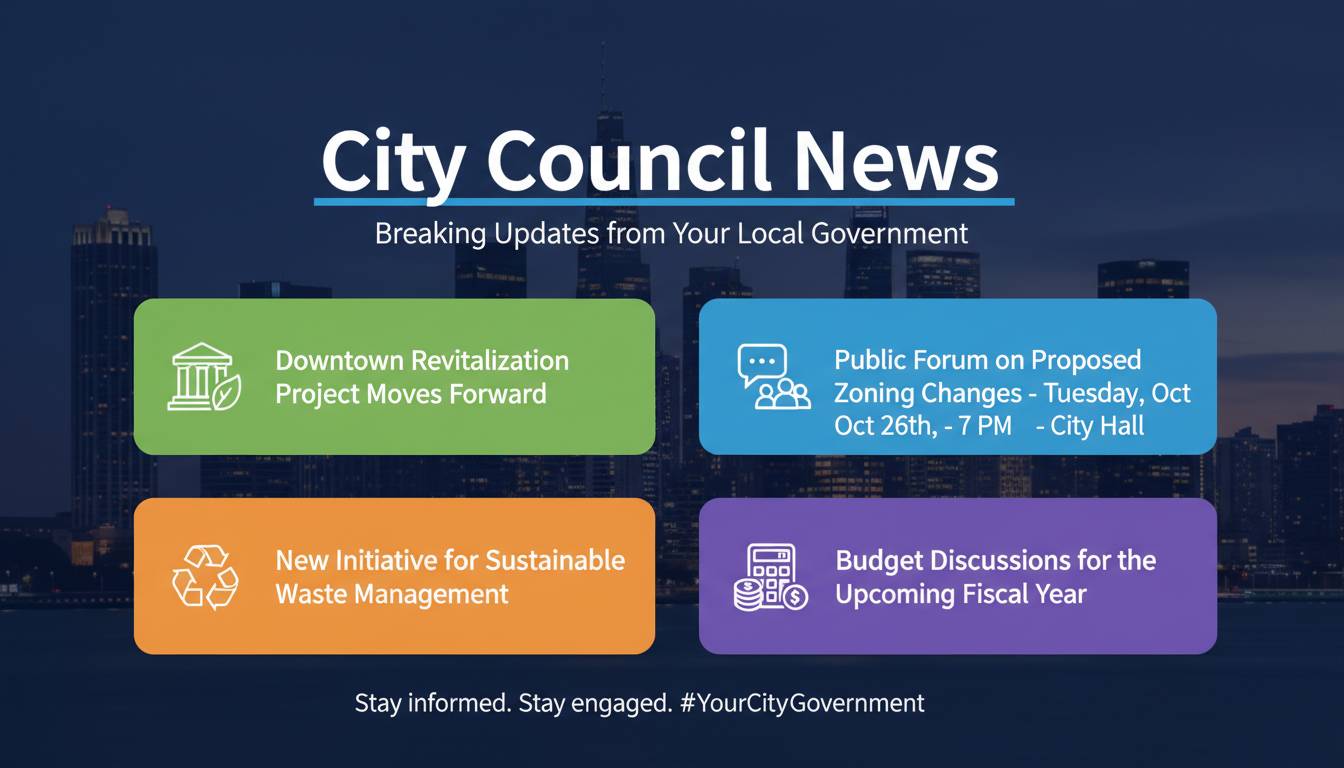
Local government affects your daily life more directly than any other level of politics—from the streets you drive on to the schools your children attend, city councils make decisions that shape your community. Yet many residents remain unaware of how their city council operates or how to stay informed about the decisions being made on their behalf. This guide provides everything you need to understand city council news, track your local government, and engage with the decisions that impact your neighborhood.
📊 STATS
• 84% of Americans say local government has the biggest impact on their daily lives compared to state or federal government
• 72% of U.S. cities operate under a council-manager system, the most common form of city government in America
• 58% of residents rarely or never attend city council meetings, despite them being open to the public (International City/County Management Association, 2023)
Key Takeaways
• City councils are elected legislative bodies that set policy, approve budgets, and make key local decisions
• Meeting transparency has improved significantly with livestreaming and online records now standard in most cities
• Public participation directly influences outcomes—council members frequently cite constituent input as a deciding factor in close votes
• Breaking news often involves zoning changes, budget approvals, development projects, and public safety decisions
• Multiple channels exist for staying informed, from official websites to local news coverage
What Is a City Council?
A city council is the legislative branch of municipal government, responsible for creating local laws, approving the city budget, and overseeing city services. Unlike federal or state governments with separate executive and legislative branches, city governments take various forms—and understanding yours is the first step to engaging with local politics.
Council Structures
Council-Manager System: The most common structure in the U.S., where an elected council sets policy and hires a professional city manager to handle daily operations. Council members focus on legislation while the city manager executes decisions.
Mayor-Council System: The mayor serves as the chief executive while the council handles legislation. This comes in two forms: strong mayor (executive powers vested in the mayor) and weak mayor (ceremonial role with limited powers).
Commission System: Less common, this combines legislative and executive functions into a commission that both creates laws and runs government departments.
💡 STAT: The average U.S. city council has 5-9 members, with larger cities typically having more seats. New York City Council has 51 members, while many small towns operate with just three .
How Council Members Are Elected
Most council members are elected by district (ward-based) or at-large. District elections ensure geographic representation, while at-large elections mean all voters choose every council member. Term lengths typically range from two to four years, with many cities imposing term limits to encourage fresh perspectives.
Types of City Council Decisions
City councils address a wide range of issues that directly affect residents. Understanding the types of decisions made at council meetings helps you know what to watch for in city council news.
Budget and Finance
The annual budget approval is typically the most significant decision council members make. This process determines funding levels for:
• Public safety (police, fire, emergency services)
• Infrastructure (roads, bridges, water systems)
• Parks and recreation
• Public health and social services
• Education funding (in some jurisdictions)
📈 CASE: In 2023, the city of Austin, Texas, approved a $1.1 billion capital improvement budget after months of public input sessions, with council members citing resident feedback as a key factor in prioritizing sidewalk repairs and flood mitigation projects.
Zoning and Land Use
Zoning decisions determine what can be built where—from new housing developments to commercial districts. These decisions often generate significant public interest and debate:
• Rezoning applications
• Conditional use permits
• Subdivision approvals
• Historic preservation designations
Public Safety and ordinances
Councils pass local ordinances that function as city laws, covering everything from noise ordinances to pet regulations to rental property requirements. They also approve police and fire department budgets and sometimes appoint police chiefs or fire chiefs.
Contracts and Procurement
Major city contracts—for services like waste collection, infrastructure construction, or consulting services—require council approval above certain financial thresholds.
| Decision Type | Frequency | Public Interest Level | Typical Timeline |
|---|---|---|---|
| Annual Budget | Annual | High | 2-4 months |
| Zoning Changes | Monthly | High | 30-90 days |
| Routine Ordinances | Monthly | Medium | 2-8 weeks |
| Contract Approvals | Monthly | Low-Medium | 2-4 weeks |
| Appointments | Quarterly | Medium | 2-6 weeks |
How City Council Meetings Work
Understanding the meeting structure helps you follow city council news and, if desired, participate in person.
Meeting Types
Regular Meetings: Held on a scheduled basis (weekly, biweekly, or monthly), these cover standard city business. Most decisions are made at regular meetings.
Special Meetings: Called for urgent matters that cannot wait until the next regular meeting. These must be announced publicly in advance, typically 24-72 hours.
Work Sessions: Informal gatherings where council members discuss issues without taking formal votes. These provide insight into upcoming decisions but offer limited public comment opportunities.
Public Hearings: Required for certain decisions like zoning changes or budget approvals, these are specifically designated times for resident input.
The Meeting Process
-
Call to Order: The meeting begins, often with the pledge of allegiance and roll call of members.
-
Approval of Minutes: Council votes on the previous meeting’s minutes.
-
Public Comment: Residents can speak on any topic, typically with a time limit (often 2-3 minutes per speaker). This period may be limited to items not on the agenda.
-
Reports: The mayor, city manager, or department heads provide updates on ongoing matters.
-
Old Business: Continuation of items from previous meetings.
-
New Business: Introduction and discussion of new items.
-
Action Items: Formal votes on resolutions and ordinances.
-
Adjournment: Meeting concludes.
⚠️ CRITICAL: Most councils require ordinances to be read at two separate meetings before final passage, giving residents two opportunities to voice concerns before final decisions.
Understanding Meeting Documents
Key documents you’ll encounter in city council news:
• Agenda: The list of items to be discussed, typically published 3-7 days before the meeting
• Staff Reports: Background information and analysis prepared by city staff for each agenda item
• Resolutions: Formal statements of council policy or decisions
• Ordinances: Local laws that carry the force of regulation
• Minutes: Official record of what occurred at the meeting
Staying Informed About Local Government
Modern technology has made tracking city council news easier than ever, though options vary by city.
Official Sources
City Website: Most cities now maintain dedicated government websites with meeting calendars, agendas, minutes, and often video archives. Look for a “Government” or “City Council” section.
Email Alerts: Many cities offer email subscription services for meeting notifications, agenda updates, or specific topic areas like zoning or public safety.
Social Media: An increasing number of city councils and individual members maintain active social media presence, sharing updates and engaging with constituents.
Code of Ordinances: Your city’s website should host the complete collection of local laws, searchable by topic.
News Coverage
Local Newspapers: Even as many print publications have declined, local news remains the most consistent source of in-depth city council coverage.
Local Television: Broadcast stations typically cover major council decisions, especially those affecting public safety or large development projects.
Digital Local News: Sites like Patch, local TV station websites, and community news platforms increasingly cover municipal government.
Neighborhood Associations: Local organizations often track council decisions affecting their areas and share updates through newsletters and meetings.
Meeting Access
In-Person Attendance: All council meetings must be open to the public, though some cities have returned to in-person-only meetings post-pandemic.
Livestreaming: Approximately 78% of U.S. cities with populations over 50,000 now livestream council meetings .
Video Archives: Most cities that livestream also maintain online archives, allowing you to watch meetings on demand.
Television Broadcasts: Many cities broadcast meetings on local government access channels.
Common Issues Addressed by City Councils
Certain topics consistently generate significant city council news coverage and public interest.
Development and Growth
Housing development proposals consistently rank among the most contested issues at council meetings. Topics include:
• Rezoning requests for new construction
• Tax increment financing (TIF) districts for economic development
• Historic preservation requirements
• Density bonuses and affordable housing requirements
Public Safety
Council decisions affecting public safety include:
• Police department budgets and staffing levels
• Body camera policies and accountability measures
• Fire station locations and response times
• Traffic safety improvements (speed bumps, crosswalks, signals)
Infrastructure and Transportation
Roads, bridges, water systems, and public transit all fall under council oversight:
• Street repair and maintenance priorities
• Public transit routes and funding
• Parking regulations and rates
• Bike lane and pedestrian infrastructure
Environment and Sustainability
Increasingly, councils address environmental issues:
• Renewable energy initiatives
• Stormwater management requirements
• Tree preservation ordinances
• Climate action plans
📈 CASE: In 2023, the city of Denver City Council passed comprehensive environmental regulations requiring new buildings to include solar panels, citing both environmental goals and economic benefits—the solar industry subsequently reported a 23% increase in local employment .
Tools and Resources for Tracking Council News
Multiple tools exist to help residents stay informed about local government decisions.
| Tool | Cost | Best For | Accessibility |
|---|---|---|---|
| Nextdoor | Free | Neighborhood-level updates | App/Website |
| SeeClickFix | Free | Reporting and tracking local issues | App/Website |
| GovDelivery | Free | Email alerts from your city | |
| Meeting Bot | Free | Automated meeting notifications | Various |
| BallotReady | Free | Candidate and issue information | Website |
| Councilmatic | Free | Meeting tracking and archives | Website |
Top Recommendations:
• Set up email alerts through your city’s website for agenda items in your areas of interest
• Follow your council members on social media for informal updates and engagement
• Download your city’s app if available—many offer direct notification options
• Connect with neighborhood associations that aggregate relevant council news
• Use a meeting tracking service if your city offers one for monitoring specific agenda items
Expert Insights on Local Government Engagement
👤 Dr. Karen Mossberger, Professor of Public Administration at Arizona State University
“Research consistently shows that even brief public comment periods can influence council decisions. When residents speak on specific issues, council members listen—they represent those constituents. The key is being informed about the issue and presenting clear, factual points.”
👤 James Brooks, Civic Technology Director at Bloomberg Philanthropies
“Cities that have implemented open data platforms and user-friendly meeting archives see measurably higher resident engagement. When information is accessible, people participate. We’ve documented a 40% increase in civic engagement in cities that have modernized their government transparency tools.”
📊 BENCHMARKS
| Metric | Average | Top 10% Cities |
|——–|———|—————-|
| Meeting video archive retention | 2 years | 10+ years |
| Agenda published days in advance | 3 days | 7+ days |
| Online public comment options | 12% | 45% |
| Mobile app availability | 34% | 78% |
Frequently Asked Questions
How can I find out when city council meetings are held?
Most cities publish meeting schedules on their official websites, typically under a “City Council” or “Government” section. You can also sign up for email notifications through your city’s website, or search for “city council meeting schedule [your city name]” to find the current schedule.
Can I speak at a city council meeting?
Yes, virtually all city council meetings include a public comment period where residents can speak on any topic. Check your city’s website for specific rules—some require registering in advance, and time limits typically range from 2-5 minutes per speaker.
How do I contact my city council representative?
Most cities provide contact information for individual council members on their official website. You can typically reach them by email, phone, or through constituent service portals. Many council members also maintain social media presence.
What happens if I can’t attend meetings in person?
Most cities now offer livestreaming of meetings through their websites or social media channels. Many also maintain video archives where you can watch recordings on demand. Some cities have added options to submit public comments online or via voicemail.
How long do city council terms last?
Term lengths vary by city but are typically 2-4 years. Many cities also have term limits restricting how many consecutive terms a person can serve. Check your city’s charter or municipal code for specific information.
Where can I find voting records for my city council members?
Most cities publish meeting minutes and voting records on their websites, often in searchable databases. Some cities also use apps or platforms that track voting history and make it easily accessible to residents.
Conclusion
City council news directly affects your daily life—from property values in your neighborhood to the quality of your local parks to the responsiveness of emergency services. While following local government may seem overwhelming, modern tools have made it easier than ever to stay informed about the decisions shaping your community.
The key is finding the information channels that work for you: whether that’s subscribing to email alerts, following council discussions on social media, or tuning in to livestreamed meetings. Remember that your input matters—council members consistently report that constituent feedback influences their decisions, and public participation remains the cornerstone of democratic local governance.
Start small by signing up for agenda notifications on an issue you care about, or simply watch one meeting to understand how your local government operates. The more informed you are, the more effectively you can engage with the decisions that affect your home, your neighborhood, and your city.
















Leave a comment