

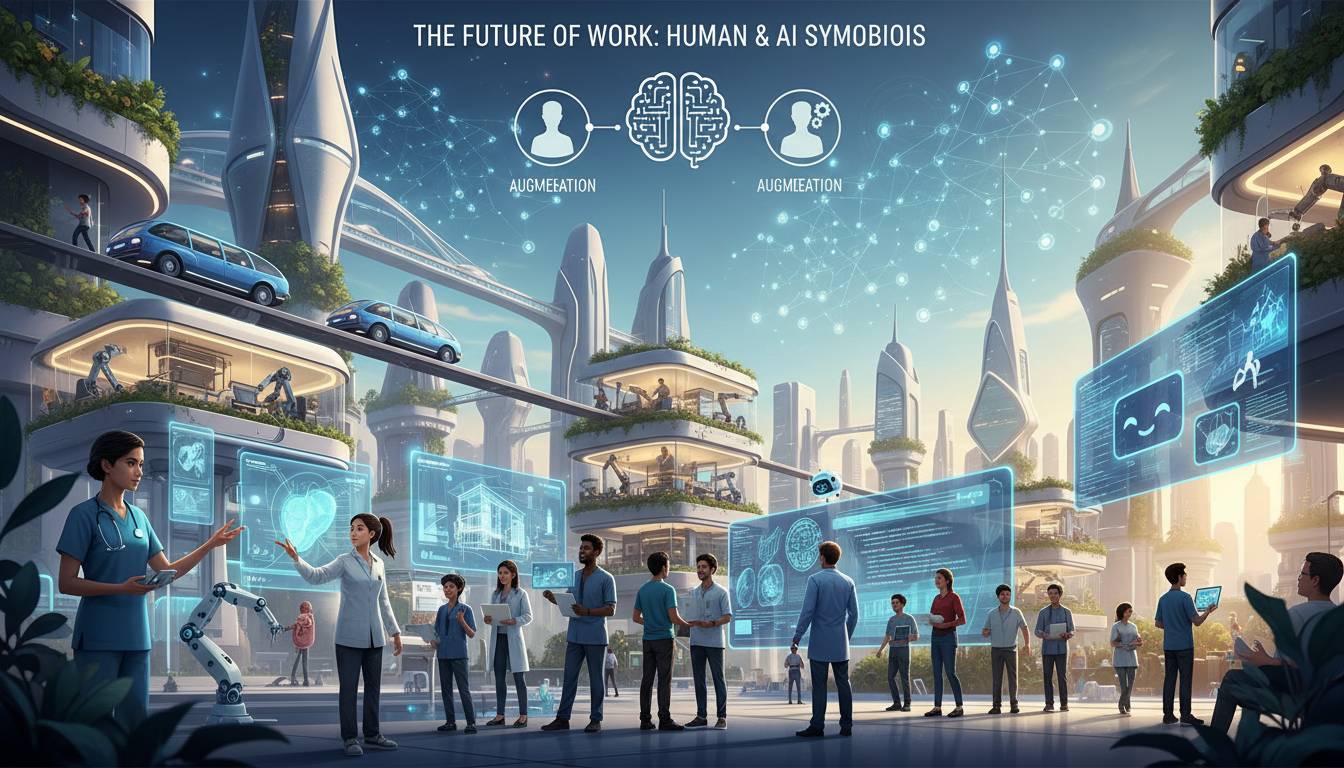
The question of whether artificial intelligence will replace human workers has moved from science fiction speculation to a pressing economic reality. As AI systems grow more capable—from large language models that can write code to computer vision systems that can diagnose diseases—workers across industries are grappling with an unsettling uncertainty: is my job safe?
The short answer is nuanced. AI won’t replace most jobs entirely, but it will fundamentally transform how nearly every profession operates. Research from multiple sources suggests that while AI may automate certain tasks within jobs, complete job replacement is rarer than headlines suggest. Understanding what the research actually shows—and what remains genuinely uncertain—can help workers, businesses, and policymakers prepare for a workforce landscape that is already changing.
The Current State of AI in the Workplace
AI adoption has accelerated dramatically since the release of ChatGPT in November 2022. According to a Gallup poll conducted in February 2024, approximately 22% of U.S. workers reported using AI in their jobs, nearly tripling from 8% just a year earlier. This rapid integration has sparked both enthusiasm and anxiety across industries.
The technology’s capabilities have expanded beyond simple automation. Modern AI systems can now perform tasks that previously required human cognition: analyzing complex datasets, generating written content, identifying patterns in medical images, and even engaging in customer service conversations. Goldman Sachs research from March 2023 estimated that AI could affect approximately 300 million jobs globally, representing roughly 18% of global labor market employment. In the United States, the Brookings Institution has identified that roughly 36 million jobs face high exposure to AI automation, though this doesn’t mean those jobs will disappear entirely.
The retail sector illustrates this transformation clearly. Major retailers like Walmart, Amazon, and Target have deployed AI systems for inventory management, demand forecasting, and checkout automation. Walmart’s use of AI for inventory tracking has reduced stockouts by approximately 30%, according to company reports, while also reducing the need for certain manual counting tasks. However, these same companies continue to employ human workers for customer service, merchandising decisions, and store management—roles requiring judgment, empathy, and adaptability that current AI cannot replicate.
Expert Perspectives on AI and Employment
Economists offer varied perspectives on AI’s workforce impact, though most agree on certain core realities.
Daron Acemoglu, Professor of Economics at MIT and recipient of the Presidential Medal of Freedom, has been notably cautious about predictions of mass unemployment. In a 2023 interview with MIT Technology Review, Acemoglu emphasized that technology historically creates new categories of work even as it automates existing tasks. However, he warned that AI could differ from previous technological revolutions if it primarily replaces human judgment rather than physical labor. His research suggests that approximately 50% of tasks could be automated with current technology, but complete job elimination affects far fewer positions.
Erik Brynjolfsson, Director of the Stanford Digital Economy Lab and former Senior Economic Advisor to President Obama, takes a more optimistic view while acknowledging disruption. In his 2023 book “The Turing Trap: The Promise & Peril of Human-Level Artificial Intelligence,” Brynjolfsson argues that AI’s greatest potential lies in augmenting human capabilities rather than replacing them entirely. He advocates for policies that encourage “centaur” arrangements—systems where humans and AI work together, each contributing their distinct strengths. Research from his Stanford lab found that customer service agents using AI assistants were 14% more productive than those working alone, with the largest gains among less experienced workers.
Andrew Yang, entrepreneur and former presidential candidate, has been one of the most vocal advocates for addressing automation’s workforce impact. During his 2020 campaign, Yang proposed a universal basic income partly in response to anticipated job displacement from AI and automation. While his specific policy proposals remain debated, Yang’s central argument—that the U.S. is underinvesting in workforce adaptation—has gained broader acceptance. In a 2023 Washington Post interview, Yang noted that white-collar professions like law, finance, and journalism face exposure to generative AI that previous automation waves did not reach.
The World Economic Forum’s 2023 Future of Jobs Report, which surveyed 803 companies across 53 economies, projected that AI will create 97 million new jobs globally while displacing 85 million, resulting in a net gain of 12 million jobs by 2025. However, the report emphasized that this outcome depends heavily on workforce retraining and economic policies.
Jobs at Highest Risk of AI Disruption
Research consistently identifies certain categories of work facing the greatest exposure to AI-driven automation. Understanding which roles are most vulnerable can help workers and organizations prioritize adaptation strategies.
Administrative and Clerical Roles
Office and administrative support positions face some of the highest automation exposure. The BLS Occupational Outlook Handbook projects declining employment for several administrative categories through 2032. AI-powered tools can now schedule meetings, process documents, manage emails, and handle routine correspondence with increasing sophistication. A 2023 study from Princeton University found that jobs requiring strong written language skills show the highest exposure to large language model impacts, affecting approximately 20% of current worker time.
Manufacturing and Production
While robotic automation has affected manufacturing for decades, AI is accelerating the transformation. The International Federation of Robotics reported that global robot installations reached 553,000 units in 2022, a 5% increase from the prior year. AI-powered robots can now perform complex assembly tasks, quality control inspection, and adaptive manufacturing that previously required human flexibility. However, research from MIT indicates that complete factory automation remains economically unfeasible for most production lines, with human workers retaining advantages in handling exceptions, maintaining equipment, and performing tasks requiring fine motor skills.
Customer Service and Sales
The customer service sector has already seen significant AI deployment. Chatbots and virtual assistants now handle routine inquiries across banking, retail, and telecommunications. Juniper Research estimates that chatbots alone will save businesses approximately $11 billion annually by 2023. Nevertheless, complex customer interactions—those involving emotional intelligence, unusual problems, or high-stakes decisions—still require human intervention. A 2024 Harvard Business School study found that while AI handled routine inquiries effectively, human agents remained essential for retaining customers in disputes averaging more than $200 in value.
Certain Healthcare Functions
AI diagnostic tools have shown remarkable accuracy in specific applications. Studies published in Nature Medicine have demonstrated AI systems matching or exceeding human radiologists in detecting certain conditions from medical images. However, healthcare involves far more than diagnosis. A 2023 American Medical Association report emphasized that physicians spend significant time on care coordination, patient communication, and complex decision-making—tasks where human judgment remains essential. The BLS projects continued growth in healthcare employment through 2032, reflecting that technology tends to augment rather than eliminate healthcare roles.
Why Certain Jobs Remain Resistant to AI Replacement
Despite AI’s advancing capabilities, fundamental limitations explain why complete job replacement remains unlikely for most occupations.
Complex Physical Environments
Tasks requiring navigation of unstructured, physical environments remain extremely difficult for AI systems. Warehouse work, construction, and service industry roles involve constant adaptation to physical spaces, unpredictable obstacles, and varied customer interactions. While companies like Amazon have deployed extensive automation in their fulfillment centers, human workers still perform the majority of tasks requiring manipulation of diverse objects, problem-solving in novel situations, and quality control. A 2023 MIT study found that less than 5% of current occupations could be fully automated given existing technology.
Emotional Intelligence and Social Skills
Roles centered on human connection—teaching, counseling, nursing, management, and sales involving relationship building—require emotional intelligence that current AI cannot replicate. Research from Harvard Business School demonstrates that trust, empathy, and rapport significantly influence outcomes in healthcare, education, and business. While AI can assist these roles, the human element remains central. Teachers use AI for lesson planning but maintain responsibility for student motivation, social development, and individualized support. Nurses leverage AI for monitoring but provide the human care that significantly affects patient outcomes.
Creativity and Novel Problem-Solving
AI systems excel at pattern recognition and generating outputs based on training data, but they struggle with genuine creativity—the ability to produce truly novel ideas disconnected from existing examples. Writers, artists, designers, and strategists whose work involves original contribution rather than recombination remain less vulnerable. A 2024 study from Columbia University found that occupations requiring high creativity showed 59% lower exposure to language model impacts compared to routine cognitive jobs. Similarly, complex problem-solving in ambiguous situations—where the right answer isn’t clear from existing data—continues to require human judgment.
Ethical Reasoning and Accountability
Professions involving moral judgment, legal responsibility, and public accountability cannot delegate decisions to AI systems. Corporate executives, judges, police officers, and government officials must justify decisions to stakeholders and bear responsibility for outcomes. Current AI lacks the capacity for ethical reasoning required in these contexts. Legal frameworks also create barriers: who bears responsibility when an AI system causes harm? This accountability gap limits AI deployment in high-stakes decision-making roles.
New Jobs and Industries AI Will Create
Historical precedent suggests technology creates new job categories that didn’t previously exist. The internet spawned roles like social media manager, UX designer, and app developer—occupations that would have seemed foreign three decades ago. AI is expected to follow this pattern.
AI and Data-Related Roles
The demand for AI specialists has surged dramatically. The BLS projects 40% growth in data scientist positions through 2032, much faster than average occupation growth. Beyond technical AI roles, organizations need prompt engineers—workers who craft inputs to optimize AI outputs—AI ethicists who ensure systems operate fairly, and machine learning operations specialists who maintain AI systems. Companies like Google, Microsoft, and Amazon have created entire job categories around AI oversight that didn’t exist five years ago.
Human-AI Collaboration Specialists
Emerging roles focus on optimizing human-AI teamwork. AI trainers teach systems to improve accuracy. AI auditors evaluate system performance and identify biases. AI integration specialists help organizations incorporate AI tools into existing workflows. A 2023 World Economic Forum report identified these “frontier jobs” as growth categories across multiple industries.
Green Economy and AI Transition
Climate change mitigation is creating new employment categories that intersect with AI. The renewable energy sector, electric vehicle manufacturing, and sustainable technology all require workers—and AI optimizes these systems. The International Energy Agency projects that the clean energy sector could create 24 million jobs globally by 2030. Workers with skills spanning both AI and sustainability domains may find particularly strong demand.
Economic and Social Implications
Beyond individual job prospects, AI’s workforce impact raises broader economic questions that society must address.
Productivity and Economic Growth
Economists debate whether AI will significantly boost productivity—a metric that has disappointed since the 2008 financial crisis. If AI delivers on its potential, productivity gains could create economic growth that offsets job displacement through new opportunities. However, productivity improvements from AI have been difficult to measure precisely. The Federal Reserve Bank of San Francisco found minimal productivity gains from AI so far, though the technology remains nascent.
Wage and Inequality Effects
Research suggests AI may amplify existing wage inequalities. High-skilled workers who can leverage AI tools may see productivity and wage increases, while workers in automatable roles face wage pressure. A 2023 OECD study found that AI adoption correlated with increased demand for college-educated workers while reducing demand for routine manual labor. This pattern could widen educational wage gaps unless addressed through policy and training.
Workforce Adaptation Requirements
Successful workforce transition requires significant investment in retraining and education. The OECD estimates that approximately 14% of workers will need significant retraining due to AI over the next decade. Current U.S. workforce development spending falls short of this challenge. A 2023 report from the Georgetown Center on Education and the Workforce estimated that achieving adequate AI-related workforce preparation would require $50-100 billion in additional annual investment.
Frequently Asked Questions
Will AI make my job obsolete?
For most workers, AI is more likely to change how you work rather than eliminate your job entirely. Research from McKinsey suggests that while approximately 30% of current tasks in most jobs could be automated, complete job elimination affects far fewer positions. The key adaptation is learning to work alongside AI tools—workers who develop AI fluency while strengthening distinctly human skills like creativity, emotional intelligence, and complex problem-solving will be most resilient.
Which industries will be most affected by AI in the next five years?
Based on current adoption patterns, industries with significant routine cognitive work face the earliest disruption: financial services (especially in analysis and reporting), healthcare (diagnostics and administration), legal (research and document review), and media/content creation. However, transformation will occur across nearly all sectors, just at varying speeds. Service industries and blue-collar work face slower adoption due to physical task requirements and emotional intelligence needs.
How can I prepare my career for AI changes?
Focus on three areas: technical literacy (understanding how AI tools work and how to use them effectively), uniquely human skills (empathy, creativity, complex judgment, and relationship building), and adaptability (willingness to learn new tools and processes). Online platforms like Coursera, edX, and LinkedIn Learning offer AI-related courses ranging from technical training to business applications. Additionally, pursuing certifications in your field that incorporate AI tools demonstrates initiative to employers.
Are AI-related jobs well-paying?
Yes, AI and data-related positions typically offer among the highest compensation in the current job market. Machine learning engineers and data scientists frequently command salaries above $150,000 in major U.S. markets. Even adjacent roles like AI product managers and AI ethicists often earn significantly above average. However, competition for these positions is intense, and technical roles typically require strong quantitative backgrounds.
What role will government policy play in AI’s workforce impact?
Policy decisions will significantly influence outcomes. Potential interventions include: investment in workforce retraining programs, education reform emphasizing AI-related skills, adjustment of unemployment insurance for displaced workers, potential consideration of portable benefits or income support programs, and regulation of AI deployment in ways that balance innovation with worker protection. Several U.S. states have already passed or considered AI-related workforce legislation.
Looking Ahead: Navigating AI’s Workforce Impact
The evidence suggests that AI will neither create mass unemployment nor leave the workforce unchanged. Instead, the technology will reshape work in ways that require adaptation from workers, businesses, and policymakers alike.
For workers, the path forward involves embracing AI as a tool while developing distinctly human capabilities that complement rather than compete with machine intelligence. For businesses, success requires thoughtful AI integration that enhances rather than diminishes the human elements that drive innovation, customer satisfaction, and ethical decision-making. For policymakers, the challenge is creating frameworks that encourage AI’s productive potential while ensuring its benefits are broadly shared.
The transition won’t be seamless. Some workers and communities will face genuine disruption requiring support. But historical precedent—from the agricultural revolution to the internet age—suggests that technological transformation ultimately creates more opportunity than it eliminates. The key is preparing for that transition deliberately rather than passively awaiting its outcome.
Last Updated: January 2025














Leave a comment