

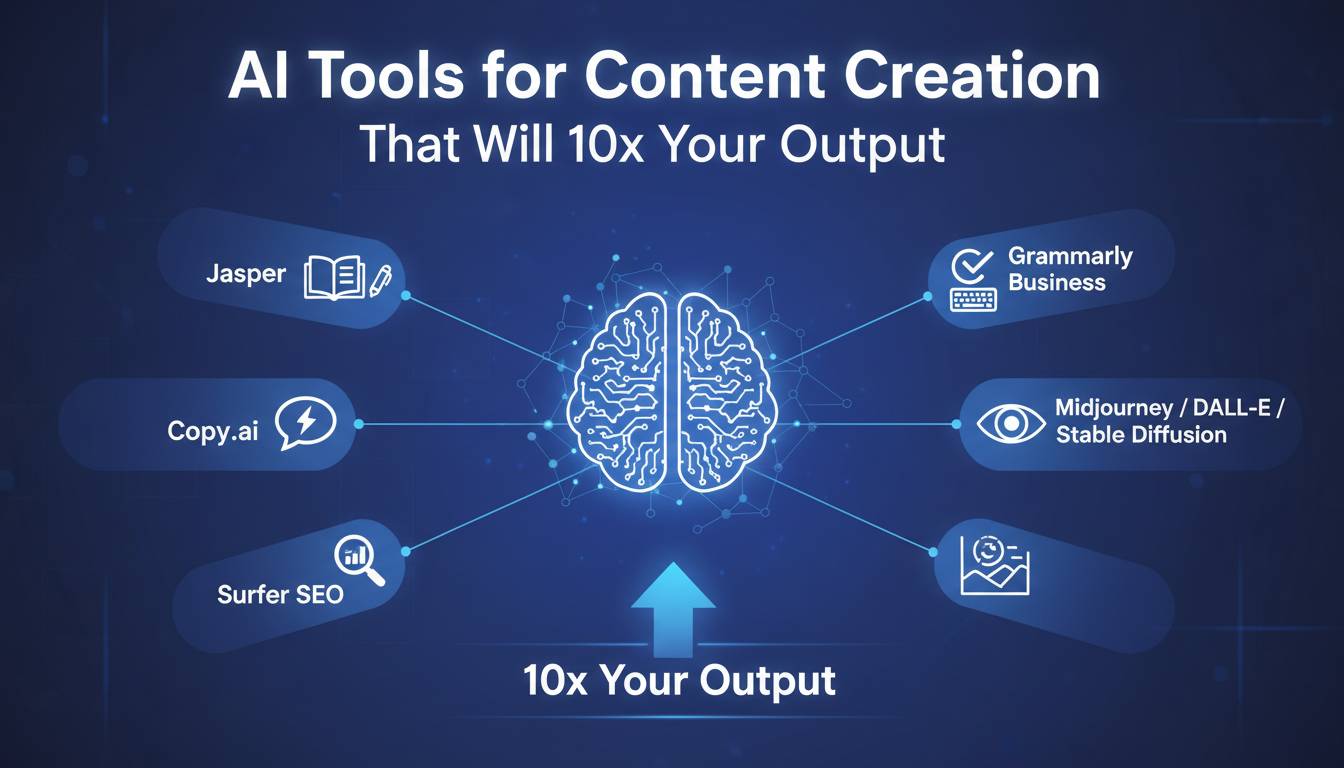
The content creation landscape has undergone a seismic shift. What once required teams of writers, designers, and editors now can be accomplished by individuals wielding powerful artificial intelligence tools. In 2024 and heading into 2025, these platforms have evolved from novelty gadgets into essential productivity infrastructure for marketers, creators, and businesses alike. This guide examines the leading AI tools transforming content creation, how they work together, and which solutions deliver measurable returns on your investment of time and money.
Understanding the Current AI Content Creation Ecosystem
The market for AI content tools has exploded, with solutions now spanning text generation, image creation, video production, audio synthesis, and multimodal workflows that combine multiple capabilities. According to industry analysis from Gartner , enterprise adoption of generative AI tools increased 300% year-over-year, with content marketing representing one of the largest implementation categories.
What makes this generation of AI tools different from earlier automation is their contextual understanding. Modern large language models comprehend nuance, tone, and audience, enabling outputs that read as genuinely human-created rather than obviously machine-generated. This shift has profound implications for content velocity, personalization at scale, and creative iteration speed.
The primary categories include writing assistants like ChatGPT, Claude, and Jasper; image generators such as DALL-E 3, Midjourney, and Stable Diffusion; video creation tools including Runway and Synthesia; audio solutions like ElevenLabs and Descript; and integrated platforms offering end-to-end workflows. Understanding which tools serve which purposes—and how they integrate—forms the foundation for building an AI-powered content operation.
Text Generation and Writing Assistants
Text-focused AI tools have matured the fastest and offer the most immediate productivity gains. ChatGPT (OpenAI) remains the dominant player, with its GPT-4 and o1 models capable of drafting articles, social posts, email sequences, and technical documentation with remarkable coherence. The platform’s Custom Instructions feature allows users to establish persistent brand voice parameters, reducing the need to repeat context across sessions.
Claude (Anthropic) has gained significant traction among writers and editors for its strong performance on long-form content and nuanced reasoning tasks. Claude 3.5 Sonnet demonstrates particular strength in maintaining consistent tone across extended documents and excels at iterative refinement—users report it requires fewer revision cycles than competitors.
Jasper positions itself specifically at marketing teams, offering templates for common content formats, brand voice consistency tools, and campaign workflows. Its Boss Mode enables voice-command drafting that appeals to teams seeking efficiency without sacrificing quality.
ForSEO content specifically, tools like Surfer SEO integrate AI writing with SERP analysis, ensuring content aligns with ranking factors while maintaining readability. Similarly, NeuronWriter combines AI generation with content optimization scoring based on competitor analysis.
The practical reality: these tools excel at generating first drafts and overcoming initial blank-page paralysis, but human editing remains essential for accuracy, brand authenticity, and strategic nuance. Writers using AI as a collaborative partner rather than a replacement report the highest satisfaction and output quality.
Visual Content Creation With AI
Image generation has transitioned from experimental curiosity to production-ready capability. Midjourney produces highly stylized, artistic imagery favored by creative professionals seeking distinctive visual identity. Its latest versions demonstrate improved text rendering and prompt adherence, addressing earlier limitations that frustrated commercial users.
DALL-E 3 (OpenAI) integrates tightly with ChatGPT, allowing users to generate images through conversational prompts without learning specialized syntax. This accessibility makes it particularly attractive for teams without dedicated design resources. Commercial usage rights come standard with paid plans, clarifying legal considerations that complicate some competitors.
Adobe Firefly represents a significant enterprise play, offering AI generation embedded within established creative workflows. Its training on Adobe Stock imagery addresses copyright concerns that have made some businesses hesitant to adopt consumer-focused generators. Integration with Photoshop and Illustrator allows AI-generated elements to become part of existing production pipelines.
For marketing teams requiring consistent brand imagery, solutions like Brandmark and Looka offer AI-powered logo and brand asset generation, though outputs require professional refinement for commercial deployment.
The emergence of AI image detection tools has created an interesting dynamic. Platforms like Hive and Originality AI help content teams identify AI-generated imagery, useful for organizations with disclosure policies or quality standards requiring human-created visuals.
Video and Multimedia AI Solutions
Video content presents both the highest effort-to-output ratio and the greatest opportunity for AI disruption. Runway has established itself as the leading AI video creation platform, offering generative video, editing tools, and effects previously requiring expensive software and specialized skills. Its Gen-2 and Gen-3 models produce increasingly photorealistic results from text prompts and image inputs.
Synthesia enables creation of AI-powered presenter videos using virtual avatars. This capability proves particularly valuable for corporate training, product demonstrations, and localized marketing—organizations can produce videos in multiple languages without hiring on-camera talent. Pricing starts around $30 per minute, making it cost-effective for high-volume video needs.
For shorter-form content, tools like Pictory and Lumen5 transform text content into video summaries, automatically selecting relevant imagery and adding motion. These serve social media and content repurposing workflows effectively.
Descript has revolutionized podcast and video editing through AI transcription, overdub (voice cloning for corrections), and automatic filler-word removal. Its Studio Sound feature removes background noise and enhances audio quality from recordings made in less-than-ideal environments.
The video generation space continues rapid evolution. OpenAI’s Sora, though not yet publicly available as of early 2025, has demonstrated capabilities that suggest significant advancement in text-to-video quality. Organizations should monitor this space closely while implementing currently available solutions.
Integrated Workflow Platforms and Automation
Beyond individual tool categories, integrated platforms are emerging that combine multiple AI capabilities into unified workflows. Copy.ai offers end-to-end campaign creation combining copywriting, social media, and email generation. Its workflow builder allows teams to create custom automation sequences matching their content processes.
HubSpot’s AI content tools integrate with its CRM platform, connecting AI-generated content directly to customer data for personalization at scale. This integration represents the direction the market moves—AI content creation not as standalone capability but as component of broader marketing operations.
Zapier connects AI tools with thousands of applications, enabling custom automation sequences. A typical workflow might generate a ChatGPT response to a form submission, create a corresponding image in DALL-E, and compile both into a social media post via Buffer—all without manual intervention.
For enterprise organizations, Microsoft Copilot and Google Gemini embed AI capabilities directly into productivity suites, bringing content assistance to the applications workers already use daily. This ambient integration reduces friction compared to adopting entirely new platforms.
Practical Implementation Strategies
Successfully deploying AI content tools requires strategic rather than tactical implementation. Organizations achieving the highest returns follow consistent patterns:
First, identify specific bottlenecks in existing content workflows. Common pain points include ideation and research time, initial drafting speed, content repurposing across formats, and localization for different markets. AI tools should target identified inefficiencies rather than adopted generically.
Second, establish clear guidelines for AI usage within your organization. This includes disclosure policies (whether and how you communicate AI usage to audiences), quality review processes, and brand voice parameters encoded into tool configurations. The absence of these frameworks leads to inconsistent output and potential brand damage.
Third, invest in training. The difference between productive and frustrating AI tool usage often correlates with prompt engineering skill. Teams that learn effective prompting techniques dramatically outperform those treating AI as magic boxes producing unknown outputs.
Fourth, measure results against specific KPIs. Whether tracking time-to-publication, content volume, engagement metrics, or conversion rates, establishing baseline measurements before implementation enables genuine assessment of AI tool value.
Cost Considerations and ROI Analysis
AI tool pricing varies significantly across categories and providers. Individual writing tools typically range from free tiers to $50-100 monthly for professional plans. Image generation tools often charge per credit or offer monthly generation limits, with costs scaling with usage volume. Video production tools represent the higher end, with enterprise solutions running thousands of monthly.
Calculating ROI requires accounting for both direct costs and opportunity costs. A tool that costs $500 monthly but saves 20 hours of team time at $50 hourly rates delivers clear positive return. More difficult to quantify but equally important is the capacity to pursue projects previously impossible with available resources—additional content volume, faster iteration cycles, or capabilities like multilingual production that required external vendors.
Many organizations report that the most valuable AI implementation produces outputs they never would have created without the tool—not just faster versions of existing processes. This transformational rather than incremental value often exceeds efficiency gains in total impact.
Emerging Trends and Future Outlook
Several trajectories will shape AI content creation through 2025 and beyond. Multimodal AI—systems processing and generating text, images, audio, and video within unified frameworks—will reduce the friction of current tool fragmentation. Already, GPT-4V and Gemini demonstrate capabilities spanning modalities.
Personalization at scale will become increasingly sophisticated. Rather than producing multiple versions of content manually, organizations will feed AI systems with audience data to automatically generate variant content optimized for different segments.
Agentic AI—systems capable of autonomous action rather than just response—will handle more of the execution burden. Current AI requires human initiation and review; next-generation tools will manage entire content campaigns with human oversight rather than hands-on involvement.
Regulatory and ethical frameworks will continue developing. Disclosure requirements, copyright considerations, and authenticity standards will clarify, potentially favoring organizations that proactively adopt responsible AI practices rather than waiting for mandates.
Frequently Asked Questions
Which AI writing tool is best for content marketing?
The best tool depends on your specific use case. ChatGPT offers the most versatile capabilities and benefits from continuous improvement through OpenAI’s research. Jasper provides the most marketing-specific templates and workflow features. Claude excels at long-form content requiring nuanced reasoning. Most content teams find value in using multiple tools for different purposes—ChatGPT for ideation and drafting, Claude for refinement, and specialized tools for SEO optimization.
Can AI-generated content rank well in search engines?
Yes, AI-generated content can rank well when it provides genuine value, demonstrates expertise, and meets search intent—factors Google evaluates regardless of how content was created. The key is ensuring AI serves as a productivity enhancer rather than a shortcut to low-quality output. Search engines penalize content that is unhelpful, inaccurate, or created primarily to manipulate rankings, regardless of whether humans or AI produced it.
How do I maintain brand voice when using AI tools?
Establishing consistent brand voice requires upfront configuration and ongoing refinement. Most AI tools allow Custom Instructions or similar features where you document brand voice characteristics, terminology preferences, and style guidelines. Save these configurations as reusable templates. Additionally, always review and edit AI outputs rather than publishing them directly. Over time, you’ll refine your prompting approach based on what produces outputs closest to your brand standards.
Are there copyright concerns with AI-generated images and content?
This remains an evolving legal area. U.S. Copyright Office guidance indicates that AI-generated content without human creative input may not receive copyright protection, while human-edited AI output can qualify. For commercial use, prefer tools with clear commercial rights policies (Adobe Firefly trains on licensed stock; DALL-E includes commercial rights with paid plans). Organizations with strict compliance requirements should involve legal counsel in AI tool selection and usage policies.
What is the learning curve for implementing AI content tools?
Most consumer-facing AI tools require minimal technical knowledge—capable users achieve basic proficiency within hours. However, achieving professional-quality outputs consistently requires practice with prompting techniques, understanding tool limitations, and establishing effective workflows. Budget training time accordingly: expect 2-4 weeks of regular use before your team achieves comfortable proficiency and 2-3 months before reaching efficiency plateau.
How much should a business budget for AI content creation tools?
Budgets vary widely based on team size and usage volume. Individual tools range from free to $100+ monthly per user. An SMB marketing team might budget $200-500 monthly for a core toolkit (writing + image generation + basic video). Enterprise operations with integrated platforms and higher volumes can expect $1,000-5,000+ monthly. Start with essential tools, measure utilization and ROI, then expand budget based on demonstrated needs rather than預 speculating on requirements.
Conclusion
AI tools for content creation have matured from experimental technology to operational necessity. The organizations achieving transformative results approach implementation strategically: identifying specific workflow bottlenecks, selecting tools targeting those needs, establishing clear usage guidelines, and measuring results against defined KPIs.
The most successful practitioners treat AI as a collaborative partner rather than replacement for human creativity. These tools excel at handling repetitive tasks, generating initial drafts, and expanding production capacity—but strategic direction, brand authenticity, and quality assurance remain fundamentally human responsibilities.
The tools and capabilities will continue evolving rapidly. Rather than attempting to adopt every new development, focus on building flexible foundations: prompt engineering skills, workflow integration capabilities, and evaluation frameworks that allow you to assess new tools against demonstrated needs. This adaptive approach positions content operations to capture value from advancing AI capabilities while maintaining the quality and authenticity that builds genuine audience relationships.
Start with one tool addressing your most pressing bottleneck, measure the impact, and expand systematically. The 10x output improvement promised in the AI content space isn’t automatic—but it’s entirely achievable with thoughtful implementation and realistic expectations about what these tools actually deliver.












Leave a comment