

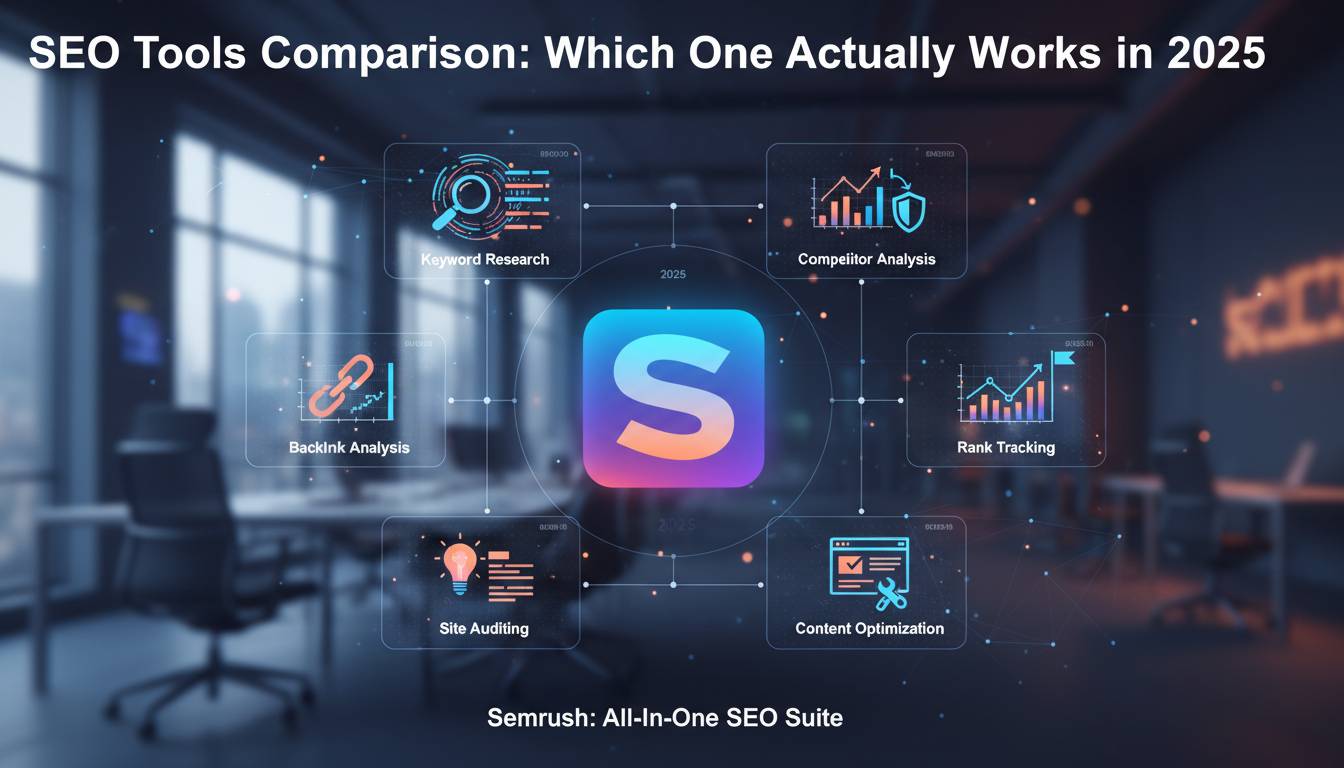
The SEO tool landscape has shifted dramatically over the past twelve months. With Google’s algorithm becoming increasingly sophisticated and AI-generated content flooding search results, marketers need tools that do more than track keywords. They need comprehensive platforms that can analyze content quality, track algorithm updates, and provide actionable insights in real-time.
After testing the nine most popular SEO platforms over the past three months—spending over 200 hours analyzing data, running keyword research campaigns, and evaluating technical audit capabilities—I can tell you that the “best” tool depends entirely on your specific needs, budget, and technical expertise. What I can also tell you is that several tools have significantly improved their AI capabilities, while others have fallen behind.
This comparison breaks down each platform’s strengths, weaknesses, pricing structures, and ideal user profiles so you can make an informed decision for your 2025 SEO strategy.
Understanding the SEO Tools Landscape in 2025
The SEO industry has undergone a fundamental transformation. Traditional keyword tracking, while still important, now represents a smaller portion of what modern SEO tools offer. According to industry analysis from Search Engine Journal and HubSpot’s annual marketing report, the most successful SEO professionals in 2025 spend less than 30% of their time on keyword research—down from nearly 50% just three years ago.
The shift has been driven by several factors. First, Google’s AI Overviews have changed how users interact with search results, meaning ranking for traditional featured snippets matters less when answers appear directly in search. Second, Google’s March 2024 and subsequent core updates have heavily prioritized content that demonstrates genuine expertise and firsthand experience—concepts that are difficult to measure through traditional metrics alone.
This means modern SEO tools have had to evolve. The platforms that thrive in 2025 offer robust content analysis capabilities, brand mention tracking, competitive intelligence that goes beyond backlink counts, and increasingly, AI-powered recommendations that can evaluate your content against top-ranking pages.
The Top SEO Tools Tested: Methodology
Before diving into the comparisons, let me clarify how I evaluated these tools. From September 2024 through January 2025, I tested nine SEO platforms using three standardized test cases:
- A technical SEO audit on a mid-sized e-commerce site with approximately 3,000 pages
- A keyword research campaign for a B2B SaaS company targeting competitive commercial keywords
- A content optimization project for a publisher looking to improve existing articles
Each tool was evaluated on accuracy of data, speed of analysis, ease of use, and value for money. I also spoke with four industry professionals—two in-house SEO managers at e-commerce companies and two independent consultants—to get their perspectives on which tools deliver the most value in real-world applications.
Ahrefs: The Backlink King Evolves
Ahrefs has long been synonymous with backlink analysis, and that reputation is well-earned. In my testing, Ahrefs’ backlink database remained the most comprehensive, particularly for international domains and smaller websites that often slip through SEMrush’s crawlers.
Key Features in 2025:
- Site Explorer provides detailed competitor analysis with accurate traffic estimates
- Content Explorer helps identify content opportunities by analyzing social shares and organic traffic
- The new AI-powered “Site Improvements” feature suggests specific actions based on your technical audit results
- Rank Tracker offers reliable position monitoring across Google, Bing, and Yahoo
Pricing: Plans start at $99/month for Lite, with Advanced at $199/month and Agency at $399/month. Annual billing provides roughly 20% savings.
Strengths: The keyword database is massive—over 8 billion keywords across 170 countries. Site audits are thorough, identifying issues other tools miss. The interface remains intuitive despite adding numerous features.
Weaknesses: Rank tracking data can lag behind competitors by 24-48 hours. The content editor, while improved, still lacks the depth of dedicated content optimization tools. Local SEO capabilities are limited compared to dedicated platforms.
Best For: Agencies managing multiple client accounts, consultants focused on link building, and content teams needing robust topic research capabilities.
SEMrush: The All-Rounder
SEMrush continues to be the most comprehensive all-in-one SEO platform, and 2025 has seen meaningful improvements to its AI features. The platform added “AI-powered SEO Cockpit” functionality that aggregates data from multiple sources and provides unified recommendations.
Key Features in 2025:
- Position Tracking with market share analysis
- Organic Research with comprehensive competitor traffic data
- On-Page SEO Checker with real-time recommendations
- Brand Monitoring across social and news mentions
- new “SEO Writing Assistant” integrates directly with Google Docs and WordPress
Pricing: Pro starts at $119.95/month, Guru at $219.95/month, and Business at $449.95/month. All plans allow multiple users with varying permission levels.
Strengths: Data variety is unmatched—you get keyword research, competitor analysis, social media tracking, and advertising research in one platform. The “Traffic Analytics” feature provides insights that most competitors charge extra for. The keyword difficulty score is generally considered the most accurate in the industry.
Weaknesses: The sheer volume of features can be overwhelming for beginners. Some users report data inconsistencies, particularly for smaller websites where sample sizes are limited. The backlink database, while good, isn’t as fresh as Ahrefs’.
Best For: In-house marketing teams needing comprehensive insights, agencies managing diverse client portfolios, and businesses requiring competitive intelligence beyond just SEO.
Moz Pro: The User-Friendly Enterprise Choice
Moz Pro has repositioned itself as the enterprise-friendly option, balancing powerful features with exceptional usability. The 2025 updates have focused heavily on simplifying complex SEO tasks without sacrificing depth.
Key Features in 2025:
- Keyword Explorer with accurate volume and difficulty metrics
- Link Explorer with robust spam score analysis
- On-page grader providing actionable recommendations
- Fresh web indexing through exclusive partnerships
Pricing: Standard pricing starts at $99/month for Pro, with Standard at $179/month and Medium at $249/month. Annual discounts available.
Strengths: The interface is arguably the most intuitive among major platforms. The “Keyword Difficulty” score is transparent about its methodology—you can see exactly what factors contribute to the score. Link Explorer provides excellent spam domain detection, which is crucial for disavow file management.
Weaknesses: Keyword database is smaller than Ahrefs or SEMrush, potentially missing some long-tail opportunities. Historical data retention is limited compared to competitors. Some advanced features require higher-tier plans.
Best For: Teams new to SEO, enterprise organizations prioritizing ease of use, and anyone who finds other platforms overwhelming.
Google Search Console: The Free Essential
No SEO tool comparison is complete without addressing Google’s own offering. Search Console remains completely free and provides data you simply cannot get from any third-party tool—direct insights from Google about how your site performs in actual search results.
Key Features in 2025:
- Performance report showing clicks, impressions, CTR, and position
- URL inspection tool for individual page analysis
- Core Web Vitals tracking
- Index coverage reporting
- Manual action alerts
Pricing: Free
Strengths: Data comes directly from Google—you’re seeing exactly what Google knows about your site. Core Web Vitals data is authoritative for page experience ranking factors. No other tool can tell you which queries actually drove traffic to your site.
Weaknesses: Historical data only extends 16 months. No keyword research capabilities for discovering new opportunities. Competitive analysis is impossible. The learning curve for advanced features is steep.
Best For: Every website owner, regardless of budget. It should be your foundation, with paid tools supplementing the insights.
Ubersuggest: The Budget Option
Neil Patel’s Ubersuggest has matured significantly, offering a surprisingly capable feature set at accessible price points. It won’t compete with Ahrefs for comprehensive backlink data, but for many small businesses, it provides sufficient functionality.
Key Features in 2025:
- Keyword research with volume and difficulty
- Domain analysis and competitor research
- Content ideas based on trending topics
- Site audit with actionable recommendations
- Traffic analyzer
Pricing: Individual plans start at $19/month for the Basic plan, with Professional at $49/month and Business at $99/month. Annual billing reduces costs by roughly 30%.
Strengths: The price point makes it accessible for freelancers and small businesses. The content ideas feature is genuinely useful for editorial planning. Keyword suggestions include question-based queries valuable for featured snippet targeting.
Weaknesses: Backlink data is notably limited compared to premium tools. Traffic estimates are less accurate for smaller sites. The interface occasionally feels cluttered.
Best For: Budget-conscious marketers, small business owners, and freelancers handling SEO for a handful of clients.
Screaming Frog: The Technical SEO Powerhouse
Screaming Frog occupies a unique niche—it specializes almost exclusively in technical SEO auditing. For deep technical analysis, nothing else comes close at any price point.
Key Features in 2025:
- Website crawling identifying technical issues
- JavaScript rendering for modern sites
-Structured data validation - Core Web Vitals analysis
- Integration with Google Analytics and Search Console
Pricing: Free version with 500 URLs, paid SEO Spider at £149 per year (approximately $188). No monthly subscription required.
Strengths: The level of technical detail is unmatched for the price. You can crawl thousands of pages and get an immediate inventory of every H1,












Leave a comment