

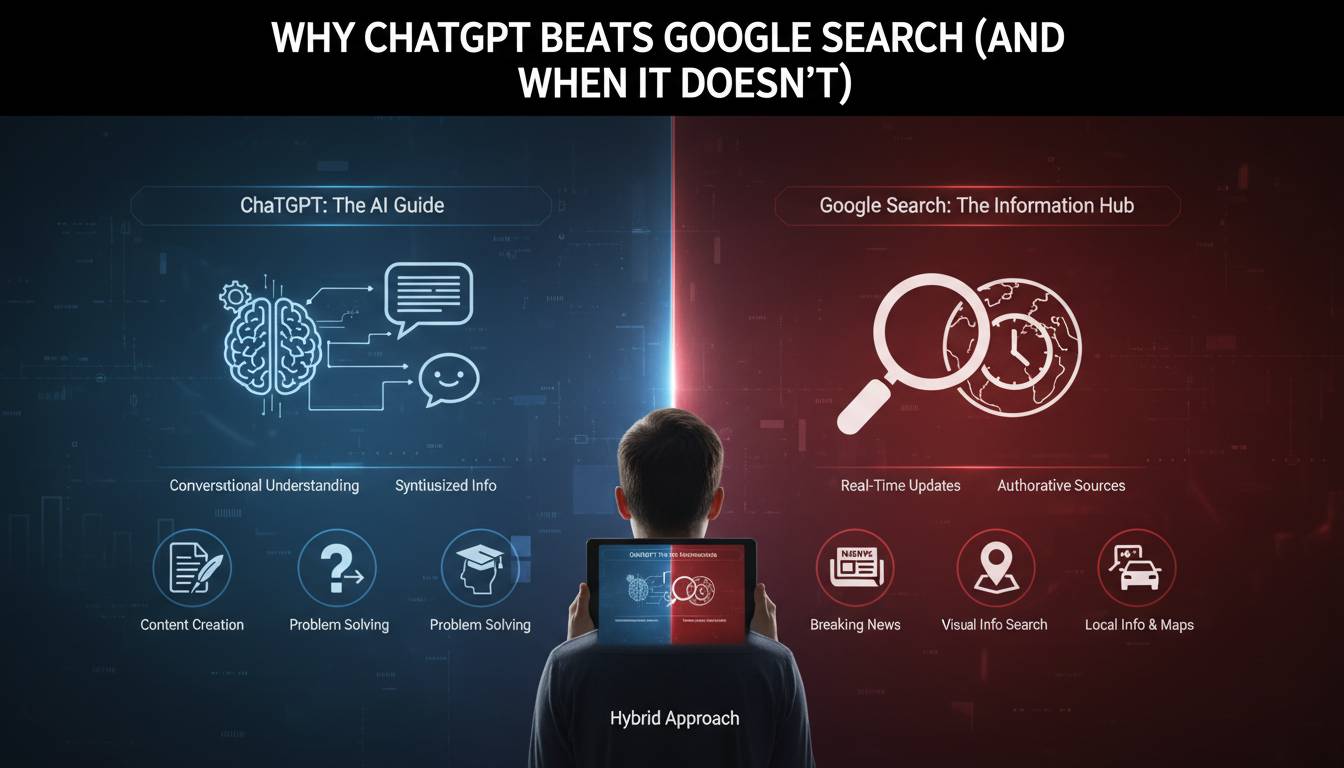
The way we find information online is undergoing its biggest shift since Google introduced PageRank in 1998. ChatGPT, launched by OpenAI in late 2022, has challenged the dominant position of traditional search engines, with over 100 million users within just two months of its release. But is ChatGPT actually better than Google Search? The answer is more nuanced than a simple yes or no—each tool excels in different scenarios, and understanding when to use which can dramatically improve how you work, learn, and solve problems.
This article examines the fundamental differences between ChatGPT and Google Search, identifies specific situations where each platform shines, and provides practical guidance for choosing the right tool for your needs. Whether you’re a researcher, student, professional, or curious individual, understanding these differences will help you navigate the evolving landscape of digital information retrieval.
Understanding the Fundamental Differences
Before comparing ChatGPT and Google Search, it’s essential to understand what each tool actually does and how they differ at their core.
How Google Search Works
Google Search operates as an index-based retrieval system. When you type a query, Google’s algorithms scan billions of web pages in its index and return links to the most relevant results based on hundreds of ranking factors including relevance, authority, freshness, and user engagement signals. Google does not generate new content; it points you to existing content created by humans across the web. The results you see are essentially curated links, each leading to a website where the actual information lives.
The search engine continuously crawls the internet, indexing new content and updating its understanding of which pages provide the most valuable answers to specific queries. Google processes over 8.5 billion searches daily, and its algorithm aims to match user intent with the most authoritative available source.
How ChatGPT Works
ChatGPT, by contrast, is a large language model that generates responses based on patterns learned from vast amounts of text data. When you ask a question, ChatGPT synthesizes information from its training data to produce original, conversational responses rather than simply linking to existing sources. It can explain concepts, write code, create content, and engage in multi-turn dialogues that adapt to follow-up questions.
Unlike Google’s link-based results, ChatGPT provides answers directly in the chat interface. However, it’s important to note that ChatGPT’s knowledge has a cutoff date—it cannot access real-time information without additional tools like browsing capabilities, and its responses are generated based on patterns rather than verified facts from specific sources.
When ChatGPT Beats Google Search
There are distinct scenarios where ChatGPT’s conversational approach and synthesis capabilities provide meaningful advantages over traditional search.
Complex Explanations and Conceptual Understanding
ChatGPT excels at breaking down complex topics into digestible explanations. When you need something explained in multiple ways, tailored to your existing knowledge level, or connected to related concepts, ChatGPT’s conversational interface handles this gracefully.
For example, if you ask Google “what is quantum computing,” you’ll receive a list of links to articles, tutorials, and encyclopedia entries. You might need to visit several sources, read through varying levels of technical depth, and synthesize the information yourself. Ask ChatGPT the same question, and you receive an immediate explanation that you can follow up with questions like “can you simplify that further” or “what are the practical applications.”
This conversational approach proves particularly valuable for learning new subjects. Research from the Stanford Graduate School of Education found that students who used AI assistants for explanations showed improved conceptual understanding compared to those relying solely on static content. The ability to engage in dialogue—to ask “why” and “how” iteratively—mimics the Socratic method of learning that traditional search cannot replicate.
Creative Work and Content Generation
When you need to generate original content, brainstorm ideas, or work through creative problems, ChatGPT provides a significant advantage. It can draft emails, write code, create marketing copy, compose poetry, develop lesson plans, and produce first drafts that you can then refine.
Google Search can help you find examples of existing content for inspiration, but it cannot create new content for you. If you’re a writer facing a blank page, ChatGPT can help generate initial drafts. If you’re a developer needing code for a specific function, ChatGPT can write it directly. The ability to have an iterative conversation—refining the output through multiple exchanges—makes ChatGPT a powerful creative partner.
Personalized and Contextual Responses
ChatGPT maintains context throughout a conversation, allowing for highly personalized responses. You can explain your specific situation, provide background details, and receive answers tailored to your circumstances. A doctor, a teacher, and a student can all ask about “learning disabilities” and receive explanations appropriate to their respective contexts.
Google Search results, while increasingly personalized based on search history, provide the same core results to everyone searching a given query. The personalization is algorithmic and based on patterns, not on direct understanding of your specific situation.
Synthesizing Information Across Multiple Topics
When your question spans multiple domains or requires synthesizing information from various fields, ChatGPT can integrate concepts more fluidly. You might ask something like “how do the principles of behavioral psychology apply to product design in mobile apps,” and ChatGPT will draw on its understanding of both fields to provide an integrated response.
With Google, you’d likely need to search for behavioral psychology principles, then separately search for mobile app design best practices, then manually connect the dots yourself. This synthesis capability makes ChatGPT particularly valuable for interdisciplinary thinking and research.
When Google Search Beats ChatGPT
Despite ChatGPT’s strengths in several areas, Google Search remains superior in specific scenarios that are critical for many use cases.
Current Events and Real-Time Information
Google Search has a decisive advantage when you need up-to-the-minute information. News, stock prices, weather updates, sports scores, and live events all require current data that ChatGPT cannot provide without specific browsing tools—and even with those tools, Google remains more comprehensive for real-time queries.
If you need to know about breaking news, recent scientific discoveries, or emerging trends, Google Search delivers immediate access to the latest information. ChatGPT’s knowledge has a training cutoff date, meaning it cannot tell you about events that occurred after its last update without additional integration.
Verifiable Sources and Citations
When you need to verify information, check original sources, or conduct academic research, Google’s link-based approach provides crucial transparency. You can examine the source directly, assess its credibility, check publication dates, and verify authorship.
ChatGPT sometimes produces confident-sounding responses that may contain inaccuracies—a phenomenon researchers call “hallucination.” While ChatGPT can cite sources when prompted with browsing capabilities, the default experience lacks the transparency of seeing exactly where information originated. For journalistic, academic, or professional research requiring source verification, Google Search remains essential.
Navigational and Transactional Queries
Google excels at helping you navigate to specific websites or complete transactions. Queries like “Amazon login,” “YouTube trending,” “nearest Starbucks,” or “Delta Airlines flight status” return immediate, actionable results. Google has optimized for these navigational and transactional queries over decades.
ChatGPT is not designed for these use cases. While it can help you find information about businesses or provide directions, it cannot replace the immediacy of Google’s map integration, business listings, and real-time availability information.
Understanding Consensus and Diverse Perspectives
When you want to understand what “everyone” thinks about a topic—professional consensus, public opinion, or varying perspectives across different groups—Google Search provides more comprehensive access to the diversity of human knowledge. You can see how different publications, experts, and communities have addressed a topic.
ChatGPT synthesizes patterns from its training data, which may not fully represent the range of current opinions or recent developments. For understanding controversial topics, conducting balanced research, or ensuring you haven’t missed important perspectives, Google’s breadth remains valuable.
Practical Guidance: Choosing the Right Tool
Making the optimal choice between ChatGPT and Google Search depends on understanding your specific needs in the moment.
Use ChatGPT when: you need explanations tailored to your level of understanding, want to generate original content, need help brainstorming or working through problems, want conversational interaction that builds on previous messages, are learning new concepts, or need help with creative tasks like writing, coding, or planning.
Use Google Search when: you need current information about recent events, want to verify facts and check original sources, need navigational help to specific websites, are conducting academic research requiring citations, want to see diverse perspectives on controversial topics, or need real-time data like prices, schedules, or weather.
Consider using both: Many tasks benefit from combining both tools. Research a topic on Google to understand the current landscape and find authoritative sources, then use ChatGPT to explain concepts you find confusing or help you synthesize what you’ve learned.
The Evolving Landscape
The competition between AI-powered conversation and traditional search is driving rapid innovation in both spaces. Google has integrated AI features into its search results through the Search Generative Experience (SGE), providing AI-generated summaries alongside traditional links. OpenAI continues to improve ChatGPT with browsing capabilities, plugins, and more recent knowledge cutoffs.
The lines between these tools will continue to blur. Microsoft’s integration of ChatGPT technology into Bing Search represents an early attempt to combine the strengths of both approaches. The future likely involves more hybrid systems that provide conversational AI alongside traditional search capabilities.
However, understanding the fundamental differences between these tools—synthesis versus indexing, conversational versus link-based, personalized versus algorithmic—will remain valuable regardless of how the technology evolves. Each approach offers distinct advantages, and the most effective information seekers will learn to leverage both appropriately.
Frequently Asked Questions
Is ChatGPT replacing Google Search?
No, ChatGPT is not replacing Google Search. While ChatGPT offers advantages for certain types of queries, Google Search remains superior for real-time information, source verification, and navigational queries. Many users find they use both tools for different purposes rather than one replacing the other.
Can ChatGPT provide inaccurate information?
Yes, ChatGPT can sometimes produce incorrect or misleading information, a phenomenon known as “hallucination.” Unlike Google Search, which points you to sources you can verify yourself, ChatGPT generates responses that may sound confident but contain factual errors. For important information, verification through Google Search or direct source checking remains essential.
Does Google Search have AI features?
Yes, Google has introduced AI-powered features through its Search Generative Experience (SGE). These provide AI-written summaries at the top of search results for certain queries. Google also uses AI extensively in its ranking algorithms and has integrated various AI features into its ecosystem, though the core search experience remains link-based.
Which is better for academic research?
For academic research, Google Search is generally more appropriate due to its ability to provide verifiable sources, access to peer-reviewed publications, and connection to academic databases. ChatGPT can help explain concepts or assist with writing, but for verifying specific claims, checking citations, or accessing the latest scholarly work, Google Search remains the primary tool.
Can I use both ChatGPT and Google Search together?
Absolutely. Many users find that using both tools complement each other effectively. You might use Google Search to find current information and authoritative sources on a topic, then use ChatGPT to explain complex concepts or help synthesize what you’ve learned. This combined approach leverages the strengths of both platforms.
Is ChatGPT free to use?
ChatGPT offers a free tier with access to GPT-3.5. ChatGPT Plus, the subscription service, costs $20 per month and provides access to GPT-4, faster response times, and access during peak hours. Google Search remains free with ads, though Google also offers various subscription services for enhanced features.
Conclusion
The question of whether ChatGPT is better than Google Search doesn’t have a simple answer because each tool excels in fundamentally different ways. ChatGPT shines for conversational explanations, creative work, personalized responses, and synthesizing complex concepts. Google Search remains superior for current events, source verification, navigational queries, and research requiring citations.
Rather than viewing this as a competition where one tool must win, the most effective approach recognizes both as valuable components of your information toolkit. As AI continues to transform how we access and process information, the ability to choose the right tool for each task—understanding the strengths and limitations of each—becomes an increasingly important skill.
The future will likely bring more integrated experiences that combine the best of both approaches. Until then, informed users who understand when to use conversational AI versus traditional search will have a significant advantage in navigating the wealth of information available online.













Leave a comment