

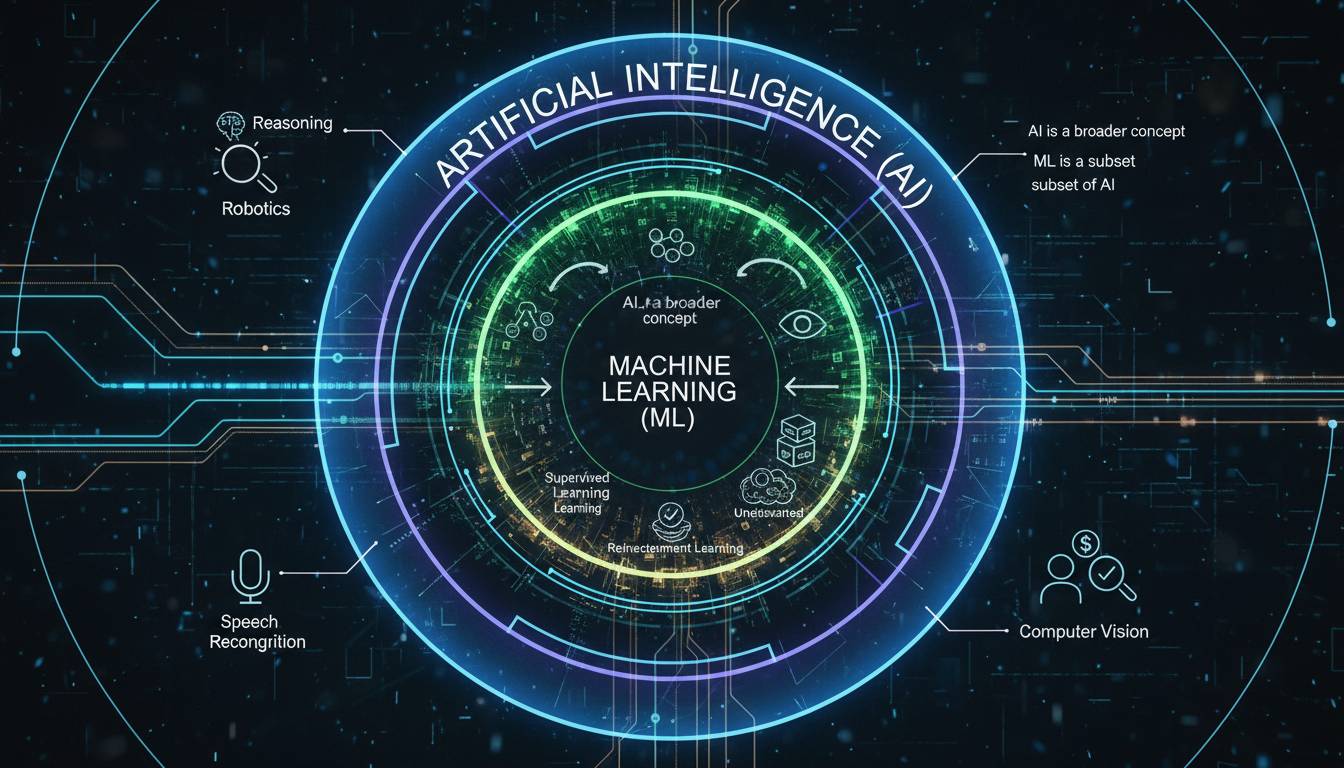
Artificial intelligence and machine learning are two terms that get thrown around constantly in tech conversations, business meetings, and headline news. Yet despite their widespread use, many people struggle to explain how they differ—or even recognize that one is actually a subset of the other. Understanding this relationship isn’t just academic trivia; it shapes how we think about technology’s capabilities, limitations, and future trajectory.
The simplest way to understand the distinction: machine learning is a specific approach to achieving artificial intelligence. Think of it like geometry versus mathematics—geometry is a branch of mathematics, and machine learning is a branch of AI. This article breaks down both concepts, explores how they connect, and clarifies why the distinction matters for anyone trying to make sense of modern technology.
What Is Artificial Intelligence?
Artificial intelligence refers to any system or machine designed to mimic human cognitive functions—things like learning, reasoning, problem-solving, perception, and language understanding. The goal of AI is to create machines that can perform tasks that typically require human intelligence, whether that’s recognizing a face in a photo, translating languages, or playing chess at a championship level.
AI as a concept traces back to the 1950s, when pioneering computer scientist Alan Turing posed the famous question: “Can machines think?” This philosophical foundation sparked decades of research into how computers could be made to simulate human thought processes. The field has evolved through multiple waves of enthusiasm and skepticism, now entering what many experts call the “AI spring” driven by breakthrough in deep learning and massive increases in computational power.
Modern AI encompasses a broad spectrum of technologies and techniques. Some AI systems follow explicit rules programmed by humans—they make decisions based on predetermined logic paths. Others learn patterns from data without being explicitly programmed for every possible scenario. This distinction between rule-based systems and learning systems is fundamental to understanding the relationship between AI and machine learning.
Narrow AI vs General AI
When discussing artificial intelligence, it’s crucial to distinguish between narrow AI (also called weak AI) and general AI (sometimes called strong AI). Narrow AI systems are designed to perform specific tasks within limited domains. The AI that recommends movies on Netflix, powers voice assistants like Siri, or detects fraud in credit card transactions—all of these are narrow AI. They excel at particular jobs but cannot apply their knowledge to unrelated tasks.
General AI, the hypothetical ability of a machine to understand, learn, and perform any intellectual task that a human can do, remains theoretical. Researchers have made remarkable progress in narrow applications, but creating a truly general artificial intelligence that matches human cognitive flexibility remains an open challenge decades away from realization, if it’s achievable at all.
What Is Machine Learning?
Machine learning is a subset of artificial intelligence that focuses on a specific method: enabling computers to learn from data and improve their performance on tasks without being explicitly programmed for every step. Instead of following rigid, hand-coded rules, ML systems identify patterns in data and use those patterns to make predictions or decisions.
The core idea is surprisingly straightforward. Traditional programming requires a human developer to write explicit instructions that tell the computer exactly what to do. Machine learning flips this paradigm: you provide the computer with examples (data) and the desired output, and the system learns the rules itself. Show a machine learning system thousands of pictures of cats, and it learns to recognize cats. Feed it millions of emails labeled as spam or not-spam, and it learns to filter spam.
This approach has proven remarkably powerful. Machine learning drives many of the most impressive AI applications today, from image recognition and natural language processing to recommendation systems and autonomous vehicles. The availability of massive datasets, advances in computing power (particularly GPUs), and algorithmic improvements have transformed machine learning from a promising research area into a technology reshaping industries.
Types of Machine Learning
Machine learning encompasses several distinct approaches, each suited to different types of problems and data.
Supervised learning involves training models on labeled data—examples where both the input and the correct output are known. The system learns to map inputs to outputs by examining thousands of labeled examples. This approach powers email spam filters (trained on emails labeled spam/not-spam), medical diagnosis tools (trained on patient data with known outcomes), and face recognition systems. The learning process involves the system making predictions, comparing them to the correct answers, and adjusting its internal parameters to improve accuracy.
Unsupervised learning works with unlabeled data—information without predefined categories or labels. The system identifies patterns, structures, or relationships within the data on its own. Clustering algorithms that segment customers into behavioral groups, dimensionality reduction techniques that simplify complex data, and anomaly detection systems that flag unusual patterns all rely on unsupervised learning. This approach is valuable when labeled data is scarce or when exploring unknown patterns in data.
Reinforcement learning represents a different paradigm where an agent learns by interacting with an environment and receiving feedback in the form of rewards or penalties. The system learns which actions lead to positive outcomes through trial and error. This approach has achieved remarkable success in game-playing AI, robotics, and optimization problems. DeepMind’s AlphaGo, which defeated world champion Go players, combined reinforcement learning with deep neural networks to achieve superhuman performance.
The Relationship Between AI and Machine Learning
Understanding the relationship between AI and machine learning requires recognizing that machine learning is one technique among many used to achieve artificial intelligence. Not all AI involves machine learning—early AI systems relied on symbolic reasoning and explicit rule-based programming. Conversely, all machine learning is a form of AI, since it enables machines to perform tasks requiring some form of intelligence.
This hierarchical relationship matters because it shapes how researchers and engineers approach building intelligent systems. Some AI applications are better suited to traditional programming approaches, while others benefit enormously from the pattern-recognition capabilities of machine learning. Modern AI systems often combine multiple techniques, using machine learning for perception and pattern recognition while employing rule-based systems for logical reasoning and decision-making.
The rise of machine learning, particularly deep learning since the 2010s, has dramatically expanded what’s possible with AI. Tasks that seemed impossibly difficult for machines—accurately transcribing speech, translating between languages, identifying objects in images—became achievable through machine learning approaches. This has led some observers to equate AI with machine learning, but this conflates a broad field with one particularly successful subset.
Key Differences at a Glance
Understanding the practical differences between AI and machine learning helps clarify when each technology applies.
Approach to problem-solving: Traditional AI uses explicit rules and logic programmed by humans. Machine learning discovers rules automatically by analyzing data. If you want a system to determine if a transaction is fraudulent, you could either program specific rules (transaction over $10,000 from foreign IP) or train a machine learning model on historical transaction data.
Data requirements: AI systems based on rules can function with minimal data—they simply follow programmed logic. Machine learning systems require substantial amounts of data to learn effectively. The performance of machine learning models typically improves with more data, while rule-based systems don’t benefit from additional training data.
Explainability: Rule-based AI decisions can often be traced through explicit logic chains, making them more interpretable. Machine learning models, especially deep neural networks, frequently function as “black boxes”—they produce accurate results but the reasoning behind specific decisions remains opaque. This has significant implications for applications requiring accountability and transparency.
Human involvement: Traditional AI requires expert programmers to encode knowledge and rules. Machine learning reduces the need for manual rule encoding but requires expertise in data preparation, model selection, and training optimization. Both approaches need human guidance, but the nature of that involvement differs.
Real-World Applications
The distinction between AI and machine learning becomes clearer when examining specific applications across industries.
Healthcare leverages both approaches. AI systems help with administrative tasks like scheduling and billing through rule-based automation. Machine learning models analyze medical images to detect cancers, predict patient outcomes, and identify potential drug interactions. The combination is transforming diagnostic accuracy and treatment personalization.
Finance uses AI for automated customer service through chatbots and rule-based fraud detection systems. Machine learning powers credit scoring models, algorithmic trading, and sophisticated fraud detection that learns new attack patterns. The ability of ML systems to detect subtle anomalies makes them invaluable for identifying fraudulent transactions that rule-based systems would miss.
Transportation demonstrates the spectrum from basic AI to advanced machine learning. Traffic prediction apps use machine learning to forecast congestion. Self-driving cars combine machine learning (for perceiving the environment and identifying objects) with rule-based systems (for obeying traffic laws and making certain decisions). The complex dance between learned behaviors and hard-coded safety rules illustrates how modern AI systems integrate multiple approaches.
Retail and e-commerce employ machine learning for product recommendations, demand forecasting, and inventory management. AI powers chatbots and customer service automation. The personalized shopping experiences that platform users expect rely heavily on machine learning analyzing browsing history, purchase patterns, and preferences.
Why the Distinction Matters
Understanding whether a system uses traditional AI approaches or machine learning has practical implications for several reasons.
Capability expectations differ significantly. Knowing a system uses machine learning suggests it can handle ambiguous, complex data and improve over time with more examples. A rule-based AI system, by contrast, will perform reliably within its programmed boundaries but cannot adapt to novel situations it wasn’t designed to handle.
Trust and accountability concerns vary by approach. When machine learning systems make consequential decisions—in lending, hiring, or healthcare—understanding how they reach conclusions becomes critical. The opacity of many ML models creates challenges for regulatory compliance and public trust.
Resource requirements differ substantially. Machine learning systems require data infrastructure, computational resources for training, and expertise in model development. Rule-based AI can often run on simpler systems with less ongoing investment. Organizations must understand these trade-offs when choosing approaches.
Future-proofing matters too. Machine learning systems can continue improving as data accumulates. Rule-based systems require manual updates to handle new scenarios. For rapidly evolving domains, machine learning offers advantages; for stable domains with well-understood rules, traditional approaches may suffice.
Frequently Asked Questions
Is machine learning the same as artificial intelligence?
No, machine learning is not the same as artificial intelligence. Machine learning is a specific technique or approach within the broader field of artificial intelligence. Think of it this way: all machine learning is AI, but not all AI involves machine learning. AI encompasses multiple approaches to creating intelligent systems, including rule-based systems, logic programming, and machine learning.
Which came first, AI or machine learning?
Artificial intelligence as a concept predates machine learning. AI emerged as an academic field in 1956 at the Dartmouth Conference, while machine learning as a distinct subfield developed later, gaining significant traction in the 1980s and 1990s. Deep learning, a specific type of machine learning using neural networks, became prominent in the 2010s.
Do I need machine learning for my business?
It depends on your specific needs. If you’re automating straightforward, rule-based processes, traditional AI approaches may work well. If you’re working with large amounts of unstructured data—customer interactions, images, sensor data—or need systems that improve with experience, machine learning offers powerful capabilities. Many businesses benefit from combining both approaches.
Can AI exist without machine learning?
Yes, artificial intelligence can exist without machine learning. Early AI systems from the 1960s through the 1980s relied on symbolic reasoning and explicit programming rather than learning from data. These rule-based systems demonstrated intelligence in narrow domains without any learning component. Modern AI often combines multiple approaches, including both learned and programmed components.
Is deep learning different from machine learning?
Deep learning is a specialized subset of machine learning that uses artificial neural networks with multiple layers (hence “deep”). Deep learning has driven many recent breakthroughs in AI, particularly in image and speech recognition. However, many machine learning approaches don’t use neural networks at all, relying instead on other algorithms like decision trees, support vector machines, or linear regression.
Conclusion
The relationship between artificial intelligence and machine learning is best understood as hierarchical: machine learning is a powerful subset of artificial intelligence that enables systems to learn from data rather than follow explicitly programmed rules. AI represents the broader goal of creating intelligent machines, while machine learning provides one particularly effective path toward that goal.
This distinction matters practically because it affects what technologies can accomplish, how they’re developed, and what expectations are reasonable. Machine learning has enabled remarkable breakthroughs in recent years, but it represents one tool among many in the AI toolkit. Understanding this relationship helps businesses, policymakers, and individuals make more informed decisions about which technologies to adopt and how to evaluate their capabilities and limitations.
As both fields continue evolving, the boundaries between different AI approaches will likely blur further. Systems increasingly combine learned components with reasoning engines, creating hybrid architectures that leverage the strengths of multiple approaches. The future of AI likely involves not choosing between machine learning and other techniques, but intelligently integrating them to create systems more capable than any single approach alone.













Leave a comment