

Last Updated: January 15, 2025
Choosing the right programming language to learn in 2025 can feel overwhelming. With over 700 programming languages in active use, each promising different career outcomes and capabilities, how do you decide where to invest your time? This guide cuts through the noise using data from industry surveys, job market analytics, and developer community research to give you clear, actionable recommendations based on your specific goals.
Quick Answer
For most beginners and career changers in 2025, Python remains the best overall programming language to learn first, thanks to its readability, versatility across AI/ML, data science, and web development, and consistently strong demand. However, the “best” language depends entirely on your career goals—JavaScript dominates web development, Rust offers the highest salary potential, and Go provides excellent entry into cloud computing roles.
At-a-Glance Comparison
| Language | Best For | Average Salary (US) | Job Openings (Approx.) | Learning Difficulty | Demand Trend |
|---|---|---|---|---|---|
| Python | AI/ML, Data Science, Web Backends | $120,000+ | 180,000+ | Beginner-Friendly | ↑ Strong Growth |
| JavaScript | Web Development, Frontend/Backend | $110,000+ | 200,000+ | Beginner-Friendly | ↑ Stable |
| Rust | Systems Programming, Performance | $140,000+ | 25,000+ | Moderate-Difficult | ↑ Rapid Growth |
| Go | Cloud Services, Backend Dev | $125,000+ | 50,000+ | Moderate | ↑ Growing |
| Java | Enterprise, Android, Big Data | $115,000+ | 150,000+ | Moderate | → Stable |
| C# | .NET, Game Dev, Enterprise Apps | $110,000+ | 80,000+ | Moderate | → Stable |
| TypeScript | Large-Scale Web Apps | $115,000+ | 70,000+ | Beginner (after JS) | ↑ Growing |
| Swift | iOS/macOS Development | $120,000+ | 30,000+ | Moderate | → Stable |
Salary and job data sourced from Indeed, Glassdoor, and Stack Overflow Developer Survey 2024
Key Takeaways
- ✅ Python dominates AI/ML — 65% of machine learning developers use Python as their primary language
- ✅ JavaScript powers the web — 97% of all websites use JavaScript client-side (W3Techs, December 2024)
- ✅ Rust has highest satisfaction — 83% of Rust developers would use it again
- ✅ Go is growing fastest in cloud — Used by 32% of cloud-native applications
- ❌ Don’t choose solely by salary — Language choice should align with your career goals and interests
- 💡 “Learn the concepts, not just the syntax” — Core programming fundamentals transfer across languages
Key Entities
- Languages Covered: Python, JavaScript, Rust, Go, Java, C#, TypeScript, Swift, Kotlin
- Key Reports Referenced: Stack Overflow Developer Survey 2024, TIOBE Index January 2025, RedMonk Q4 2024, IEEE Spectrum 2024 Rankings
- Industries: Web Development, Data Science, AI/ML, Cloud Computing, Mobile Development, Systems Programming, Enterprise Software
How We Evaluated Languages for This Guide
This analysis synthesizes multiple industry data sources to create a balanced view of the programming landscape in 2025. We examined the Stack Overflow Developer Survey 2024 (with over 90,000 responses), TIOBE Index rankings, RedMonk language rankings, and job market data from major employment platforms.
Our evaluation criteria included:
- Current and projected job market demand
- Salary potential and career growth trajectories
- Learning curve and accessibility for beginners
- Industry adoption trends and major company usage
- Community support and ecosystem maturity
- Versatility across different application domains
We prioritized languages with strong job markets, healthy salary prospects, and clear growth trajectories while considering accessibility for those new to programming.
Python: The Clear All-Rounder
Python has maintained its position as the most popular programming language for several consecutive years, and 2025 shows no signs of that changing. The language’s success stems from its exceptional readability—Python code reads almost like English—making it an ideal starting point for beginners while remaining powerful enough for enterprise-scale applications.
The driving force behind Python’s continued dominance is the artificial intelligence and machine learning boom. According to the JetBrains Developer Ecosystem Survey (2024), Python is the primary language for 65% of machine learning developers and 59% of data scientists. Major AI companies including OpenAI, Google DeepMind, and Anthropic rely heavily on Python for model development and research.
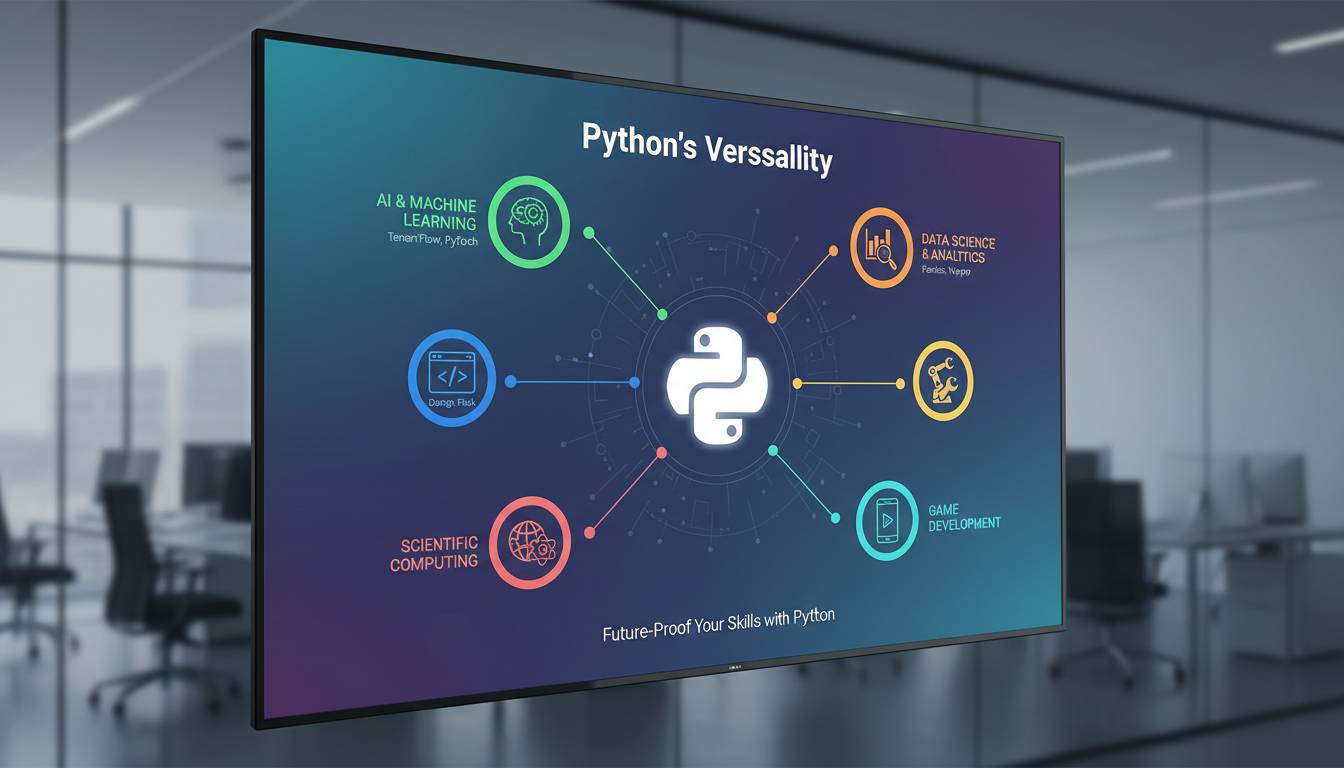
Beyond AI, Python excels in web development (Django, Flask), automation and scripting, scientific computing, and cybersecurity. The extensive library ecosystem—over 400,000 packages on PyPI—means you can accomplish more with less code than in most other languages.
Average salary: $120,000-$150,000 depending on specialization
Job outlook: 15% growth projected through 2029 (US Bureau of Labor Statistics)
Best for: Beginners, data science aspirants, AI/ML engineers, automation specialists
JavaScript: The Web’s Foundation
If your goal is web development—whether frontend, backend, or full-stack—JavaScript remains the undisputed champion. According to W3Techs , JavaScript is used by 97% of all websites as a client-side programming language. This ubiquity translates to enormous job security and variety.
The JavaScript ecosystem has matured significantly with the rise of Node.js for server-side development, enabling developers to use a single language throughout the entire web stack. Frameworks like React, Vue, and Angular power the frontend of virtually every major web application, while Express and Next.js handle backend logic.
TypeScript, a statically-typed superset of JavaScript, has emerged as the preferred choice for large-scale web applications. Major companies including Google, Microsoft, and Airbnb have adopted TypeScript for its improved maintainability and developer experience. The language’s growth rate consistently outpaces JavaScript itself.
Average salary: $110,000-$130,000
Job outlook: Steady demand with growth in enterprise adoption
Best for: Web developers, full-stack engineers, frontend specialists
Rust: The High-Growth Contender
Rust has emerged as the language of the future for systems programming, offering memory safety without garbage collection—a combination that historically seemed impossible. The Stack Overflow Developer Survey (2024) found that 83% of Rust developers would use the language again, the highest satisfaction rate of any language.
Major technology companies are investing heavily in Rust. Microsoft is rewriting core Windows components in Rust, Google is increasing Rust usage in Android development, and Amazon uses Rust extensively for AWS infrastructure. The language’s ability to provide C-level performance with modern safety guarantees has made it essential for performance-critical applications.
The primary drawback is Rust’s steep learning curve. Concepts like ownership, borrowing, and lifetimes require significant mental adjustment for developers coming from garbage-collected languages. However, for those willing to invest the time, Rust offers exceptional career opportunities with often the highest salaries in the industry.
Average salary: $140,000-$175,000
Job outlook: 25%+ growth expected through 2029
Best for: Systems programmers, performance engineers, security-conscious developers
Go: Cloud Computing’s Workhorse
Developed by Google, Go (or Golang) has become the language of cloud computing. Its simplicity, built-in concurrency support, and excellent performance make it ideal for building scalable microservices and cloud-native applications. According to the Cloud Native Computing Foundation Survey (2024), 32% of cloud-native applications now use Go.
The language’s design philosophy prioritizes readability and simplicity over complexity. Go programs are known for being easy to write, understand, and maintain—qualities that appeal to companies building large-scale distributed systems. Companies like Google, Uber, Dropbox, and Twitch rely on Go for critical infrastructure.
Go’s job market has grown substantially as enterprises modernize their infrastructure. While the total number of Go positions remains smaller than JavaScript or Python, the ratio of positions to qualified developers is notably favorable.
Average salary: $125,000-$145,000
Job outlook: 20%+ growth projected
Best for: Cloud engineers, backend developers, DevOps professionals
Java and C#: Enterprise stalwarts
Java and C# continue powering vast portions of the global enterprise infrastructure. Java remains the dominant language for Android development (despite Kotlin’s growth), big data processing (Hadoop, Spark), and enterprise applications. Meanwhile, C# is essential for .NET development, Unity game development, and enterprise software.
These languages offer excellent job stability. Banks, insurance companies, and government institutions continue investing in Java-based systems, while C# remains vital for Microsoft-centered enterprise environments. Both languages have mature ecosystems with extensive documentation and community support.
The learning curve for both languages is moderate. They introduce concepts like static typing and object-oriented programming that form the foundation for many other languages, making them excellent educational investments even if you eventually specialize elsewhere.
Java average salary: $115,000
C# average salary: $110,000
Best for: Enterprise developers, Android developers, game developers (.NET/Unity)
Choosing by Career Path
Your ideal programming language depends heavily on what you want to do professionally. Here’s a breakdown by common career goals:
Aspiring Data Scientist or AI Engineer:
Start with Python. The language’s dominance in data science and machine learning makes it non-negotiable for these fields. Add SQL for database work and consider R if you’ll focus on statistical analysis.
Web Developer (Frontend or Full-Stack):
JavaScript is essential. Begin with vanilla JavaScript fundamentals, then learn React or Vue for frontend work, and Node.js if pursuing full-stack development. TypeScript should follow as you advance.
Mobile Developer:
Swift for iOS, Kotlin for Android. Flutter (Dart) offers cross-platform options if you want to build for both platforms simultaneously.
Systems or Low-Level Programmer:
Rust is the forward-looking choice, while C remains essential for embedded systems and legacy infrastructure work.
Cloud or Backend Engineer:
Go is excellent for cloud-native roles, while Java and C# remain strong for traditional backend positions. Python works well for AWS Lambda and serverless functions.
Factors That Should Influence Your Decision
Beyond job prospects, consider these practical factors:
Learning resources availability: Python and JavaScript have the largest tutorial libraries, courses, and community support. Niche languages like Rust have excellent official documentation but fewer beginner resources.
Job market competition: JavaScript and Python have the most job openings, but also the most competition. Languages like Rust and Go offer fewer positions but less competition per opening.
Your background: If you have a mathematical or scientific background, Python’s data science capabilities align well. Those with engineering or systems backgrounds might find Rust’s safety guarantees intuitive.
Long-term viability: Languages like COBOL still support critical systems, but learning a growing language positions you for future opportunities. The TIOBE Index and Stack Overflow surveys help identify trends.
Conclusion
The best programming language to learn in 2025 ultimately depends on what you want to achieve. Python offers the most versatile starting point with strong demand across AI, data science, and web development. JavaScript remains essential for web developers. Rust presents the highest salary potential and fastest-growing demand, while Go provides the clearest path into cloud computing.
Rather than chasing the “most popular” language, identify your career goals and choose accordingly. Once you master your first language, learning subsequent languages becomes substantially easier—the concepts transfer, and you’ll adapt syntax to context.
Our recommendation: Start with Python if you’re entirely new to programming or interested in AI/data roles. Choose JavaScript if web development is your goal. Select Go or Rust if you’re focused on cloud or systems programming and want premium compensation.
Frequently Asked Questions
Q: Which programming language has the highest salary in 2025?
A: Rust developers command the highest average salaries at approximately $140,000-$175,000 annually in the US, followed by Go ($125,000-$145,000) and Python ($120,000-$150,000) for specialized roles. However, salary varies significantly by location, experience, and specific job requirements. Senior engineers in any language can earn well over $200,000.
Q: Can I learn programming on my own, or do I need a formal degree?
A: You can absolutely learn programming independently. Many successful developers are self-taught. Bootcamps, online courses (Coursera, Udemy, freeCodeCamp), and documentation provide comprehensive education. What matters most is building projects and creating a portfolio rather than credentials. Many companies now prioritize skills and demonstrated ability over formal education.
Q: How long does it take to learn a programming language?
A: Basic proficiency typically takes 3-6 months of consistent study for beginner-friendly languages like Python or JavaScript. Becoming job-ready usually requires 6-12 months of dedicated learning including project building. Mastery develops over years of professional experience. Python and JavaScript are generally faster to learn than languages like Rust or C++.
Q: Should I learn Python 2 or Python 3 in 2025?
A: Learn Python 3 exclusively. Python 2 reached end-of-life in January 2020 and no longer receives security updates. All current libraries, frameworks, and job opportunities use Python 3. Any tutorials or courses still teaching Python 2 are outdated.
Q: Is it too late to learn JavaScript given the rise of AI coding tools?
A: No—JavaScript remains essential and AI tools currently work best as assistants rather than replacements for human developers. Understanding JavaScript fundamentals is crucial whether you write code yourself or review AI-generated code. The language’s role in web development remains unchanged, and AI tools have increased rather than decreased demand by making developers more productive.
Q: What’s the easiest programming language for beginners?
A: Python is widely considered the easiest programming language for beginners due to its simple, readable syntax that resembles English. JavaScript is also accessible since you can see results immediately in a web browser. Both have extensive learning resources and supportive communities. The “easiest” language ultimately depends on what you want to build—web applications favor JavaScript, while data or AI projects favor Python.













Leave a comment