

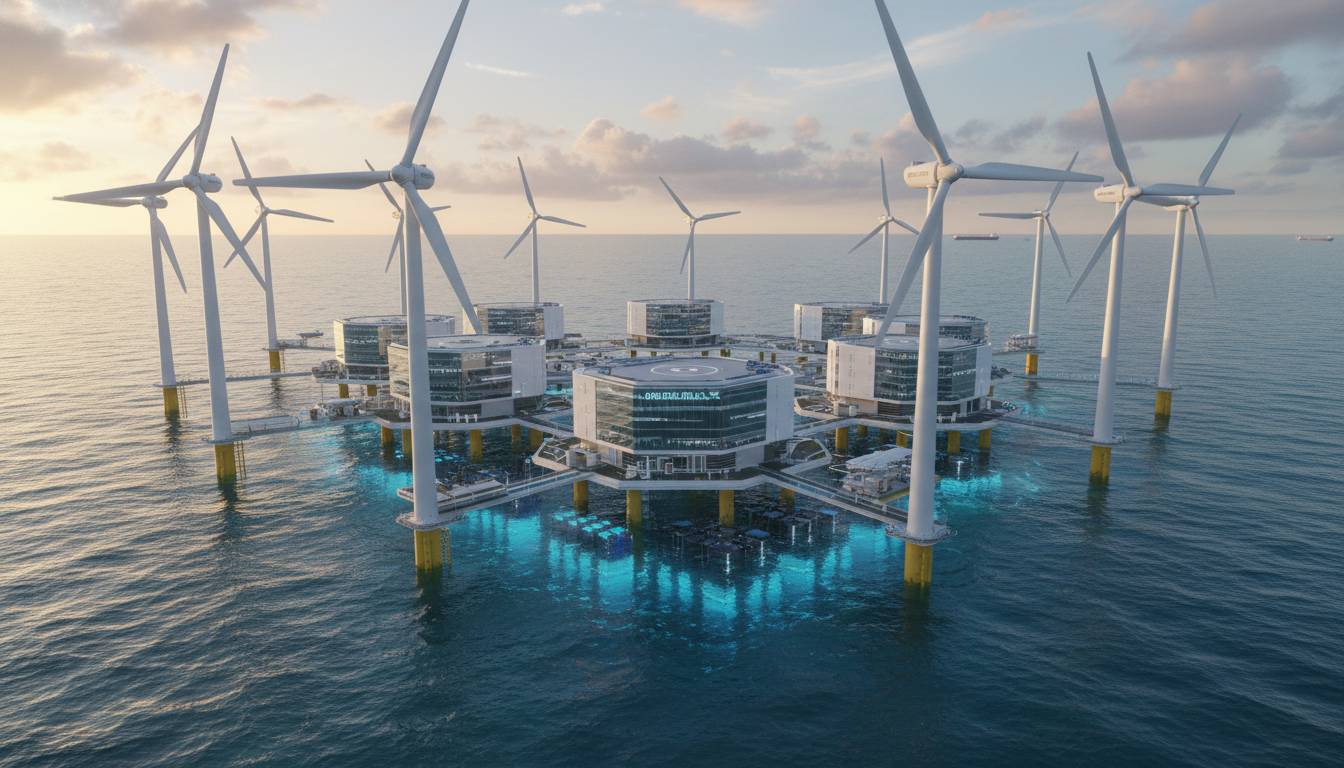
A startup has found a way to put data centers right underneath offshore wind turbines. The idea is simple: generate wind power, process data, and cut out the middleman transmission losses that happen when electricity travels hundreds of miles from offshore farms to land-based data centers.
The concept tackles two problems at once. Data centers eat up enormous amounts of electricity—about 1-2% of global demand, and rising. Meanwhile, offshore wind farms generate clean power far from where it’s needed, losing 3-5% or more along the way. Putting the two together makes obvious sense, even if actually building it is complicated.
The Growing Energy Demands of Data Centers
Data centers run everything: streaming services, social media, enterprise software, government systems. In the US alone, they used roughly 46 terawatt-hours in 2022, and that’s projected to climb sharply as AI, cloud computing, and IoT devices keep spreading.
This energy appetite has drawn serious scrutiny. Google, Microsoft, and Amazon have all pledged to run on 100% renewable energy, putting pressure on the whole industry to clean up its act.
The catch with most data centers is that they pull from the grid, which means fossil fuels depending on where you are. Even companies buying renewable energy credits or signing power purchase agreements face inefficiencies because the electricity they claim to use and the electricity actually flowing to their facilities often aren’t the same electrons.
How Co-Location with Wind Turbines Works
The startup’s model places modular data center units at the base of offshore wind turbines. These aren’t massive purpose-built facilities—they’re smaller, factory-built modules that can be installed relatively quickly compared to traditional data center construction, which can take years.
The big advantage is cutting transmission. Offshore wind farms sit miles offshore, and getting power to coastal data centers requires long cable runs that lose energy along the way. By putting the data center at the turbine, you skip that problem entirely.
Wind farm operators could also benefit from extra revenue—either selling power directly to the data center or collecting lease payments for using the space below their turbines. That could make offshore wind projects more financially attractive overall.
Environmental and Economic Implications
The environmental picture looks promising but isn’t simple. Co-location reduces transmission losses, and since the power source is renewable, the carbon footprint stays low. But offshore environments are brutal—saltwater destroys equipment, storms are constant, and getting technicians out to maintain anything is expensive and time-consuming. Data center gear needs precise temperature control to function reliably, and designing hardware that thrives in those conditions is an engineering challenge.
Economically, sharing infrastructure could lower costs for both industries. Wind developers save by not needing separate sites; data centers get renewable power without negotiating complex off-site power deals. But the maintenance and equipment costs in harsh marine environments could easily offset these savings.
Industry Response and Future Outlook
Industry analysts have been cautiously receptive, which is PR-speak for “interesting but unproven.” Whether this becomes mainstream or stays a niche experiment depends heavily on how the first few projects perform.
What could push adoption forward? Tighter regulations on data center energy use, stricter corporate sustainability requirements, and continued drops in both modular data center and offshore wind costs.
The US offshore wind industry is expanding fast, with billions pouring into East Coast and Gulf projects. If co-location works at scale, it could reshape how tech companies think about powering their infrastructure.
Conclusion
Putting data centers under offshore wind turbines isn’t magic—it’s a practical idea that exploits obvious synergies between two industries with spatial and energy challenges. Whether it takes off depends on solving real engineering problems and whether the economics work out in practice.
The concept deserves attention not because it’s revolutionary, but because it represents the kind of cross-industry thinking actually needed to square digital growth with environmental limits.
Frequently Asked Questions
What is the concept of placing data centers under offshore wind turbines?
This involves installing modular data center facilities at the base of offshore wind turbines. Power gets generated and used in the same location, reducing transmission losses and providing direct access to renewable energy.
Why are data centers being placed near renewable energy sources?
Data centers use enormous amounts of electricity. Locating them at wind or solar farms lets operators cut carbon emissions, avoid transmission losses, and meet sustainability pledges without relying on grid electricity from mixed sources.
What are the main challenges of this approach?
Saltwater corrosion, extreme weather, difficult access for repairs, and the need for specialized equipment that works reliably in harsh marine conditions. Regulatory frameworks also haven’t caught up to this kind of co-located infrastructure.
How much energy can be saved by co-locating data centers with wind turbines?
Transmission losses from offshore wind farms to distant data centers typically run 3-5%. Placing data centers at the generation site eliminates most of these losses, though exact numbers vary by project.
Which companies are developing this technology?
A handful of startups and established players are exploring this space. The specific startup driving recent discussion has developed modular data center designs built specifically for offshore wind farm environments.
Is this approach economically viable compared to traditional data centers?
It depends. Higher upfront costs for marine-rated equipment and maintenance could be offset by operational savings and renewable energy benefits. As carbon regulations tighten and the technology matures, the economics may become more favorable than traditional siting.











Leave a comment