

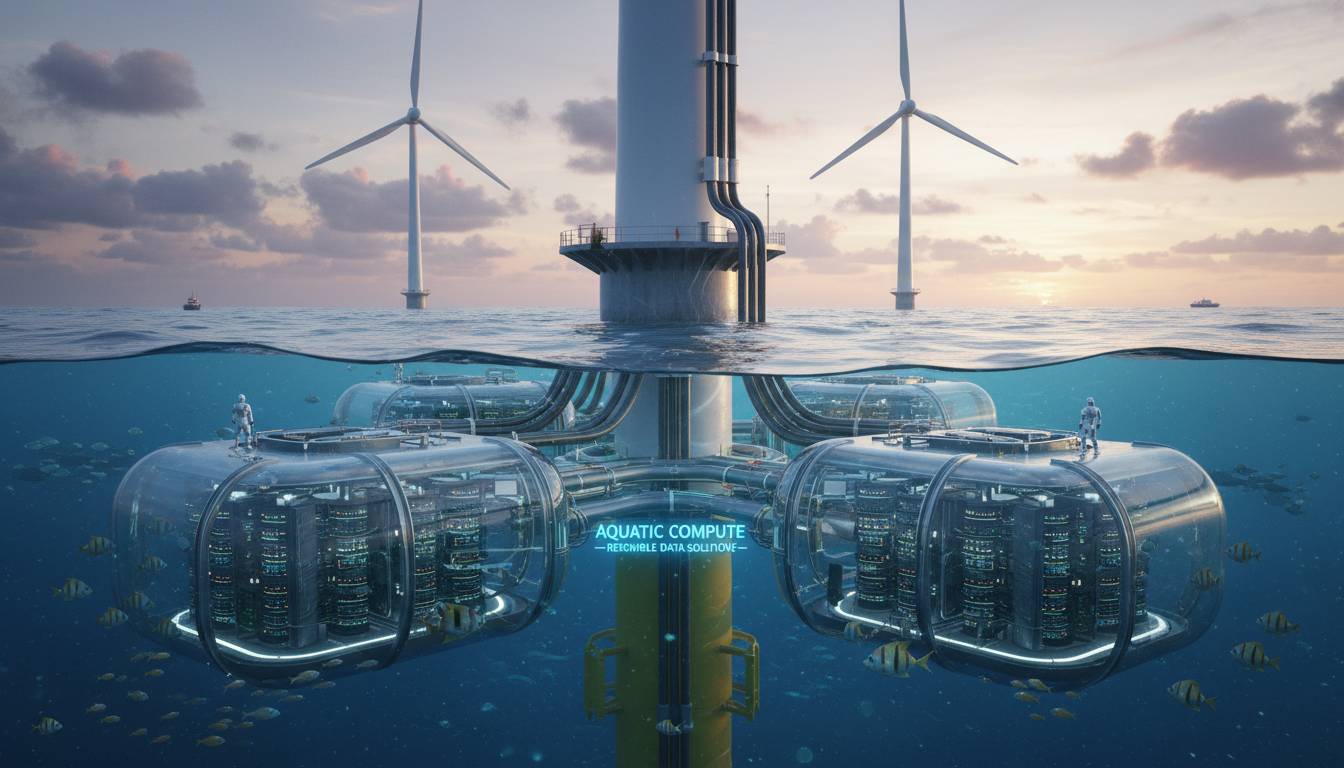
Data centers consume about 1-2% of global electricity, a figure that’s climbing as AI workloads explode. This has led some startups and big tech companies to explore unusual locations for these facilities—including underneath offshore wind turbines. It’s an interesting idea that tackles two problems at once: where to find enough clean power, and where to put facilities that need lots of space but can’t be near people.
How It Works
The basic concept pairs data centers with offshore wind farms. Wind turbines out at sea generate 5 to 15 megawatts each—substantial capacity. Instead of transmitting all that power to shore through costly underwater cables, some could go to computing equipment installed directly in or beneath the turbine structures.
Microsoft’s Project Natick proved underwater data centers could work. In 2018, the company dropped a containerized data center off the Scottish coast and ran it for years. The cold ocean water provided natural cooling, and the sealed environment actually reduced equipment failures compared to land-based facilities. The wind turbine application takes this further by using existing wind farm infrastructure rather than building from scratch.
A few startups are now developing modular designs specifically for this purpose—sealed computing pods that fit inside turbine foundations or platforms that hang beneath the structures.
Technical Challenges
It’s not simple. The environment under a turbine is harsh: constant vibration from spinning blades, saltwater corrosion, and limited room for equipment. Engineers need to design containers that protect hardware from all this while still allowing maintenance access.
Cooling is both an advantage and a complication. The ocean stays cold year-round, which could reduce energy use compared to air-cooled data centers. But pumping seawater through systems adds complexity and requires more maintenance.
Connectivity is another hurdle. Wind farms have monitoring networks, but data centers need much higher bandwidth. Laying fiber optic cables alongside power lines would work, though it adds cost.
The Economics
On paper, there are savings to chase. Wind farms and data centers both face big expenses for grid connections, permits, and land. Co-locating cuts some of that duplication.
Energy is the biggest ongoing cost for data centers. Getting power directly from nearby turbines could avoid the 20-30% markup that transmission and distribution charges add in most markets. Some regions even offer better rates for locally generated renewable power.
But specialized marine equipment costs more than standard data center gear—corrosion-resistant materials, robust sealing, reinforced structures. And when something breaks offshore, repairs are harder and more expensive than on land.
The timing might work out though. U.S. offshore wind capacity is projected to hit 30 gigawatts by 2030, and data center demand keeps growing 20-30% annually in major markets. More of both means more reason to combine them.
Environmental Trade-offs
The sustainability pitch is straightforward: zero-carbon electricity, no land use conflicts in crowded coastal areas, and natural cooling that cuts energy use. The ocean’s stable temperatures might even extend hardware life.
But offshore installations affect marine ecosystems. Any project would need environmental reviews covering effects on fish, wildlife, and water quality. That’s standard for offshore wind anyway, but adding data centers into the mix means more scrutiny.
Regulation and Timeline
This falls into a regulatory gap. Offshore wind leasing through the Bureau of Ocean Energy Management focuses on energy production—not computing infrastructure. The rules would need to evolve to allow data centers within turbine sites.
The UK, with its larger offshore wind industry, might develop policies first. Europe is already discussing offshore “energy hubs” that combine different infrastructure types.
Realistically, we’re probably looking at five to ten years before commercial-scale projects appear, assuming regulations develop and the technology proves itself. Early pilot projects will likely come first, testing whether the engineering works at scale.
Conclusion
Putting data centers under offshore wind turbines isn’t just a gimmick—it makes logical sense. Less transmission loss, free cooling, no land fights, and direct access to renewable power. The engineering is hard and the rules don’t exist yet, but the underlying economics improve as both industries scale.
Whether this becomes mainstream or stays a niche experiment depends partly on policy, partly on tech development, and partly on whether anyone can actually make the numbers work. It’s worth watching.












Leave a comment