

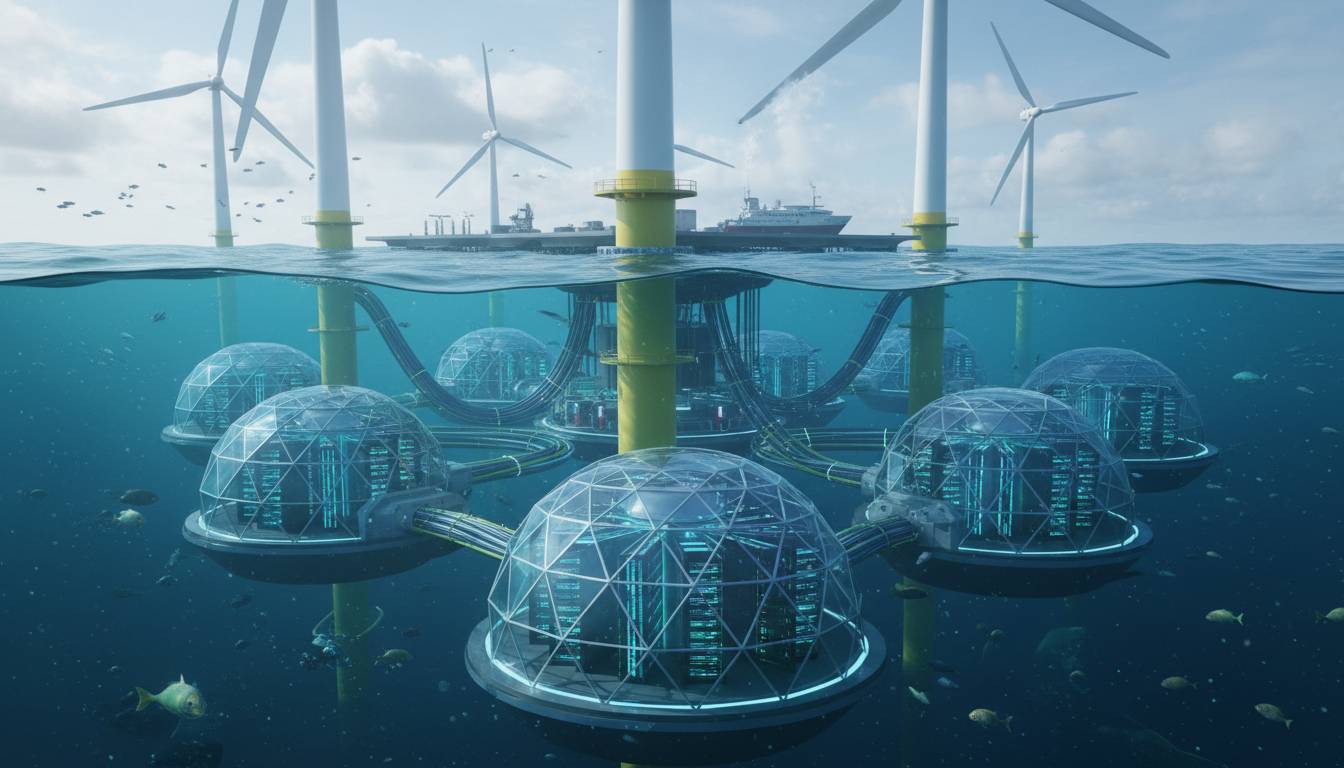
A startup has come up with an idea that tackles two problems at once: data centers need enormous amounts of power, and wind farms need space. The plan is to put data centers right under offshore wind turbines, letting them run on renewable electricity without building new transmission lines.
The concept uses the area around wind turbine foundations, which would otherwise sit empty. Modular data center units could fit in those spaces, connected directly to the turbines’ power output. It’s an interesting idea, though it faces real engineering challenges.
Why Data Centers Are Growing Fast
The global data center market has exploded over the past ten years. Cloud computing, streaming, and now AI have all driven demand for more computing capacity. Data centers now use roughly 200 terawatt-hours of electricity every year, and that number keeps climbing.
In the US alone, data centers account for about 2% of total electricity use. That percentage has been rising steadily. Many regions are struggling to supply enough power to data center clusters without building new fossil fuel plants.
Traditional data centers are massive facilities, and finding land for them has gotten harder. Communities push back against large energy-guzzling buildings. Cooling requires huge amounts of water. These constraints have pushed companies to explore alternatives—underwater data centers, underground facilities, and now, combining data centers with offshore wind.
The Startup’s Approach
The company wants to use the physical footprint of offshore wind farms to house data center infrastructure. Wind turbines need substantial foundations to stay stable in the ocean. The area around these foundations could hold modular data center containers.
The founders realized both data centers and wind farms face similar hurdles: finding locations, getting permits, connecting to the grid. Combining these needs into one offshore development could solve multiple problems at once.
The containers would connect straight to the wind farm’s electrical output. That means the data centers would run on renewable power without needing additional transmission lines to reach onshore grids.
Modular design would let these units be built offsite and installed relatively quickly. That matters because the demand for computing capacity—driven by AI development—is urgent.
The Engineering Problems
Marine environments are brutal for electronics. Saltwater causes corrosion, humidity stays high, and storms batter everything. Data center operators have historically avoided coastal locations for these reasons.
Keeping equipment running reliably underwater or nearshore would require specialized cooling, robust sealing, and corrosion-resistant materials throughout. All of that costs money—potentially a lot more than traditional data center construction.
There’s also the power supply issue. Wind farms produce variable output depending on weather. Data centers need consistent power. They’d either need battery backup or connections to broader grids to ensure reliable operation.
Connectivity is another problem. Data centers need high-bandwidth, low-latency connections to serve users effectively. Offshore wind farms have some communication infrastructure for operations, but it would need major expansion to support data center workloads.
Environmental Tradeoffs
The environmental case looks promising in some ways. Data centers running on direct wind power would produce no carbon emissions from electricity. That’s a real improvement over facilities powered by fossil fuel grids.
The model also avoids land use conflicts. Offshore wind areas are already modified marine spaces, so putting data centers there doesn’t create new visual impact or community opposition issues.
For wind farm operators, hosting data centers could mean extra revenue. That might help make renewable projects more financially viable in some locations.
There’s also a transmission efficiency benefit. Moving electricity over long distances causes losses. Data centers consuming power right at the generation point avoid those losses.
What Experts Are Saying
Renewable energy analysts see potential but are cautious. The concept could represent a natural evolution of offshore wind development as the industry looks to maximize returns on marine spatial investments.
Environmental groups have welcomed approaches that pair renewable generation with digital infrastructure. Addressing climate change requires meeting growing energy demands without building more fossil fuel plants.
But some data center operators are skeptical. Reliability is their top priority, and the challenges of maintaining equipment in marine environments could mean more downtime and maintenance headaches.
The regulatory picture is complicated too. Offshore wind farms and data centers currently operate under separate permitting systems. Combining them would require coordination among multiple government agencies—something that doesn’t exist yet.
What’s Next
The startup plans to pursue pilot projects in the next few years, though no specific locations have been announced. Success depends on partnering with established offshore wind developers and proving the economics work.
If pilots succeed, the model could grow significantly. Countries worldwide are planning major offshore wind installations to meet climate targets. Integrating data centers into those projects could become a new way to build sustainable digital infrastructure.
The concept also fits with broader trends toward distributed computing and edge infrastructure. Rather than concentrating everything in traditional tech hubs, offshore data centers would create digital infrastructure closer to coastal populations while using renewable energy.
Conclusion
Putting data centers under offshore wind turbines is a creative attempt to solve several infrastructure problems at once. Combining renewable generation with digital infrastructure could help meet AI and cloud computing’s growing energy needs while supporting decarbonization goals.
The obstacles are real: marine engineering challenges, unclear regulations, and questions about whether the economics beat other options. But if pilots show it’s feasible, this could become a meaningful model for sustainable data center development.
As the tech industry grapples with its environmental impact, solutions that integrate digital infrastructure with renewable energy will keep attracting interest from investors, policymakers, and companies looking for sustainable paths forward.
FAQ
What’s the basic idea?
Installing modular data centers in or around offshore wind turbine foundations. The data centers run on power directly from the turbines, eliminating the need for new transmission infrastructure.
What are the main technical problems?
Saltwater corrosion, humidity, keeping equipment cool in marine conditions, ensuring consistent power from variable wind generation, and building enough network connectivity. All of this adds cost.
How much energy do data centers use?
Globally, about 200 terawatt-hours per year—roughly 2% of global electricity consumption. That number is climbing fast due to AI and cloud services.
Would this reduce carbon emissions?
Yes, if data centers run on wind power directly, they produce no carbon emissions from electricity. That’s a big improvement over fossil fuel-powered grid electricity.
Are there similar projects already?
The idea of underwater or offshore data centers has been explored before, but fully integrated installations with operating offshore wind farms are still conceptual. Some companies have announced pilots, but nothing at scale exists yet.
What regulations would need to change?
Regulators for energy, telecommunications, and marine construction would all need to coordinate. New frameworks would address hybrid installations that combine elements of all three.













Leave a comment