

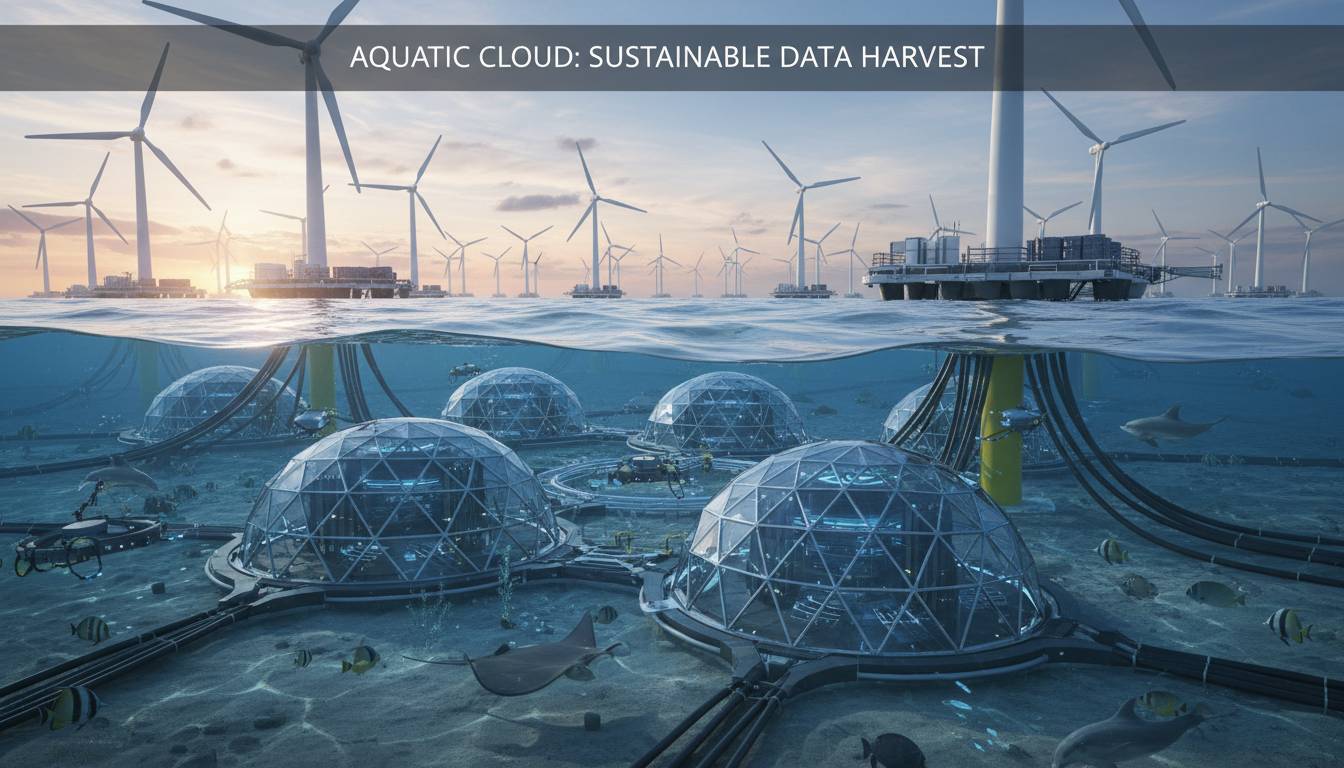
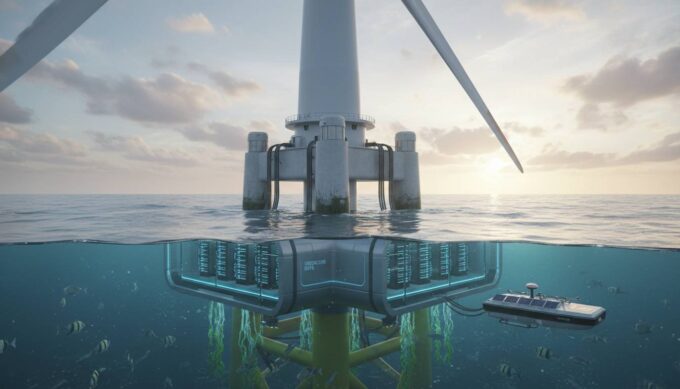
A new startup wants to put data centers underwater, right next to offshore wind turbines. The idea is straightforward: run computing hardware in sealed modules on the seabed beneath wind farms, draw power directly from the turbines, and use cold ocean water to keep the servers cool.
It’s an unconventional approach to two growing problems. Data centers already consume enormous amounts of electricity, and that consumption is climbing fast. The International Energy Agency estimates data centers used about 460 terawatt-hours globally in 2022, with projections suggesting that could double by 2026. Meanwhile, offshore wind is expanding rapidly in the United States—the Department of Energy says installed capacity could reach 30 gigawatts by 2030. This startup sees an opportunity to combine both trends.
How It Would Work
The plan involves deploying modular data center units at depths of 30 to 60 meters below the ocean surface. These sealed units would contain standard server hardware, modified to handle pressure and saltwater exposure. Heat would dissipate directly into seawater—a cooling method that some analysts estimate could cut energy use by up to 40 percent compared to air-cooled facilities.
Power would come straight from the wind turbines, avoiding the transmission losses that happen when electricity travels long distances to land-based data centers. This also helps wind farm operators, who currently face high costs for grid connection infrastructure. A reliable, always-on power customer right at the generation site could improve their revenue options.
Microsoft tested something similar with Project Natick, placing an underwater data center prototype off the California coast in 2015. It ran for over two years. But Microsoft ultimately decided not to pursue commercial deployment—maintenance was too difficult, and scaling seemed impractical. This startup’s proposal differs by tying the data center directly to existing wind farm infrastructure, which might address some of those economic concerns.
The Challenges
The engineering obstacles are substantial. Saltwater destroys electronics, so the encapsulation and corrosion protection need to be flawless. Any seal failure could destroy everything inside.
Maintenance is perhaps the biggest problem. Land-based data centers let technicians walk in and swap out failing components. Underwater, you’d need remotely operated vehicles or divers for even routine work. That means the systems need to run reliably for years without human intervention—a much higher bar than typical data center design.
Power also requires careful handling. Wind turbines generate electricity at medium voltage, which needs stepping down and conditioning before server equipment can use it. That equipment would have to live somewhere—in the turbine foundations or in subsea enclosures—adding more complexity.
Environmental concerns exist too. Deploying industrial infrastructure on the seabed could disrupt benthic habitats. Continuous heat discharge might alter local ocean temperatures, with uncertain effects on marine life. Regulators would require extensive environmental impact assessments before approving anything.
The regulatory path is also unclear. Multiple federal agencies have overlapping jurisdiction—energy generation, telecommunications, maritime law, environmental protection. Navigating that maze could take years.
What Comes Next
A proof-of-concept demonstration would likely take two to three years to develop and test. Commercial deployment would follow only if that succeeds and if the startup can secure necessary approvals and funding.
The concept has generated cautious interest from analysts who acknowledge the innovation but remain skeptical about execution. Some in the renewable energy industry question whether the technical complexity and costs can be managed. Others see the fundamental logic—co-locating power generation and consumption to eliminate transmission inefficiencies—as sound.
Whether this approach succeeds or not, it reflects a growing reality: the technology sector is under pressure to find sustainable solutions as digital services and AI applications expand. The industry will keep looking for ways to decouple computational growth from environmental impact. This particular idea may or may not pan out, but the underlying impulse—finding synergies between renewable energy and digital infrastructure—will likely keep producing creative proposals.











Leave a comment