

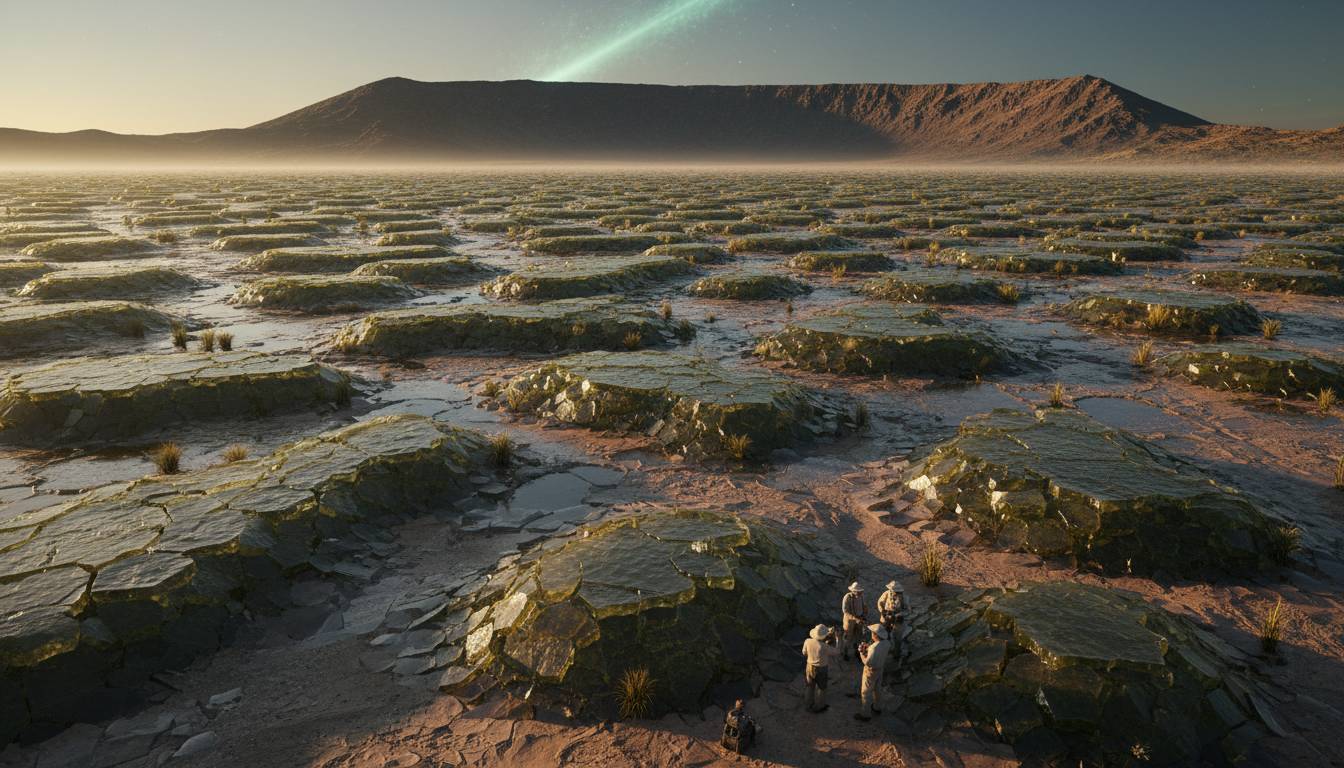
About 6 million years ago, a massive meteorite struck northeastern Brazil, creating one of Earth’s largest natural glass fields. Scientists have studied this site for decades, and it remains one of the best places on the planet to see what happens when a cosmic object hits Earth at hypersonic speed.
The impact produced tons of natural glass, known as tektites, scattered across hundreds of square kilometers. These glass formations—black, green, and sometimes translucent—have survived relatively intact despite millions of years of exposure to rain, wind, and Brazil’s harsh semi-arid climate.
What is Natural Impact Glass?
When a meteorite strikes Earth at extreme velocity, it generates temperatures hot enough to instantly melt silica-rich rocks and sand. This molten material cools so quickly that it solidifies into glass without forming crystals, creating the dark, glossy formations called tektites. The word comes from the Greek “tektos,” meaning “molten” or “fused.”
These materials differ fundamentally from volcanic glass like obsidian. Volcanic glass forms from cooling lava during eruptions. Tektites form from impact events—sudden, catastrophic moments that fuse surface materials in an instant.
The Brazilian site is unusual because of its sheer scale. Unlike scattered tektite finds elsewhere, this formation covers extensive areas with glass litter so dense you can still find specimens by walking the surface.
The 6-Million-Year-Old Impact Event
The impact occurred during the late Miocene epoch, when South America’s geography looked different than it does today. The collision released energy equivalent to millions of tons of TNT, instantly vaporizing the meteorite and much of the rock it struck. A shockwave propagate outward, melting surface materials and hurling molten glass droplets across the landscape.
Radiometric dating of the glass and surrounding geological formations consistently points to an impact around 6 million years ago. This places it within the timeframe of other significant Cenozoic impact events, though the precise crater location remains somewhat uncertain.
The meteorite was probably rich in iron and nickel, common in stony-iron and metallic meteorites. The impact destroyed the original object entirely, leaving only the transformed terrestrial materials as evidence. However, chemical analysis of the Brazilian glass reveals distinctive markers confirming its extraterrestrial origin, including rare element ratios that don’t match any naturally occurring Earth rocks.
Location and Physical Characteristics
The glass field lies in northeastern Brazil, primarily in Bahia state and surrounding areas. The terrain is semi-arid scrubland with rocky outcrops—geologically stable enough that the glass deposits survived intact despite millions of years of weathering.
Visitors today can still find glass specimens scattered across the surface, ranging from tiny fragments to pieces weighing several kilograms. Colors vary from deep black through shades of green to translucent amber, depending on chemical composition and cooling conditions.
Some specimens have aerodynamic shapes—teardrops, dumbbells, and other forms that developed as molten droplets flew through the atmosphere and solidified before landing. These shapes tell scientists about the trajectories and velocities of material during the impact.
The largest pieces can exceed ten kilograms. These represent material that pooled together during the impact and cooled slowly enough to form larger masses, unlike the small droplets common in most tektite finds.
Scientific Significance and Research Value
The site gives scientists a natural laboratory for studying hypervelocity impacts—processes that can’t be replicated in controlled experiments. Geologists, planetary scientists, materials researchers, and chemists have all conducted extensive work here, analyzing the glass structure and composition to understand impact physics.
The glass preserves information about environmental conditions at the time of impact, including atmospheric composition and surface materials. Trapped gases and isotopes provide snapshots of ancient Earth conditions that interest paleoclimatologists and geochemists.
Beyond Earth science, the findings inform planetary geology across the solar system. Similar impact processes have shaped the Moon, Mars, Mercury, and other bodies. Studying Earth’s accessible examples helps scientists understand geological processes operating throughout the inner solar system.
Global Context: Other Major Impact Glass Formations
The Brazilian field is significant, but it’s not alone. The Indochinite tektites of Southeast Asia, formed about 700,000 years ago, represent another extensive glass field. North American tektites from Georgia and Texas have been studied for decades.
The oldest known tektites date back tens of millions of years—Australian specimens exceed 30 million years. Each major field offers different research opportunities, since each impact produces glass with distinct characteristics revealing information about both the cosmic object and the target terrain.
The Brazilian formation’s 6-million-year age places it in the middle range of known impacts. Compared to older sites, it has experienced less weathering, preserving features that might be erased in formations tens of millions of years old.
Conclusion
The meteorite impact that created Brazil’s glass field remains one of Earth’s most accessible geological records of cosmic collision. The site continues to provide researchers with insights into impact physics, materials science, and Earth’s geological history while reminding us that extraterrestrial events have repeatedly shaped our planet.
As analytical techniques improve, scientists will undoubtedly learn more from this remarkable formation. Understanding these ancient events helps us appreciate the dynamic processes that have operated throughout Earth’s history—and continue to operate across our solar system.
Frequently Asked Questions
How old is the Brazilian impact glass field?
The glass field was created approximately 6 million years ago during the late Miocene epoch. Scientists confirmed this age through radiometric dating of the glass and associated geological formations.
How was natural glass formed in Brazil?
A meteorite struck at hypervelocity, generating temperatures exceeding several thousand degrees Celsius. This extreme heat instantly melted silica-rich rocks and sand, which cooled rapidly without crystallizing, forming tektites or impact glass.
What is the difference between impact glass and volcanic glass?
Impact glass (tektites) forms from meteorite impacts through instantaneous fusion and cooling of terrestrial materials. Volcanic glass (like obsidian) forms from cooling lava during volcanic eruptions.
Where is the Brazilian glass field located?
The field is in northeastern Brazil, primarily within Bahia state and surrounding regions. The area features semi-arid terrain where glass deposits have remained relatively well-preserved.
Can visitors see the Brazilian impact glass field?
Yes, the area is accessible and glass specimens can still be found scattered across the surface in many locations. Visitors should check local regulations before collecting samples, as certain areas have scientific protection status.
Why is the Brazilian impact glass field scientifically important?
Researchers use it as a natural laboratory to study hypervelocity impact processes, analyze chemical composition of ancient cosmic collisions, and understand how extraterrestrial events have shaped Earth’s geology. Its preservation and accessibility make it one of the world’s most valuable impact glass research sites.











Leave a comment