

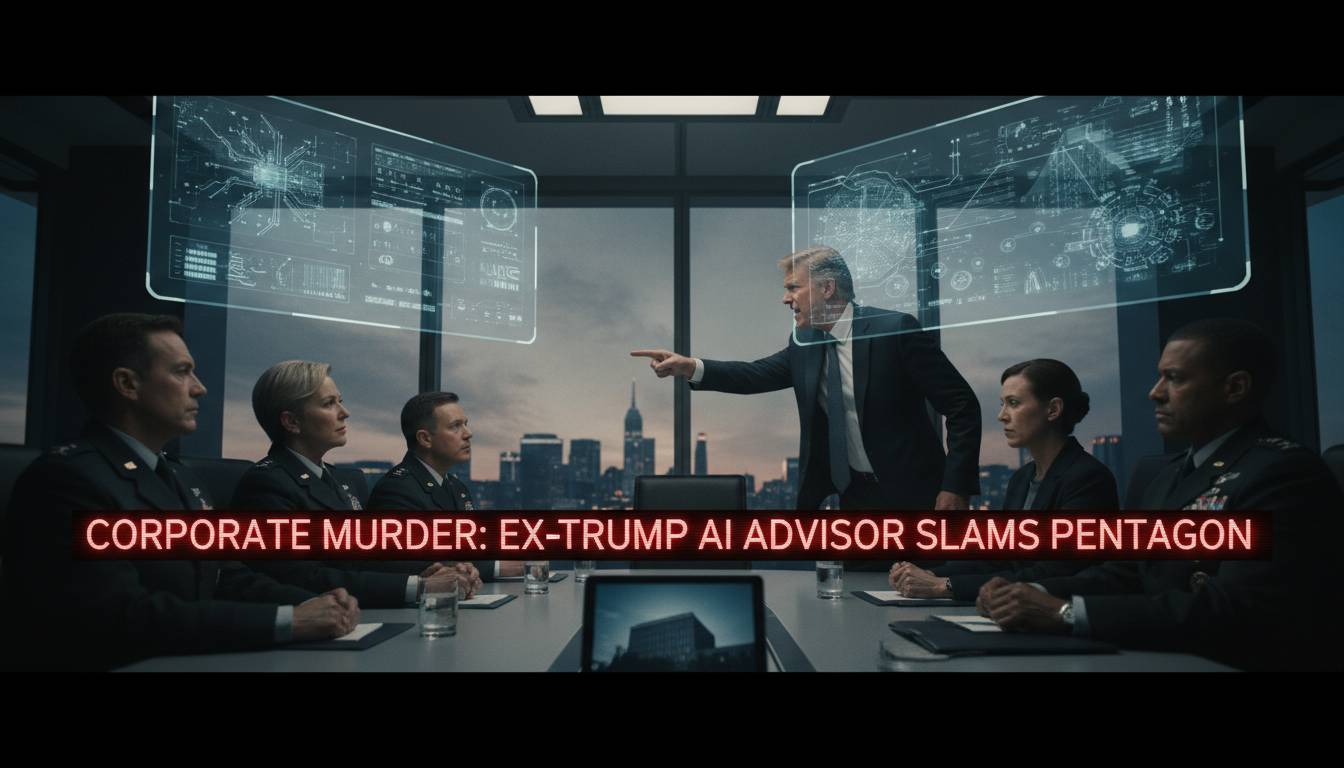
A former artificial intelligence advisor to the Trump administration testified before Congress this week, accusing the Pentagon of enabling what he called “corporate murder” through its handling of military AI contracts and autonomous weapons development. The allegations have sparked sharp divisions among policymakers, defense industry executives, and technology experts, coming at a moment when Congress is actively working on regulations for artificial intelligence in warfare.
The former advisor, who served in the Office of Science and Technology Policy, spent nearly three hours testifying before the Senate Armed Services Committee. In his opening statement, he described the Pentagon’s approach to AI-powered weapons systems as “fundamentally reckless” and said defense contractors were pursuing profit-driven development paths that prioritized speed over safety.
“The Pentagon has created a system where corporations essentially hold a license to kill without meaningful oversight,” he testified. “This is corporate murder—profit-motivated decision-making that removes human judgment from life-and-death decisions on the battlefield.”
His testimony targeted the Pentagon’s AI initiatives broadly, claiming that insufficient testing protocols and aggressive timelines have led to deployed systems that malfunction in unpredictable ways. He cited incidents where autonomous defense systems engaged targets without proper authorization, though Pentagon officials disputed his characterization of these events.
The Pentagon quickly rejected the allegations as “factually inaccurate and politically motivated.” A Department of Defense spokesperson emphasized that all AI-powered weapons systems undergo rigorous testing and maintain human oversight throughout their operational lifecycle.
“The Department of Defense is committed to the ethical and responsible use of artificial intelligence technologies,” the statement said. “Our development processes include multiple layers of human review, and we maintain full accountability for all weapon system deployments.”
Defense industry groups also pushed back. The Aerospace Industries Association, representing major Pentagon contractors, called the testimony “an unfair characterization of an industry that takes its ethical responsibilities seriously.” Several contractors named in the testimony said they may pursue legal action for what they described as defamatory statements.
Some defense analysts noted that the controversy reflects genuine tensions within the defense establishment about AI development timelines. A recent Government Accountability Office report found that the Pentagon’s AI acquisition processes lack standardized safety protocols, though the report did not characterize the situation as dangerous.
The allegations have added momentum to legislative efforts to establish AI governance frameworks. Senators from both parties have introduced bills requiring human-in-the-loop requirements for autonomous weapons and creating new oversight bodies for military AI development.
Senator Maria Cantwell, chair of the Senate Commerce Committee, announced plans to hold additional hearings. “We cannot allow the defense industry to police itself when lives are at stake,” Cantwell said. “The testimony we heard today raises serious questions that demand answers.”
The former advisor’s recommendations included establishing an independent AI safety board with authority to halt weapons testing that fails to meet safety standards. He also called for criminal penalties for corporate executives who approve deployment of AI systems known to have critical safety flaws.
Technology ethicists and security experts offered mixed reactions. Dr. Sarah Chen, director of the Stanford University Human-Centered AI Institute, testified alongside the former advisor and supported many of his conclusions. “The current trajectory of autonomous weapons development is fundamentally incompatible with international humanitarian law,” Chen said. “We need immediate action to establish binding international agreements.”
Others took a more measured view. James Wilson, a former Pentagon analyst now at the Center for Strategic and International Studies, cautioned against “knee-jerk reactions” to the testimony. “The Pentagon has made significant progress in establishing AI ethics guidelines,” Wilson noted. “While there’s certainly room for improvement, characterizing the situation as ‘corporate murder’ is hyperbole that undermines productive policy discussions.”
Military historians drew parallels to previous controversies over emerging weapons technologies. “Every major technological advancement in warfare—from submarines to nuclear weapons—has sparked similar debates about accountability and ethics,” said Professor Michael O’Brien of the Naval War College. “What matters is that we have these conversations now, before these systems are deployed at scale.”
The controversy has exposed deep divisions within the national security establishment about balancing technological advancement with ethical considerations. Defense officials argue that falling behind rival nations in AI capabilities would create unacceptable national security risks. China and Russia have both invested heavily in autonomous weapons systems, and Pentagon planners warn that U.S. restraint could embolden adversaries.
The former advisor addressed these concerns directly in his testimony. “There’s a false choice being presented between safety and competitiveness,” he argued. “Systems that malfunction and cause civilian casualties will damage our moral authority and international standing far more than any competitive advantage we might gain.”
Industry analysts suggest the controversy could slow the Pentagon’s AI acquisition timelines. Several planned deployments of autonomous systems have already been delayed pending additional review, and defense contractors are reportedly reassessing their development schedules.
The congressional hearings are expected to continue for several weeks, with additional witnesses scheduled to testify about various aspects of military AI development. The Pentagon has announced an internal review of its AI safety protocols, though critics have questioned whether internal reviews can provide adequate accountability.
The former advisor concluded his testimony with a direct challenge to lawmakers. “You have an opportunity to prevent a new arms race in autonomous weapons that could destabilize international security for generations,” he said. “The question is whether you have the courage to stand up to the defense industry and demand better.”
Public opinion polls show growing concern about AI weapons development among American voters, particularly independents and moderates. Whether this controversy translates into legislative action remains uncertain, but it has clearly elevated the profile of AI ethics in national security discourse.
The allegations have crystallized long-simmering tensions about the role of artificial intelligence in warfare. While the Pentagon and defense industry reject accusations of recklessness, the controversy has highlighted genuine gaps in oversight and accountability for autonomous weapons systems. As Congress considers legislative responses, the stakes could not be higher—decisions made in the coming months will shape the future of warfare and determine whether AI technologies are deployed responsibly or become the source of future humanitarian crises.
What is “corporate murder” in the context of military AI?
The term describes allegations that defense contractors prioritize profit and speed over safety when developing AI-powered weapons systems, potentially leading to deployments that endanger civilians and military personnel.
Who is the ex-Trump AI advisor who made these allegations?
The advisor served in the Office of Science and Technology Policy during the Trump administration and testified before the Senate Armed Services Committee. His identity is confirmed through official congressional records.
What specific systems or programs were criticized?
The testimony targeted the Pentagon’s broader approach to AI weapons development, including autonomous targeting systems and the rapid deployment of AI-enabled platforms without comprehensive testing protocols.
Has the Pentagon responded to these allegations?
Yes, the Pentagon rejected the allegations as “factually inaccurate and politically motivated,” stating that all AI weapons systems maintain human oversight and undergo rigorous testing.
What legislative action is being considered?
Senators from both parties have introduced bills requiring human-in-the-loop requirements for autonomous weapons, creating new oversight bodies, and potentially establishing criminal penalties for executives who approve deployment of unsafe AI systems.
What are the implications for U.S. national security?
Defense officials warn that excessive regulation could cause the U.S. to fall behind China and Russia in AI capabilities, while critics argue that unregulated deployment creates greater long-term risks through potential accidents and international backlash.














Leave a comment