

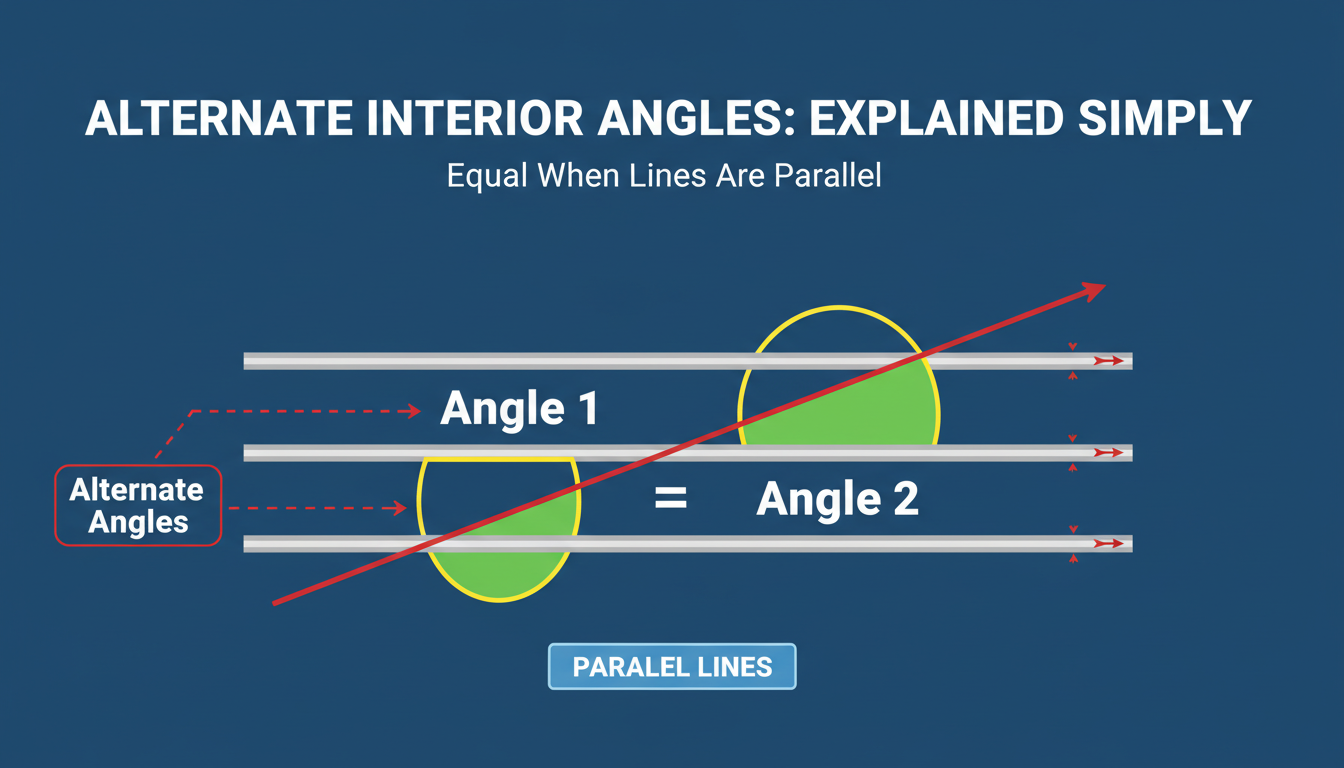
Geometry often feels like a world of rigid rules and exact angles, but sometimes, we want that comforting “aha” moment—where everything clicks. Let’s walk through “Alternate Interior Angles” as if we’re chatting over coffee—and yes, maybe even stumbling a little while explaining it.
What Are Alternate Interior Angles?
Imagine you’ve got two parallel roads—call them Road A and Road B. Then you drive a street that cuts across them, a “transversal.” Now, where it intersects, you get angles inside the two roads, but on opposite sides of your crossing road. Those are your alternate interior angles. Simple, right?
In more formal terms, these are pairs of angles:
– Between the two main lines (interior),
– On opposite sides of the transversal (alternate).
When the roads are parallel, those angle pairs are always equal—true magic in geometry.
Why They Matter (and When They Don’t)
Here’s where things get interesting (and real-world relevant). If the lines are parallel, alternate interior angles are congruent—equal in measure. But if the lines aren’t parallel, there’s no such promise. They could be off by any amount—just like how trusting GPS in the woods without service… risky business.
Quick bullet reminder:
– If lines are parallel → alternate interior angles are congruent.
– If angles are congruent → lines are parallel (the converse).
– Non-parallel lines → no congruency.
Essentially, these angles become a handy test for parallelism—the geometry detective’s tool.
Real-World Angle Sleuthing: A Mini Case Study
Let’s say you’re designing a garden walkway in your yard with two parallel hedges, and you’re adding a crossing path. You need a corner made into a 40° angle to fit some neat stone patterns. If the line across (transversal) hits hedge A making a 40° angle, guess what? On the opposite side, inside the parallel hedges, there’ll be another angle of 40°—your alternate interior angle. That’s your neat-fitting corner, no fuss.
Getting Into the Theorems (with a Dash of Narrative)
The Core Theorem
“If two parallel lines are cut by a transversal, the alternate interior angles are congruent.” Handy, yes? This is geometry’s way of saying: parallel lines + transversal = equal angle twins.
The Converse (Turning It Around)
And here’s the detective move: “If the alternate interior angles are equal, then the lines are parallel.” It’s like seeing two equal footprints and inferring the dog walked straight between them.
“Alternate interior angles give both a clue and confirmation—measure them, and you’ll know if your lines are parallel.”
A Touch of Euclid’s Legacy
This concept stems from the parallel postulate: that parallel lines never meet and make alternate interior angles congruent. Classic stuff from Euclid’s Elements, refined but holding strong in modern geometry.
Patterns and Tricks to Spot Them
You know those textbook diagrams where it looks like a big letter Z? That’s no accident—it’s a “Z-pattern.” Alternate interior angles sit there, making them easy to spot when you’re diagram-dodging boredom.
A quick visual trick:
– Draw the “Z” between the two parallel lines,
– The angles at each end of the Z’s stroke are alternate interior—and equal when lines are parallel.
When You Collapse the Parallel Assumption
What happens if the lines aren’t parallel? Forget equality. Alternate interior angles no longer match—and you can’t say anything constructive about their measures. It’s like a secret code that only reveals its message when the lines behave.
Wrapping It All Up
Alternate interior angles feel like that clever buddy in a mystery movie—quietly helpful, revealing truths when conditions (parallel lines) are right. They:
– Sit opposite each other, inside the lines, on different transversal sides.
– Are congruent if and only if lines are parallel.
– Help confirm parallelism through both direct theorem and its converse.
– Hark back to Euclid while thriving in school geometry.
Quick Summary: Key Takeaways
- Definition: Inside two lines, opposite sides of transversal.
- Property: Congruent if lines are parallel.
- Use: Check if lines are parallel (and prove if they are).
- Visualization: Spot the Z-shape.
- Caveat: No guarantee if lines aren’t parallel.
Whether you’re teaching geometry, building a garden path, or just can’t stand mismatched angles—this concept saves the day.
FAQs
What are alternate interior angles?
They’re a pair of angles formed inside two lines and on opposite sides of a transversal. When the lines are parallel, these angles are equal.
How do alternate interior angles help with parallel lines?
If the angles are equal, that indicates the lines are parallel. Conversely, parallel lines cut by a transversal produce equal alternate interior angles.
Why do we sometimes see a “Z” shape in diagrams?
The “Z” (or zig-zag) highlights the positions of alternate interior angles, making them easier to identify visually.
What if the lines aren’t parallel—are alternate interior angles still equal?
Nope. If lines aren’t parallel, the alternate interior angles are not guaranteed to be congruent and have no specific link.
How does this relate to Euclid’s postulate?
It’s a consequence: Euclid established that if a transversal cuts parallel lines, alternate interior angles are equal—foundational for much of Euclidean geometry.
Can alternate interior angles be used in more advanced geometry, like triangles?
Yes—in proofs and geometric reasoning, congruent alternate interior angles often support triangle similarity and parallel reasoning through angle equality.

















Leave a comment