

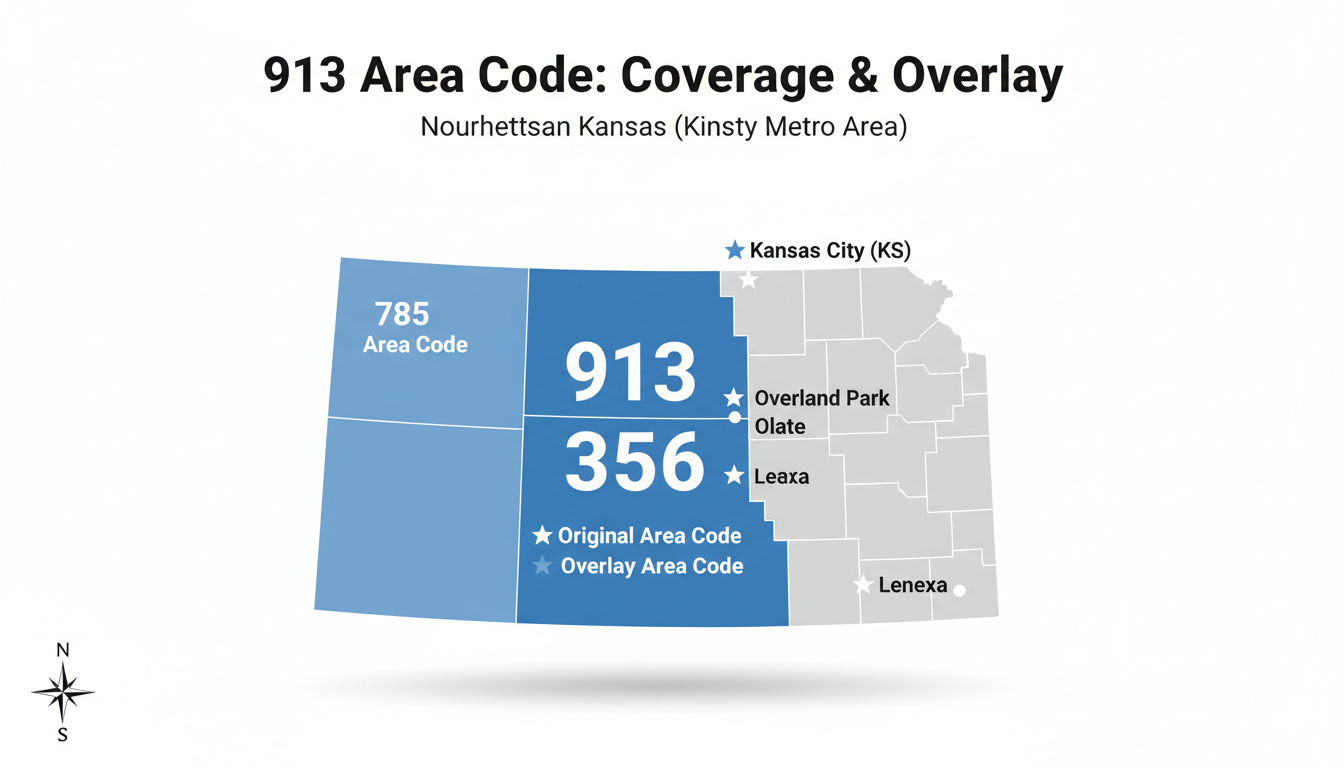
When someone asks, “What’s the story behind the 913 area code?”—well, it’s more layered than it might seem. The 913 area code covers parts of northeastern Kansas, and while it may sound narrow, it has a rich history shaped by regional growth, policy, and evolving technology. Think of it like that friends‑of‑a‑friend story where one change spirals into the next—except in telecom.
This article walks you through why the 913 code exists, what it covers geographically, how dialing habits have shifted, and what the near‑future might look like. No robotic encyclopedia tone here—expect small imperfections, a bit of meandering, and real facts.
Historical Genesis of the 913 Code
Back when AT&T designed the North American Numbering Plan in 1947, they carved Kansas into two codes—north and south. The southern half got 316, covering Wichita and beyond, while the northern half took 913, including Kansas City, Topeka, Lawrence, Manhattan, and more .
This longitudinal split was meant to minimize disruption in major toll routes that ran east‑west. It followed a rough line near Routes 4 and 96, dipping along I-135, and essentially kept east‑west traffic intact . So, from the start, geography and traffic patterns shaped the design.
Why 913 Shrunk in 1997
Fast forward to the mid-1990s: cell phones and deregulation meant exploding demand for numbers. The Kansas City metro—especially Johnson County and Overland Park—was draining those 913 numbers fast . Enter the Kansas Corporation Commission (KCC), who in early 1997 asked NANPA to help. By July 20, 1997, most of the western half of 913 became the new 785 area code, while 913 stuck to what we recognize today . During a transitional phase until October 1998, both codes worked interchangeably.
Even now, the 913 region isn’t running out of number combos—2017 projections show exhaustion possibly as far off as 2045 .
“Telecom infrastructure is never static—every growth phase prompts the next adjustment,” as one regional planner put it informally during an interview.
It’s not official, but… it kind of feels right, doesn’t it?
What Does 913 Cover Today? Geography & Demographics
Today, 913 spans a narrow ribbon of Kansas along the Missouri border, largely matching the Kansas side of the Kansas City metro . The counties included are Johnson, Wyandotte, Leavenworth, Miami, Linn, Atchison, and Doniphan—but Elwood stayed in 913 due to technical routing quirks .
Major cities under 913 include Kansas City (KS), Overland Park, Olathe, Shawnee, Lenexa, Paola, Bonner Springs, De Soto, and Louisburg . Statistic nerds love data: Overland Park clocks around 195,000; Kansas City KS—about 153,000; Olathe—around 140,000; Lawrence is actually in 785 but close enough for confusion .
Demographically, area‑codes.com reports the 2010 figures: population just over 1.26 million, predominantly White (around 960K), with Black (208K), Hispanic (80K), Asian (25K), and smaller groups making up the rest. Median age about 36.4, household income around $49K, average home value roughly $109K .
So yes—it’s a diverse and growing region.
Dialing Habits: Seven‑Digits, Ten‑Digits… What’s Required?
You might wonder: can you still dial just seven digits in 913? Turns out, yes—for now. Because 913 didn’t use the 988 prefix, the new national suicide‑hotline shortcut, it wasn’t forced into mandatory 10‑digit dialing like 785 or 620 were .
That shift—requiring 10 digits—was triggered when the FCC designated 988 for the Suicide Lifeline, creating conflicts in codes that used 988 already. Since 913 didn’t, 7‑digit local dialing remains functional . AT&T confirms that 913 is among the Kansas area codes where 10-digit dialing may be required, but hasn’t gone into effect .
Anecdotally, long-time locals say 10‑digit dialing in Kansas City began informally around 2000‑2001, as seven‑digit overlap arose across 816 (MO) and 913, though there’s no formal record .
For now then:
- Local within 913: you can still dial just the 7-digit number.
- Long-distance: dial 1 + 913 + number.
- Emergency numbers like 911 are unaffected.
What Lies Ahead for 913?
Forecasting area‑code life spans is tricky. NANPA’s NRUF reports estimate exhaustion far into the future—beyond 2045 for 913—under normal demand projections . No new overlays or splits are currently planned.
That said, gridlock, urban sprawl, or unanticipated growth—new data centers, business hubs—could change the picture. If demand spikes, authorities would likely introduce an overlay (not another split), to avoid requiring number changes, but that’s purely hypothetical.
Conclusion
Here’s the gist: area code 913 is more than just three digits. It’s the result of historical design choices, technological shifts, and regional growth trends. Today, it still covers the Kansas side of Kansas City, continues to support seven‑digit dialing (for now), and shows no signs of running out of numbers anytime soon. In other words, it’s stable but not static—a technical backbone quietly supporting a bustling community.
FAQs
What cities are covered under area code 913?
Key cities include Kansas City (KS), Overland Park, Olathe, Shawnee, Lenexa, Bonner Springs, De Soto, Paola, and Louisburg, situated across Johnson, Wyandotte, Leavenworth, Atchison, Linn, Miami, and Doniphan counties .
Was 913 one of the original area codes?
Yes, it was assigned in 1947 as part of AT&T’s original North American Numbering Plan, covering the northern half of Kansas back then .
Can I still dial just the 7-digit number within 913?
Yes—you can. Because 913 didn’t adopt the “988” prefix, local calls can still use 7‑digit dialing. Only 785 and 620 require 10 digits now due to the new 988 lifeline rule .
Why did 913 shrink in 1997 to create area code 785?
The Kansas City metro area was running out of number blocks in 913 due to population and device growth. So in 1997, most of western and northern Kansas moved to the new 785 code, leaving 913 focused on the metro area .
Is 913 expected to run out of numbers soon?
No—forecast projections (e.g. 2017 study and NRUF reports) suggest the pool of available central office codes for 913 won’t run out until approximately 2045 or later .
Are there plans for an overlay or split in 913?
Not currently. There’s no official indication of an overlay or split in the near future. But like any area code, it depends on future demand and how quickly numbers are consumed.
Understanding area code 913 shows how even small things—area code boundaries, dialing habits—reflect history, policy, and the pace of urban life. And, well, sometimes you just gotta have the facts with a side of conversational imperfection.














Leave a comment