

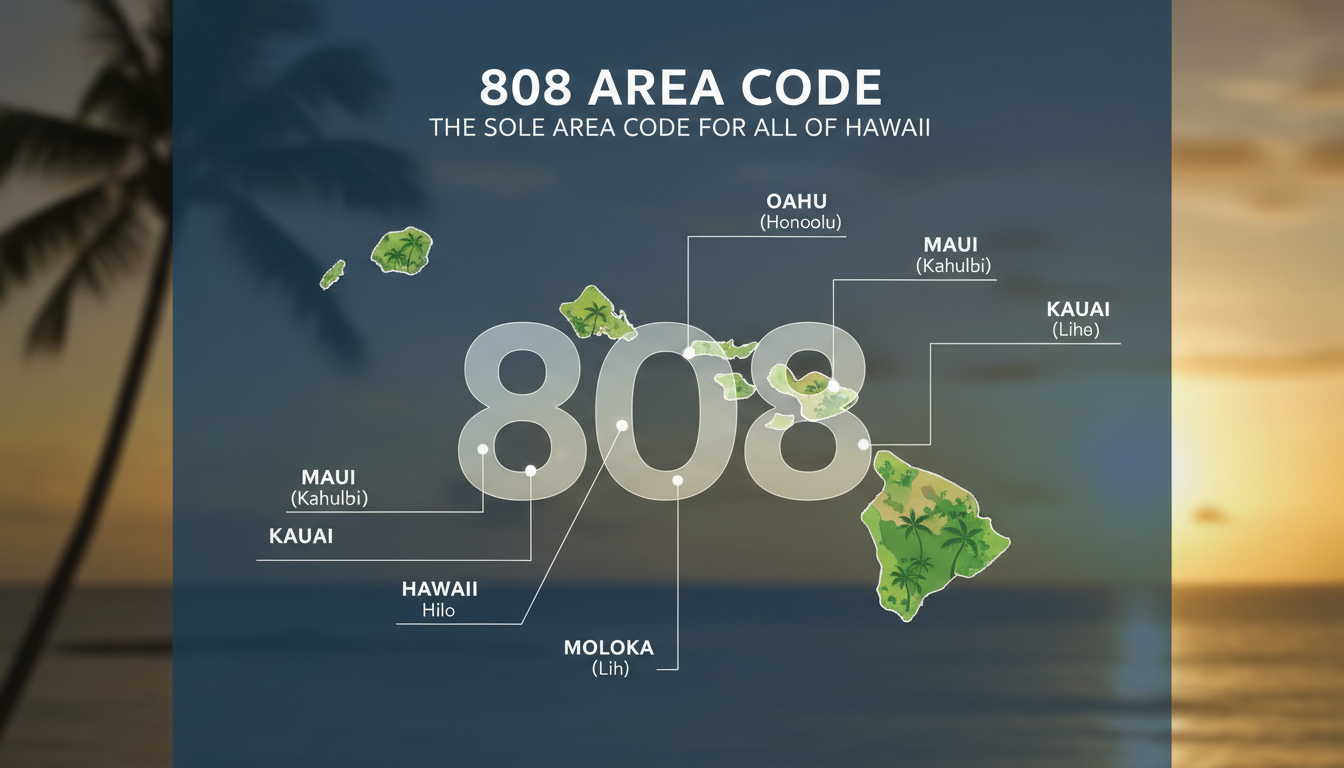
The “808 Area Code” immediately evokes images of sun-drenched beaches, lush volcanic landscapes, and the Aloha spirit—but in reality, it represents a practical communications code with a fascinating backstory. This article navigates the key facts, geographic reach, dialing quirks, and modern-day challenges associated with this iconic numeric marker. Through a blend of storytelling, data, and real-life examples, we’ll explore both the functional and cultural significance of the 808, complete with a dash of human unpredictability—because, let’s face it, nobody talks phone codes like a robot.
Geographic Coverage and Time Zone: What Does 808 Actually Cover?
Hawaii as a Unified Numbering Territory
The 808 area code blankets the entire Hawaiian archipelago—spanning O‘ahu, Maui, Kaua‘i, the Big Island, Moloka‘i, and Lana‘i . Often it feels poetic that all these islands, so diverse in terrain and culture, share a single area code. And yes, Wake Island even uses 808 when routing through Hawaii, underscoring its strategic telecom role .
Time Zone Specifics: Steady as the Island Breeze
All numbers under 808 operate in the Hawaii–Aleutian Standard Time (HST), which remains at UTC–10 year-round. Hawaii does not observe daylight saving time, making its clockwork remarkably predictable—no jarring time jumps here .
History & Numbering Predictions: From Assignment to Forecast
A Code Born Pre-Statehood
Assigned shortly after joining the North American Numbering Plan, the 808 area code dates back to the late 1950s—around two years before Hawaii became a state . In some sources, it’s noted as officially “in service” as of January 1, 1957 .
Growth without Chaos
Despite steady population growth and a deluge of mobile devices—particularly in hubs like Honolulu—the 808 continues to suffice. The North American Numbering Plan Administrator projects that the region will manage with a single area code well into at least the third quarter of 2035 . That’s less of a forecast and more of a reassuring promise.
Dialing Rules and Adjustments: How to Reach an 808 Number
Dialing Standards Across Contexts
Whether calling from within Hawaii or beyond, the rules vary:
– Local calls within Hawaii (post-2021) require full 10-digit dialing (808 + number), even between islands .
– From outside Hawaii: Dial 1 + 808 + the number.
– Internationally: Use your international access code (for instance, 011 in the U.S.) then country code, area code 808, and the number .
Why the 10-Digit Rule Became Mandatory
The shift to mandatory 10-digit local dialing on October 24, 2021, was triggered by the nationwide adoption of 988 as a three-digit number for the National Suicide Prevention Lifeline. Since 988 was previously used as a local exchange in 808, the change was essential to avoid dialing conflicts .
Real-World Usage: Who Uses 808 Numbers Today?
Ubiquity Across Devices
The 808 code spans every type of device: mobile phones, landlines, faxes—essentially wherever you can plug in .
Importance for Businesses
Businesses value 808 numbers for local legitimacy. When customers see that area code, it signals authenticity—a subtle trust builder rooted in geography .
Spoofing, Scams & Caller ID Misery: What to Watch For
Fake Calls Wearing a Hawaiian Mask
Unsolicited calls displaying the 808 area code have become a growing annoyance throughout the U.S.—a favorite ruse among scammers who spoof IDs to appear local or benign .
From impersonating banks to using “one-ring” techniques to lure callback, fraudsters leverage that slice of tropic trust for deception .
On-the-Ground Anecdotes
One Reddit user described receiving scam texts where the sender claimed they were a coworker requesting personal info—a clear sign of spoofing, not genuine connection .
Another noted repeated spam calls from local prefixes like Lanai City (563) or Lihue (645); even actions like blocking didn’t deter the persistent ringers .
Expert Advice: Treat It with Skepticism
Tech experts advise—don’t trust caller ID for legitimacy. Spoofers can even mask the number as your own, edging into unsettling familiarity .
The safest moves? Let unknown numbers go to voicemail, use call-blocking tools, and report scams to authorities like the FTC .
Quick Tips: Safeguard Yourself Against Spoofed 808 Calls
- Don’t assume an 808 number is genuine just because it seems local.
- Implement built-in call blocking or apps that filter spam-like patterns.
- Stay in the loop with known scams—like one-ring or fake bank calls.
- Report suspect activity, whether via FCC, FTC, or local consumer protection.
Wrapping It All Up
The 808 area code isn’t just a set of numbers—it’s deeply entwined with Hawaii’s identity, yet faces the same modern telecom challenges as everywhere else. It covers the entire state under one steady time zone, spans all communication devices, and has remained sufficient into the mid-2030s. Still, today’s landscape demands caution: spoofing and scam calls are real, and they toy with trust by playing that recognizable 808 number.
Understanding this code’s history and functions—and embracing healthy phone habits—help you appreciate its uniqueness and stay protected. When it comes to brandishing or encountering the 808, stay informed, stay alert, and let the code remain a symbol of aloha, not annoyance.
FAQs
Why is the 808 area code significant?
The 808 area code represents the entire state of Hawaii, encompassing all its major islands and even Wake Island, symbolizing unity and regional identity under a single dialing code.
Does Hawaii observe daylight saving time?
No, Hawaii remains consistent throughout the year on HST (UTC–10), avoiding the twice-yearly clock shifts experienced on the mainland.
Why do I need to dial 808 for local calls in Hawaii now?
Since October 24, 2021, 10-digit dialing was made mandatory to prevent conflicts with the new 988 lifeline number, which used to overlap with existing local exchanges.
Are all 808 calls from Hawaii genuine?
Not necessarily—many scammers spoof the 808 code to appear local. It’s best to handle unfamiliar calls cautiously and avoid sharing personal information.
Will Hawaii need another area code soon?
Not in the foreseeable future. Projections indicate that the 808 area code should remain adequate until at least the third quarter of 2035.
How can I reduce scam calls appearing to be from 808?
Use call-blocking tools, don’t answer unfamiliar numbers immediately, send suspicious calls to voicemail, and report any scam attempts through official channels like the FTC.












Leave a comment