

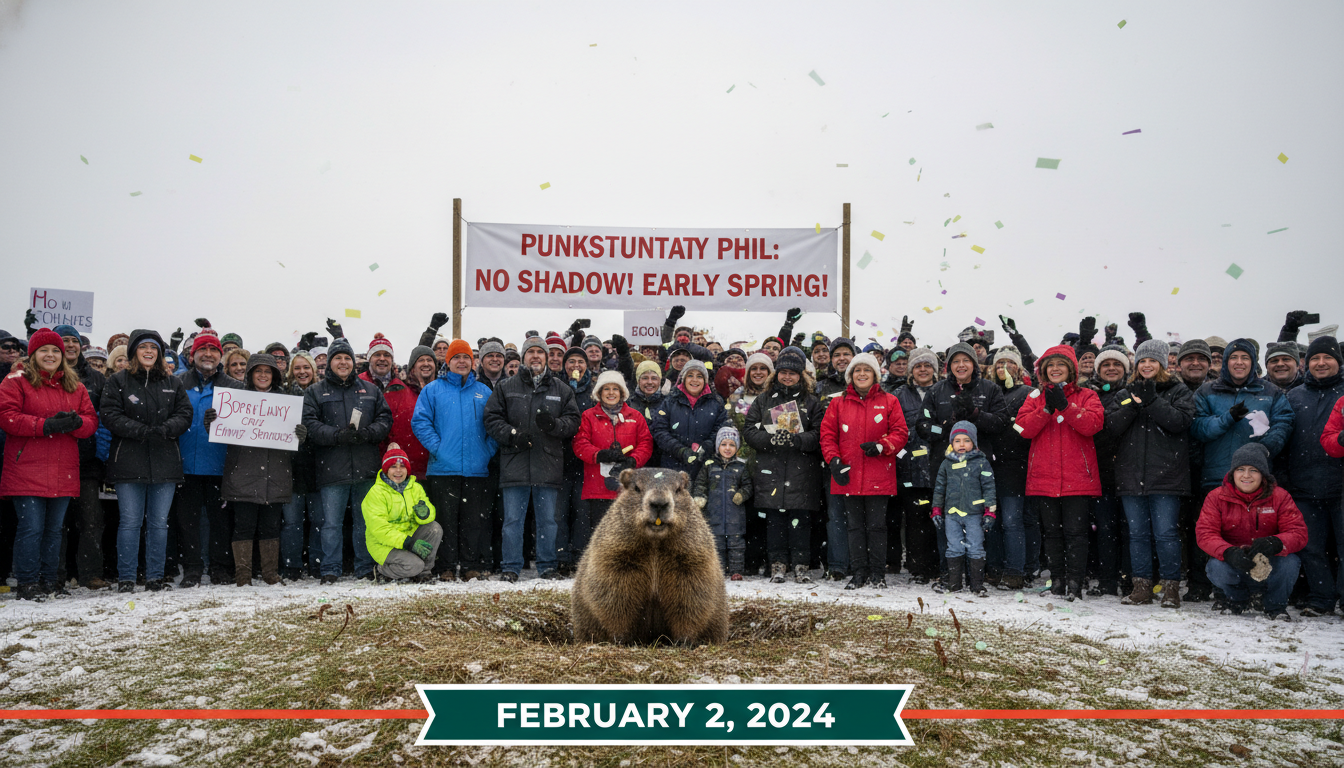
Every February 2nd, the world turns its curious eyes toward Punxsutawney, Pennsylvania, as Punxsutawney Phil—Seer of Seers—makes his annual weather forecast. This year was no exception, though the result may surprise you less than it did the frigid crowd.
What Happened This Year at Gobbler’s Knob
On Monday, February 2, 2026, Punxsutawney Phil emerged begrudgingly from his stump at Gobbler’s Knob and promptly saw his shadow—thus proclaiming six more weeks of winter. The temperature hovered in the single digits Fahrenheit, and thousands bundled up, braving the biting cold to witness the spectacle . Handlers, concerned for Phil’s welfare amid the freeze, even waived the usual post-prediction photo op, asking the audience to take selfies from a distance instead .
Despite a tradition steeped in folklore, last year’s six-more-weeks forecast turned out to be off—NOAA data showed above-average temperatures in March 2025 .
Tradition Versus Reality: How Accurate Is Phil?
The lore is delightful, yes. But how factual is this tiny forecaster’s record?
- Groundhog Day traces its roots to ancient European Candlemas or Imbolc traditions, where weather on midwinter’s day was thought to predict the remainder of the season .
- Despite its charm, modern meteorologists highlight Phil’s limited predictive power. His overall accuracy over the years hovers around a mere 35%–40%, and even lower—around 36%—for forecasts since 1969 .
- Notably, Staten Island Chuck, a fellow groundhog, boasts an 85% success rate according to NOAA, far outpacing Phil’s hit‑or‑miss history .
- LiveScience makes it clear: Phil’s predictions are more fun than factual. Human climatologists using data-based models reliably outperform him, with accuracy rates north of 60% .
The Broader Forecast Landscape
Groundhog Day isn’t just about Phil or Punxsutawney. Across the country, dozens of other critters, both serious and whimsical, make their own forecasts:
- This year, about 25 animals forecasted more winter while roughly 22 predicted an early spring .
- Staten Island Chuck agreed with Phil in calling for more winter, but Woodstock Willie offered hope, declaring—shadowless—“spring is coming!” .
- In the broader context, meteorologists are expecting a patchwork: an early spring in the western U.S. and Southern Plains, contrasted with colder-than-average conditions in the East due to an Arctic air mass .
Why We Still Watch the Groundhog
At face value, Phil’s prognostication may seem absurd—but the spectacle is less about scientific accuracy and more about community, culture, and continuity:
- Tens of thousands of people flock to Gobbler’s Knob not just for a weather reading, but for a shared experience that warms the soul in the dead of winter .
- Media personality Paul Pastelok of AccuWeather remarked on the festive mood, noting how micro-flurries only add to the atmosphere .
- Numerous news outlets—and the public—embrace Phil’s ritual not as a credible forecast, but as a charming interlude that punctuates the coldest stretch of the year.
“It is my job this February 2 to look to the skies to report back to you that there is a shadow here on my ground—six more weeks of winter abound,” the ceremonial scroll humorously proclaimed .
Conclusion
Punxsutawney Phil did indeed see his shadow this year, forecasting six more weeks of winter. The result, though expected by many, lands in that delightful zone between folklore and fun. His track record remains spotty at best, and more reliable weather forecasting comes from modern meteorology rather than a shadowed shadow. Yet the real win lies in communal spirit—warm smiles shared in the cold, centuries-old traditions preserved, and the comforting rhythm of an annual ritual that says, “we’re in this together until spring.”
FAQs
Q: What exactly does Phil seeing his shadow mean?
The folklore says that if Phil sees his shadow on February 2, winter lasts six more weeks; if not, spring arrives early.
Q: How accurate are Punxsutawney Phil’s predictions?
Phil’s accuracy hovers around 35%–40%, making him less reliable than a coin flip, especially compared to human meteorologists.
Q: Are there other groundhogs involved in predicting the weather?
Yes—dozens, including Staten Island Chuck, who has a remarkable 85% forecast accuracy, and Woodstock Willie, who predicted an early spring this year.
Q: Why do people still care about Groundhog Day if it’s not scientifically accurate?
The event blends folklore, fun, and communal tradition, offering warmth and connection in the depths of winter regardless of actual meteorology.














Leave a comment