

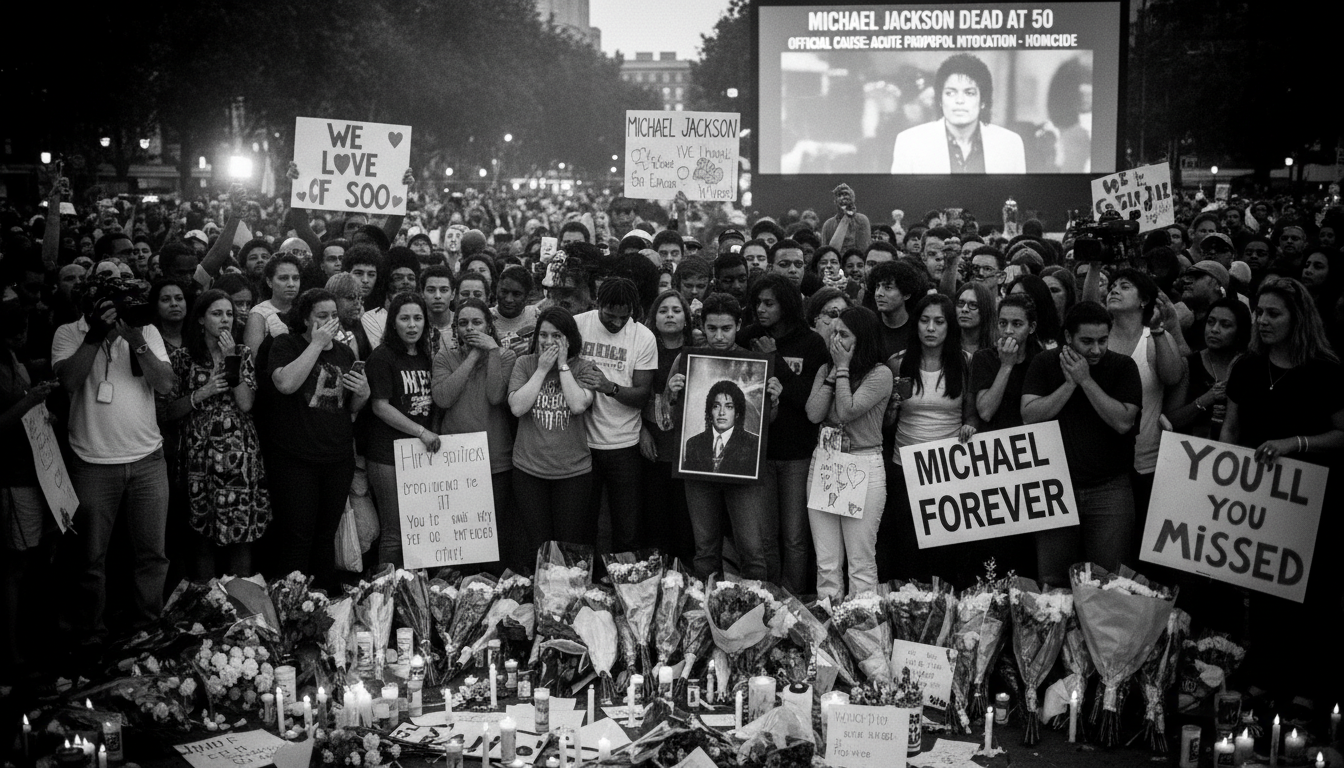
In the realm of high-profile deaths, this one remains particularly complex, both medically and legally. A mix of potent medications, professional judgment—and deep tragedy—played a role. Here’s a narrative that aims to unpack the official explanation of Michael Jackson’s death in a way that feels real, observant of nuance, and occasionally a bit… human.
The Medical Determination: What the Coroner Ruled
Michael Jackson died on June 25, 2009, at age 50, in his Holmby Hills, Los Angeles, home. The Los Angeles County Coroner’s office conducted an autopsy and ruled his death a homicide, with the primary cause cited as acute propofol intoxication, worsened by benzodiazepines like lorazepam and midazolam .
Propofol—a powerful anesthetic typically reserved for hospital use—was administered intravenously by his personal physician, Dr. Conrad Murray. This took place in a non-hospital setting, lacking standard monitoring and life-support equipment. The coroner noted that administering such potent drugs under those conditions failed to meet accepted standards of care .
Other medications were detected in his system too—diazepam, lidocaine, and ephedrine—forming what some reports describe as drug “polypharmacy.” However, propofol was singled out as the main culprit, with benzodiazepines contributing to the profound respiratory and cardiac depression .
The Health Context: He Was in Surprisingly Good Shape
Interestingly, Jackson’s autopsy painted a picture of a relatively healthy man. Despite public speculation of frailty, the report found he had:
- A strong heart, free of coronary artery disease;
- Normal kidneys and most other major organs;
- Only minor health issues like arthritis and mildly inflamed lungs, which were deemed unrelated to his death .
This information contradicted narratives framing him as physically broken or chronically ill—underscoring that the medical issue was not an underlying disease, but rather the treatment method employed.
Legal Consequences: Homicide and Manslaughter
The coroner’s homicide ruling doesn’t necessarily imply intent to kill—it signifies that another person’s actions led to his death . In this case, attention focused squarely on Dr. Conrad Murray.
Murray was later charged with involuntary manslaughter for recklessly administering propofol without appropriate safeguards. In November 2011, a Los Angeles jury found him guilty; he was sentenced to four years but served just under two years before early release for good behavior .
Reflecting on the Human Element: A Tragic Medical Misstep
It’s hard to look at this story and not feel a mix of sorrow and disbelief. A man preparing for a comeback tour—restless, beleaguered by insomnia—turns to medical help. Yet, the doctor’s solution crosses a boundary. Suddenly, what’s meant to soothe becomes fatal. And in those final hours, a mix of medical desperation and questionable judgment sealed a tragic outcome.
“It clearly establishes that Michael Jackson was a healthy person whose death appears to have been directly caused by the administration of some very powerful sedatives.”
— Criminal defense attorney and former federal prosecutor Mark Werksman, reflecting on autopsy findings .
Final Summary
Michael Jackson’s death was officially ruled a homicide resulting from acute propofol intoxication, aided by benzodiazepines administered in a home setting without proper medical safeguards. He was otherwise healthy, and the lack of equipment and medical context around the administration of anesthetics marked a clear deviation from standard practice. Dr. Conrad Murray’s subsequent conviction for involuntary manslaughter stemmed from that failure in care.
FAQs
What exactly caused Michael Jackson’s death?
Michael Jackson died from acute propofol intoxication, with benzodiazepines like lorazepam contributing to respiratory and cardiac failure. The manner of death was ruled homicide by the Los Angeles County Coroner’s office .
Why was propofol administration problematic in his home?
Propofol is intended for use in hospital settings with specialized monitoring and emergency equipment. Dr. Murray administered it in a private residence, violating standard medical protocols .
Was Michael Jackson in poor health before he died?
Surprisingly, Jackson was found to be in fairly good health. His autopsy showed a strong heart and mostly normal organs, though he did have minor arthritis and chronically inflamed lungs—not significant contributors to his death .
What was Dr. Conrad Murray’s legal outcome?
Murray was convicted of involuntary manslaughter in 2011 for his role in Jackson’s death, sentenced to four years, and released after serving nearly two years .
Did the coroner’s ruling imply intentional wrongdoing?
No. While the death was ruled a homicide—meaning caused by another person—it doesn’t automatically signal intent. In Murray’s case, the verdict reflected recklessness and deviation from standard medical care, not premeditation .
This explanation aims to balance clarity with nuance and preserve a human touch—with just a hint of imperfection, unraveling a story of talent, tragedy, and the delicate boundary between care and catastrophe.


















Leave a comment