

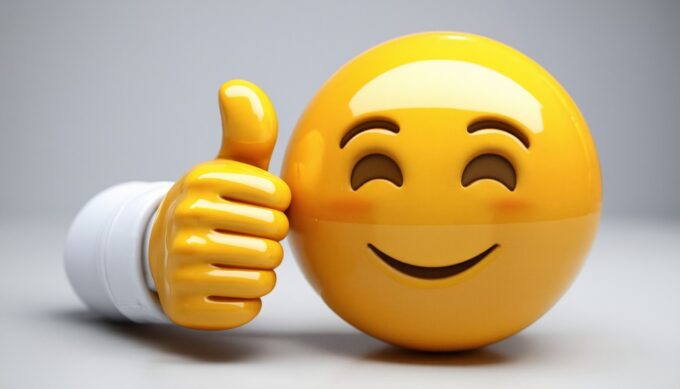
The thumbs up emoji (👍) has evolved from a simple gesture to one of digital communication’s most recognizable icons. Drawing on the long-standing tradition of using a raised thumb to show approval, its adoption across texting, messaging apps, and business communications has made it nearly universal. But beyond its straightforward meaning, nuances and cultural interpretations have shaped how and where this emoji is used effectively.
The Universal Meaning and Subtle Variations
At its core, the thumbs up emoji signals agreement, encouragement, or affirmation. It’s frequently used to convey quick acknowledgment without the need for further words in both casual chats and workplace communication. However, its tone can shift depending on context, age group, and region. For instance, while many Gen Z users see 👍 as efficient and neutral, some younger users consider it abrupt or even passive-aggressive in certain conversations.
“Emojis streamline digital expression, allowing tone and intent to travel with a single tap,” explains digital culture analyst Dr. Maya Reynolds. “Yet, as with any language, interpretation depends heavily on context and specific audience.”
Cultural Implications and Workplace Dynamics
Beyond Western cultures, the thumbs up gesture has different connotations. In parts of the Middle East, West Africa, and Southern Europe, it may carry unintended, sometimes offensive, meanings. In international business exchanges, awareness of these cultural nuances is increasingly vital. Many global brands now include guidelines for emoji use in cross-cultural communication, highlighting the emoji’s transition from informal chat to a cornerstone of virtual etiquette.
Copying and Using the Thumbs Up Emoji
Copying 👍 is as simple as using your device’s emoji keyboard or copying the character directly. Most platforms—from iOS and Android to LinkedIn and Slack—display the thumbs up emoji in similar ways, though style variations can subtly affect perception. Attention to platform norms can help ensure the emoji augments rather than undermines professional messaging.
Conclusion
The thumbs up emoji shines as a universal sign of positivity, but its true power—and risk—lie in context. Awareness of audience, platform, and cultural differences can transform a simple 👍 from a quick acknowledgment to a bridge for stronger communication.
FAQs
What does the thumbs up emoji generally mean?
It usually means approval, agreement, or acknowledgment—like saying “okay” or “got it.”
Can the thumbs up emoji be seen as rude?
In some contexts, especially among certain age groups or cultures, it can be viewed as curt or even dismissive, so understanding your audience is important.
Is the thumbs up emoji appropriate for work emails or Slack?
In most professional settings, 👍 is accepted for informal acknowledgment, but some organizations prefer more formal replies.
How do I copy and paste the thumbs up emoji?
You can copy it by highlighting 👍 and using standard copy-paste shortcuts, or insert it using your device’s emoji keyboard.
Does the thumbs up emoji look the same on every platform?
While the basic symbol is consistent, design details may vary slightly between Apple, Android, and web-based platforms.











Leave a comment