

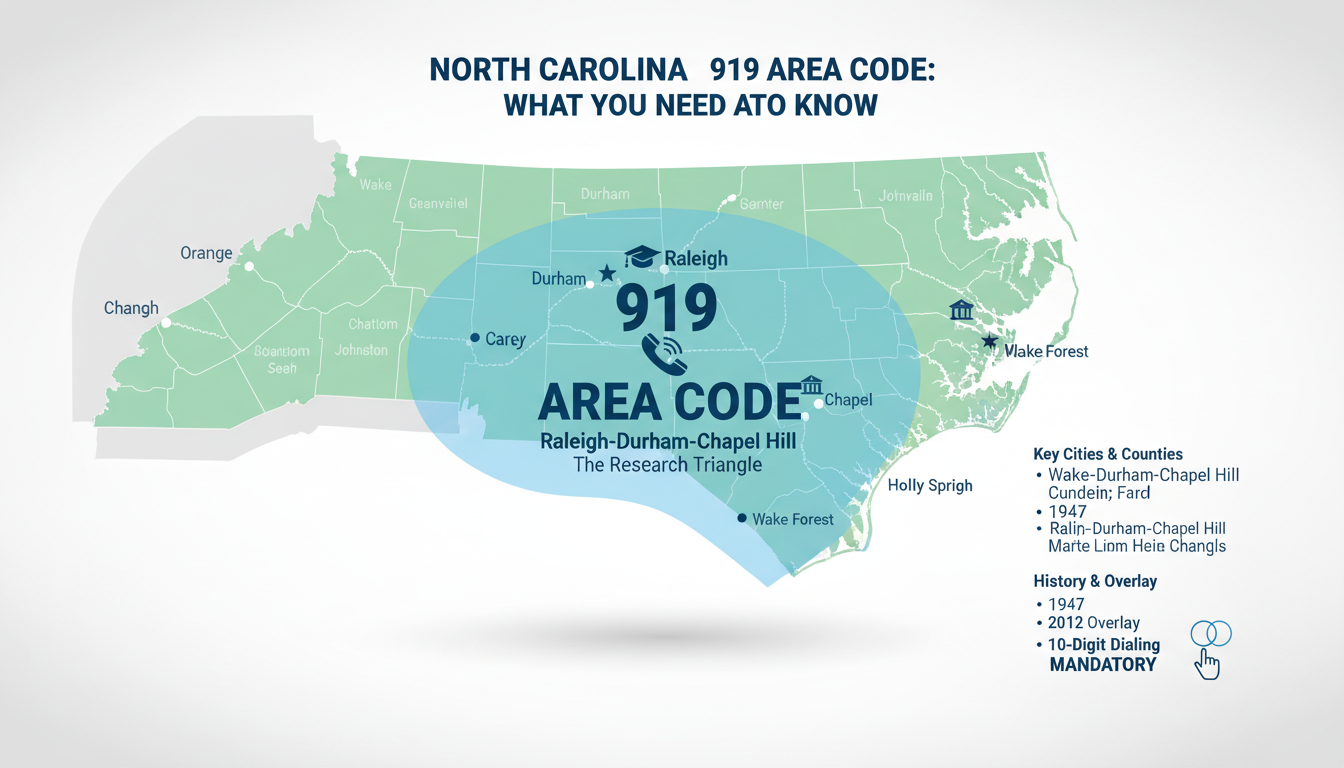
Picking up the phone and dialing a 919 number might seem like a mundane act, but there’s a compelling backstory—and real-world impact—behind those three digits. The 919 area code, deeply embedded in central North Carolina’s telecommunications identity, shines a spotlight on dynamic growth, evolving regulations, and the digital heartbeat of the Research Triangle. Along the way, the technical quirks and community shifts hidden behind this code reveal a story of expansion, adaptation, and local character.
The Origins and Evolution of 919
Historic Splits and Regional Identity
The 919 area code was introduced in 1954, emerging from a split of the original 704 area code that once covered the entire state of North Carolina . This split marked the beginning of a series of regional carve-outs. In 1993, much of southeastern North Carolina—cities like Fayetteville and Wilmington—were reassigned to the newly formed 910 area code (though a sliver around Mebane stayed in 919 for dialing integrity) . Five years later, in 1998, the northeastern portion of 919 became area code 252, further refining the region’s boundaries .
That sense of change didn’t stop there. As mobile phones, VoIP, and digital infrastructure boomed, an overlay—area code 984—was introduced in 2012. That transition ushered in mandatory ten-digit dialing across the region, fundamentally altering how locals dialed numbers—even within their own neighborhoods .
Why an Overlay? Growth, Growth, Growth
The need for 984 wasn’t an abstract issue—it reflected tangible population and technological growth. With the Research Triangle (Raleigh, Durham, Chapel Hill) expanding rapidly, demand outpaced available numbers. The overlay answered that call. Rather than carving out new regions geographically, overlaying preserved community cohesion while expanding numbering capacity .
“Despite the Triangle’s continued growth, projections show no exhaust date for 919/984 for at least 30 years,” according to forward-looking analysis .
Geographic Footprint and Economic Significance
A Tapestry of Counties and Communities
Area code 919 (and overlay 984) spans an impressive swath of east-central North Carolina, including all or parts of eleven counties: Wake, Durham, Orange, Johnston, Chatham, Franklin, Granville, Lee, Wayne, Harnett, Alamance, and Person . Within this zone lie both urban centers and quaint towns alike:
- Major cities: Raleigh (state capital), Durham, Cary, Chapel Hill .
- Additional communities: Apex, Carrboro, Fuquay‑Varina, Garner, Holly Springs, Mebane, Morrisville, Sanford, Smithfield, and Goldsboro .
This diversity mirrors a robust economic ecosystem—orchestrated by top-tier universities, tech firms, state government, health sciences, and biotechs—making 919 a marker of innovation and connection .
Real World Snapshots
- Morrisville, perched between Raleigh and Durham, is home to the operational headquarters of Lenovo and serves as a nexus for tech and clinical research .
- Fuquay‑Varina, historically rooted in agriculture and tobacco, now rides the wave of RTP-driven real estate and development .
- Knightdale has undergone a population surge—growing more than 10% in a three-year span (2010–2013)—and invested in city planning initiatives like the Knightdale Station Park revitalization .
These examples show the 919 area code isn’t just about phone numbers—it entwines with the region’s socio-economic trajectory.
Technical Nuances and Dialing Shifts
Ten-Digit Dialing and Overlay Effects
The implementation of 984 along with mandatory ten-digit dialing dramatically shifted dialing habits. Between October 2011 and March 2012, a permissive dialing period eased the transition, but by April 2012, everyone had to dial ten digits—even for local calls . The switch wasn’t seamless: early misdials often led to unintended calls to 9‑1‑1 as people confused the area code .
Overlay systems like this reflect a broader telecom trend—expanding numbering power while minimizing geographic disruption.
Prefixes and Carriers
Diving deeper, the prefixes tied to 919 reveal patterns in carrier distribution:
- BellSouth/Southern Bell holds over 150 prefixes.
- Verizon Wireless (Cellco) accounts for nearly 100.
- Frontier, Sprint Spectrum, CenturyLink, T-Mobile (Suncom), Level 3, and others make up the rest .
These numbers speak to a layered telecom landscape serving a variety of services—from mobile to enterprise-level connectivity.
A Closer Look: Why 919 Matters Today
Identity and Professional Perception
For businesses, having a 919 number signals local presence and credibility in a region known for its academic and tech clout . This local identifier helps small businesses “look and feel” local to customers navigating the Triangle’s diverse municipalities.
Resilience and Future-Proofing
The projection that 919/984 won’t hit number exhaustion for decades (at least 30 years from 2019 estimates) speaks to effective number planning and continued capacity to grow, even amid rising tech demand .
Subtle Dialing Habits and Adjustments
Though ten-digit dialing is second nature now, it required conscious adaptation at first. Supplementing phone books, company marketing materials, and signage—all had to shift. Mis-dials and awkward over-dialing were part of the early overlay transitional life.
Conclusion
The 919 area code story isn’t just about digits—it’s a chronicle of growth, infrastructure, and community identity. From its origins in 1954 to technological overlays in 2012, from small towns like Knightdale and Fuquay-Varina to tech hubs like Morrisville, 919 reflects the complexity and vitality of North Carolina’s Research Triangle. It’s a footprint of history, innovation, and local voice—all compressed into a three-digit gateway that’s here to stay.
FAQs
What cities does the 919 area code cover?
It spans the central North Carolina region known as the Research Triangle, including cities like Raleigh, Durham, Cary, Chapel Hill, and towns such as Apex, Morrisville, and Fuquay‑Varina.
Why was area code 984 added?
984 is an overlay introduced in 2012 to expand number availability in the same geographic area as 919, accommodating growth without redefining geographic boundaries.
Do I have to dial ten digits for local calls?
Yes—since 2012, ten-digit dialing became mandatory across the 919/984 area to manage the overlay logic and ensure proper routing.
Will the area code run out of numbers soon?
No—based on projections from 2019, the combined 919/984 numbering capacity is expected to last at least another 30 years before exhaustion becomes an issue.
Is 919 associated with any particular industries?
Yes, the 919 region is widely associated with education, biotechnology, state government, startups, and tech—thanks to the presence of RTP and major research universities.
Have residents seen strong growth under the 919 area code?
Definitely—towns like Knightdale grew significantly in recent decades, and areas like Fuquay‑Varina and Morrisville continue to thrive, reflecting broader RTP-driven expansion.
















Leave a comment