

So, here we are—dive into the world of the 571 area code. It might seem trivial at first glance, but if you’re texting a friend in Fairfax, setting up a business in Leesburg, or just curious, understanding what “571 area code: what you need to know” truly means can be surprisingly, well, meaningful. It’s one of those everyday details we take for granted—until it’s not.
Let’s unravel its origins, coverage, dialing quirks, and how it fits into the broader Northern Virginia tapestry. Whether you’re dialing for work, setting up a local presence, or just want to be in the know, there’s more to this trio of digits than meets the eye.
Origins and Evolution of 571
A Rapid Response to Demand
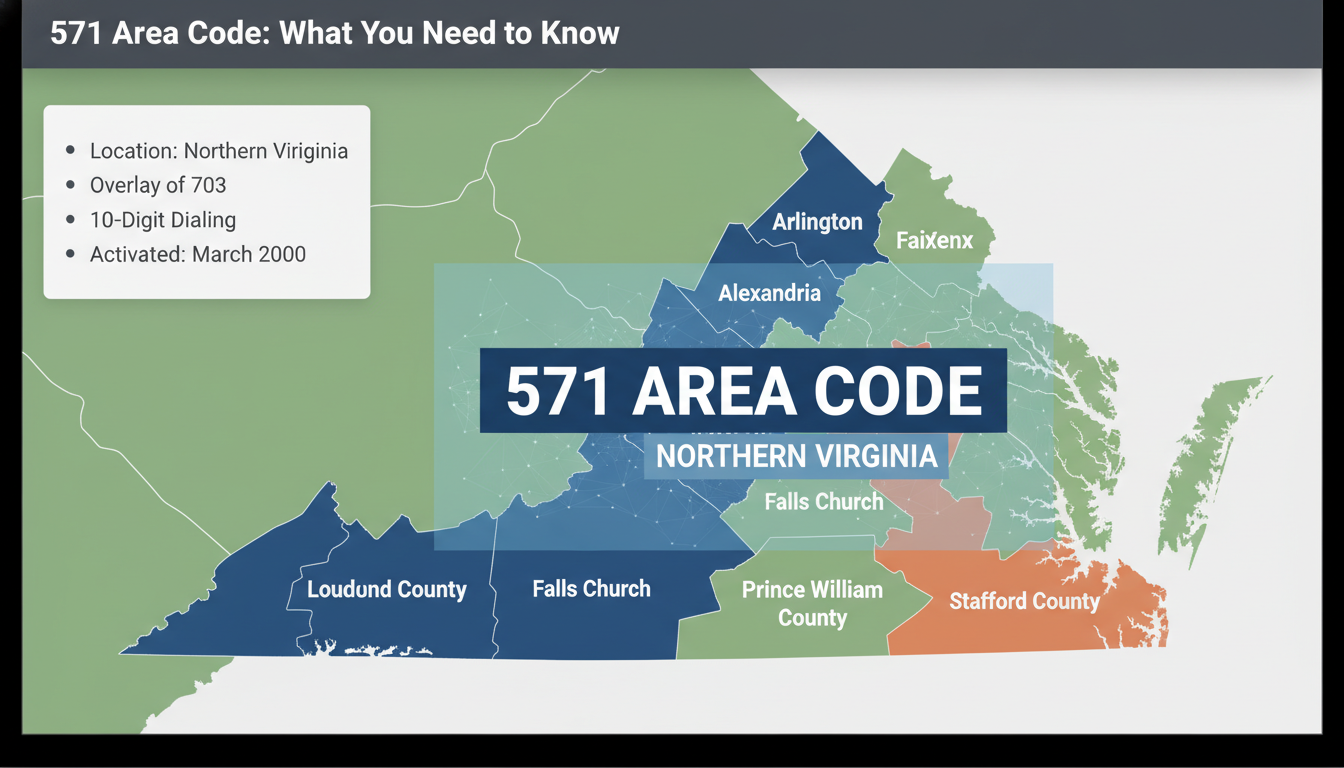
The 571 area code officially joined service on March 1, 2000, as an overlay for the existing 703 area code . That overlay was a practical move—rather than forcing everyone in Northern Virginia to change numbers, 571 was introduced to “share” the same geographic territory and allow new numbers to keep rolling.
The History Leading Up to It
To fully appreciate the emergence of 571, it’s helpful to look back. Area code 703 was one of the original US codes assigned in October 1947, and initially covered all of Virginia . But as the region—especially Northern Virginia—boomed, splits were inevitable.
In 1973, 804 was carved out. Then in 1995, pressure on 703 led to the creation of 540 for the western part of the state. Yet, demand kept rising. So instead of another split, 571 was overlaid in 2000, keeping the region intact and modernizing dialing practices .
Geographical Coverage: Who’s “571” Anyway?
The Northern Virginia Mosaic
Area codes 571 and 703 map onto the same footprint, covering key Northern Virginia regions including Arlington, Alexandria, Fairfax, Falls Church, Manassas, Manassas Park, plus parts of Fauquier, Loudoun, and Prince William counties .
Among the cities served:
– Arlington, Alexandria, Fairfax, Falls Church
– Leesburg, Reston, McLean, Manassas, Woodbridge, and more .
A Population Snapshot
The combined 703/571 area serves more than two and a half million people, spanning urban neighborhoods, dense suburbs, and outlier communities that still feel plugged into D.C. via highways and transit . This dynamism is what drove the initial strain on numbering resources—and continues to keep 10-digit dialing firmly in place.
Dialing and Numbering: A Closer Look
From Seven Digits to Ten
With the overlay, locals must dial ten digits even for calls within the same area—i.e., 703 or 571 plus the seven-digit number . Long-distance calls from landlines still use “1 + area code + number,” but cell phone users typically just stick with ten digits .
Why the Overlay Made Sense
Overlaying turned out to be more seamless than carving up the region. For institutions like the U.S. Patent and Trademark Office, Transportation Security Administration, or Fairfax County Public Schools, which operate across jurisdictions, it avoided potential operational upheaval . Plus—and this may sound odd—there’s still a sense of local identity tied to 703, and 571 lets newcomers in without a jarring “hey, your number just changed” moment.
Real-World Snapshots and Human Touches
Beyond the maps and numbers, there are little narratives tied to 571. Locals often have opinions:
“703 ran out years ago. 571 is the go-to area code for Northern VA.”
“I refuse to get a 571. Never. Ever.”
― casual chatter on regional Reddit threads
These remarks illustrate how easy it is to reach a point where the area code becomes a badge of communal identity—kind of funny, but very real.
Meanwhile, carriers handed out 703 numbers for years even post-2000, but stories abound about how eventually those ran dry, making 571 the default choice when setting up new services.
Putting It All Together
So here’s what you truly need to know about the 571 area code:
- It’s an overlay introduced in 2000 alongside 703 to meet surging demand.
- Covers the same Northern Virginia region as 703: Arlington, Alexandria, Fairfax, plus surrounding counties.
- Calls require ten-digit dialing—even locally—and long-distance uses “1 + area code + number.”
- The overlay avoided disruption for businesses and institutions and tapped into community sentiment.
- Area codes can spark lighthearted—or firm—preferences among residents (“703 forever,” or “never 571”).
Conclusion
The 571 area code might look like just another three digits, but it represents Northern Virginia’s evolution—from sprawling suburb to tech-and-government hub. It reflects smart telecom planning, respect for community identity, and a nod to how people actually connect (and sometimes argue) about the little details.
Next time you dial that ten-digit number, consider the story behind those digits—and maybe chuckle at the subtle local pride in preferring one over the other.
FAQs
What exactly does area code 571 cover?
Area code 571 covers much of Northern Virginia, overlapping with 703 to serve areas like Arlington, Alexandria, Fairfax, Falls Church, Leesburg, Reston, and parts of Fauquier, Loudoun, and Prince William counties.
Why was area code 571 introduced?
It was introduced on March 1, 2000, to overlay 703 and alleviate exhaustion of number availability in the fast-growing Northern Virginia region—without forcing everyone to change their existing numbers.
Do I have to dial ten digits even for local calls?
Yes. Due to the overlay system, ten-digit dialing (area code + number) is mandatory for all local calls in the 703/571 region.
Does 571 indicate a mobile number or anything specific?
Not necessarily. While many new mobile lines may receive 571 numbers, the code is used for both landline and wireless lines—depending on availability and assignment.
Are there more area codes planned for Northern Virginia?
There’s no immediate indication of new overlays specifically for 703/571, though Virginia continues to add area codes elsewhere as needed.














Leave a comment