

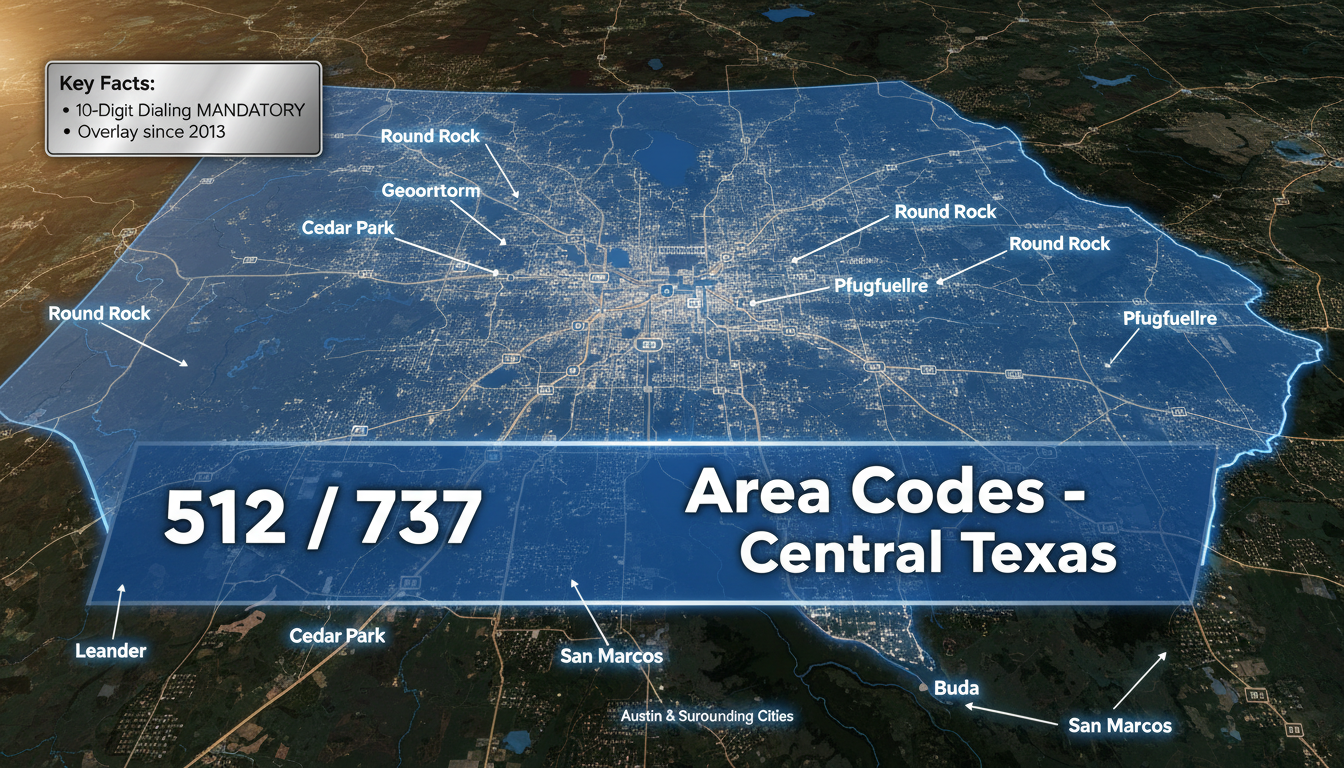
A quick glance at the 512 area code—most people just think of “Austin,” right? Yet, behind that simple three digits lies a rich tapestry of geographic history, policy decisions, and human behavior. There’s plenty to unpack, so let’s take a slow stroll through the facts, the stories, and yes, a few unexpected turns.
Origins and Evolution of the 512 Area Code
The 512 area code was assigned in January 1947 under the North American Numbering Plan (NANP), covering a massive swath of south and central Texas—from the Gulf Coast clear up through Austin and beyond . It’s wild to imagine that a single code covered everything from Corpus Christi to San Antonio, and even the Rio Grande Valley.
But growth—and technology—wait for no one. In 1992, the southwestern portion (San Antonio and the Valley) was split off into 210. The surprising part? San Antonio, larger even than Austin, gave up the original 512 code so that the state capital’s many agencies wouldn’t have to change their numbers. That was a savvy move that saved real-world dollars and confusion .
Then, in 1999, another split removed Corpus Christi and the coastal towns into the new 361 area code, trimming 512 down closer to Austin’s core region . By 2013, demand surged again—phones, fax machines, internet lines—so an overlay, area code 737, was added. That change meant everyone had to dial 10 digits, even locally, because two codes now served the same geographic area .
Geographic Scope: More than Just Austin
Sure, Austin is the anchor city—and it’s famous—but the 512/737 codes span several surrounding counties and communities. Counties include Travis, Williamson, Hays, Bastrop, Burnet, Caldwell, and Milam .
Communities like Round Rock, San Marcos, Cedar Park, Georgetown, Kyle, Buda, and even smaller places like Wimberley or Dripping Springs fall under this area code . If you work in tech in Cedar Park or live in Burnet and commute out, you’re still dialing under the same code. It’s like a phone number ecosystem: all these suburbs orbit around that 512 gravitational center.
The region observes Central Time—CST in winter and CDT during daylight saving time—just like the rest of central Texas .
Cultural Touchstones: Why 512 Still Matters
Despite splits and overlays that sliced and diced its territory, the 512 code remains emblematic. You’ll hear it pop up in local culture—like Selena Quintanilla’s iconic 1995 song “El Chico del Apartamento 512,” which nods at Corpus Christi’s old number . Even businesses, merch, and marketing lean into that “512 pride”—it signals authenticity.
One writer put it best:
“The 512 area code is the original telephone code for the Central Texas region… contributing to Austin’s cultural identity” .
That sense of identity persists—especially amid rapid growth. When new transplants land in Austin, a 737 number signals “new blood,” while 512 remains a badge of longer tenure . So yes, sometimes phone digits carry unspoken social signals—that’s human unpredictability in action.
Dialing Rules and Practical Impact
If you’ve lived here a while, you already know: 10-digit dialing is mandatory. Whether you’re calling across town or just down the block, you must dial the area code plus the seven-digit number .
Why it matters? Imagine three phone lines in your home: home, mobile, VoIP, each possibly getting assigned different area codes—and you still have to dial the full thing every time. It’s not complicated, but it’s a shift—and one that came with some grumbling.
For businesses, overlays simplified operations—no one had to change a number. For the average person, it meant updating phone settings, contacts, and autoplay confusion for a bit. But over time, it became second nature—much like adjusting to daylight saving time.
Security Considerations: Scams and Spoofing
Here’s where things get messy. Dialing familiarity can breed complacency. Scammers have exploited that comfort zone—spoofing local 512 or 737 numbers to appear legitimate . A common ruse: pretend to be Austin Energy, demand immediate payment, threaten to cut power.
One victim shared a clever disentanglement online—rebuffed the claim, contacted the real utility, and got the scam confirmed .
Other scams include fake warrants or impersonating Travis County Sheriff’s Office. People are warned to verify with known public numbers before responding .
Even Medicare scams have been reported in this area code . The key takeaway: just because a phone number looks local, it doesn’t mean it’s safe. Being skeptical—even of familiar-looking calls—matters.
Why 512 Still Matters Amid Change
It’s fascinating—despite all the boundary shifts, scan risk, and overlay confusion, 512 hasn’t just persisted—it’s endured and evolved. It’s a lens into how infrastructure, policy, and culture collide. Austin is growing fast, telecom systems try to keep pace, but the number sticks.
It’s not just digits—it’s identity. Long-time Austinites still cherish that 512 tag. Businesses still lean into it. Meanwhile, newcomers get assigned 737, growing the code ecosystem organically.
Conclusion
The 512 area code is way more than a simple set of numbers. From its massive original footprint in 1947, through splits to safeguard government operations, to overlay expansion and ongoing cultural resonance—512 is a story of how communities grow, adapt, and remember.
Even now, it bridges the old guard and new residents. It forces us to dial thoughtfully, report scams, and recognize that even familiar codes deserve respect.
FAQs
What region does the 512 area code cover today?
It covers Austin and surrounding parts of Central Texas, including suburbs like Round Rock, San Marcos, Cedar Park, and communities in several counties including Travis, Williamson, Hays, Bastrop, Burnet, Caldwell, and Milam.
Why does Austin have two area codes (512 and 737)?
Because demand for numbers outpaced availability, 737 was overlaid on the existing 512 region in 2013. Overlays allow new numbers without forcing everyone to change existing ones.
When did 10-digit dialing become mandatory in the 512 region?
Mandatory 10-digit dialing started in June 2013 when the 737 overlay was introduced, requiring callers to always include the area code.
Are there scam risks associated with dialing or receiving calls from 512?
Yes. Scammers often spoof local numbers to appear credible, running ruses like fake utility bills or law enforcement threats. It’s wise to verify calls through known official numbers before responding.
Why didn’t San Antonio keep the 512 area code in the 1992 split?
Despite San Antonio being larger, state regulators kept 512 with Austin to avoid the expense and disruption for numerous state agencies needing to change numbers, preserving government continuity.
How did the geographic area of 512 change over time?
Originally covering central and southern Texas, parts were carved out: area code 210 in 1992 for San Antonio and the Valley, area code 361 in 1999 for the coast, leaving 512 focused around Austin—then overlaid with 737 in 2013.
That’s the 512 story in a nut—but also a drama of growth, policy decisions, tech, and human quirks, all coalescing in three small digits.
















Leave a comment