

It’s funny how something as small as an area code can carry more narrative weight than you’d expect. The 424 area code, perched within Southern California, might seem like just another three-digit prefix—and yet it’s entwined with tech hubs, urban sprawl, cultural shifts, and business identity. Let’s take a dive into what you need to know about the 424 area code, with me occasionally tripping over phrases, stretching ideas, every now and then chuckling at how deeply one can go into… well, a phone code. But that’s exactly the charm.
The origin and overlay evolution of 424
The 424 area code didn’t start alone—it’s an overlay of the long-standing 310 area code. Introduced in the mid‑2000s, overlays like 424 solve numbering shortages in fast-growing regions. In practice, this meant residents and businesses suddenly found themselves with different phone prefixes while sharing the same geographic region. Beyond just digits, such changes signal shifts in population density, technological demands, and planning priorities.
Why overlays matter
- They avoid disruption, letting everyone keep existing numbers.
- They support continued growth without forcing complete changes.
- They reflect underlying demographic and infrastructure shifts.
In Southern California this meant, even as 310 remained, 424 joined the conversation—an unassuming yet significant footnote in the region’s tech and communications story.
Geography and cultural footprint: mapping 424
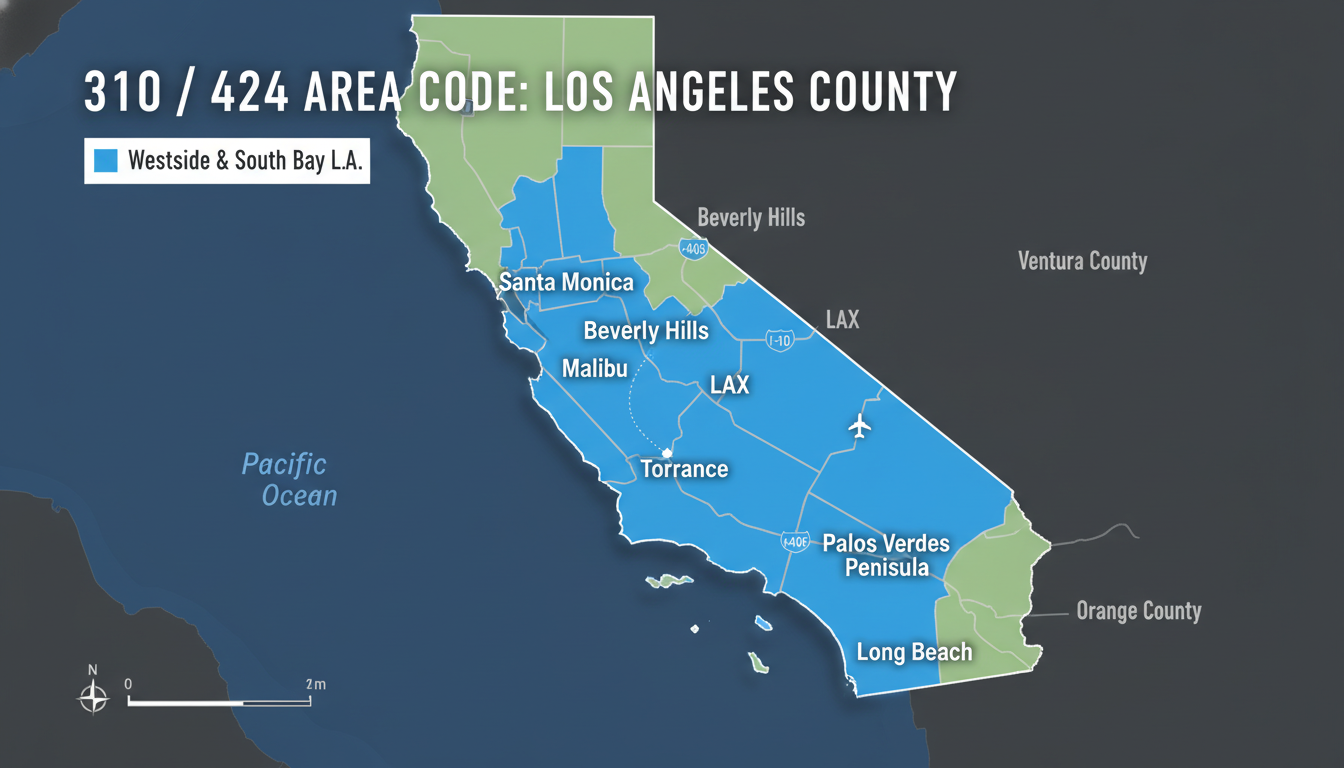
Geographically, the 424 area code blankets parts of West Los Angeles, Beverly Hills, Santa Monica, Malibu, and surrounding neighborhoods. In so many ways, these are icons of culture, commerce, and media influence—Hollywood in proximity, beach cities with high rents, startups rubbing elbows with the old guard. It’s less “just a code” and more “a stamp of place,” carrying connotations of status, innovation, or exclusivity depending on who’s talking.
Notably, many entertainment and tech firms in Santa Monica and Venice operate with 424 numbers. That subtle difference—310 versus 424—can nudge perception: “oh, newer company” or “just shifted to accommodate more connections.” Whether fair or superficial, such associations show us how area codes feed identity.
Impact on branding, logistics, and customer experience
Any business, especially in tech or consumer services, knows branding is sensory: a logo, a tone of voice, even a phone number. A switch to 424 might feel fresh or modern—but it can also lead to confusion if your audience still associates you with 310. So, the practical side matters: redirecting calls, updating marketing materials, retraining staff to recognize correct prefixes. It’s a small bit of logistics, but in real world operations, these “minor” tasks can ripple into customer experience, billing, and internal comms.
Here’s an illustrative point: a mid-size creative agency moved from a 310 number to 424. They updated the website, email signatures, business cards, yet early client feedback reported calls bouncing to old lines. They spent a week cross‑checking referrals, re‑circulating the new combination. Eventually things settled—lessons learned about thorough migration protocols.
Technical mechanics: dialing, regulation, and numbering capacity
At the regulatory level, overlays like 424 come from decisions by national and regional numbering administrators, often coordinated by local utility commissions. Technically, once 424 came live, ten‑digit dialing (area code + number) became standard for local calls—no more cozy seven‑digit shortcuts. That’s a shift in user behavior, subtly altering how people think of calling neighbors.
Long-term, overlays are a smarter strategy to expand number availability without fracturing the area. Plus, overlays accommodate future-oriented needs—like dedicated lines for smart devices, VOIP, mobile carriers—without adding new area code zones. Over time, this supports scalability in a dense, digital‑heavy environment.
A human perspective — anecdotes and mini case study
Let’s step back into everyday life for a second. Picture a small bakery in Venice that’s been around since the ’90s, always 310-xxx-xxxx. When the number switched—well, it didn’t change—but a neighboring storefront got 424-xxx-xxxx. So customers mis‑dialed or scrambled their entries, thinking the bakery’s digits had also changed. The owner joked over coffee that “my pastries are the same, but people kept calling asking about scones and getting voicemail they didn’t know.” Beyond comedic, it reflects how digital misreadings can cascade into real‑world confusion—however lighthearted.
That case captures a broader truth: people anchor to numbers. Phone digits aren’t neutral; they’re part of memory, pattern, routine. So when overlays shift that pattern, even slightly, it nudges behavior.
Industry relevance—why you (or your business) should care
So what? Why should area‑code dynamics matter beyond trivia?
- Local identity: In LA‑adjacent communities, prefix familiarity signals belonging. 424 might feel new or alternative.
- Business positioning: A 424 number could signal agility—especially for newer ventures—but may require communicative clarity.
- Operational readiness: Ten‑digit dialing, updated collaterals, staff briefings—small overhead, sure, but important in customer‑facing operations.
- Tech adaptation: With IoT, mobile devices, voice assistants, having enough numbering capacity keeps your digital infrastructure agile.
In essence, thinking about area codes isn’t just about digits—it’s thinking about perception, infrastructure, and adaptability.
Introducing a voice from the field
Here’s a point from a telecom veteran, whose work on suffix regulation helped oversee several area‑code rollouts:
“An overlay isn’t just adding digits; it’s managing expectations. We’re talking about how people make calls—whether they’re dialing their neighbor, ordering lunch, or connecting to their smart fridge. Every shift ripples through behavior.”
That resonates—as obvious as it sounds, the human side of dialing matters. Patterns, assumptions, even slight friction from dialing ten digits can impact satisfaction or adoption.
Summary: What the 424 area code tells us
Overlay evolution, nuance, and community identity all come together around 424. The story isn’t technical alone; it’s social, operational, even a bit poetic in how we interlace our daily lives with number patterns. Think about who’s calling, how they’re calling, and what subtle shift in a prefix might tell them—or make them wonder.
Suggested next‑step for readers and businesses
If you’re in the region—or expanding there—consider these steps:
- Audit your comms and collateral to ensure area‑code clarity.
- Prepare internal teams for dialing habits—don’t leave customers guessing.
- Monitor customer feedback early after changes to catch mis‑dials.
- Use your area‑code story: “Hello from the 424 zone!” can be a light, human touchpoint.
Conclusion
The 424 area code might seem like a trivial three-digit addition—but looking closer, you see it’s a lens into demographics, operations, identity, and technology. From your caller’s ear to your brand’s identity, those prefixes matter. Awareness, small adjustments, and clean communication can smooth transitions and even give brand story a playful edge. Numbering isn’t just digits—it’s how we connect.
FAQs
Q: What areas exactly use the 424 area code?
A: It overlays the same region as 310, including cities like Santa Monica, Beverly Hills, Malibu, and parts of West Los Angeles. That means the same geography, just newer number assignments.
Q: When did the 424 overlay begin, and why?
A: It was introduced in the mid‑2000s to expand phone number availability in fast-growing areas without changing existing numbers—hence the overlay system.
Q: How does 424 affect dialing behavior?
A: After the overlay, ten‑digit dialing became mandatory even for local calls in the region, as the system needs clarity between overlapping prefixes.
Q: Should businesses update all materials immediately after getting a 424 number?
A: Yes, it’s best to sync marketing materials, signage, email signatures, and train staff to use the full ten digits to avoid confusion and missed calls.
Q: Does having a 424 number give a business any branding advantage?
A: It can lend a fresh or modern impression, especially for newer companies—but its impact depends on context and how well it’s communicated.
Q: Are overlays common in other parts of the U.S.?
A: Absolutely. Overlays are widely used in various urban and growing regions as a practical alternative to carving new geographic area codes.
















Leave a comment