

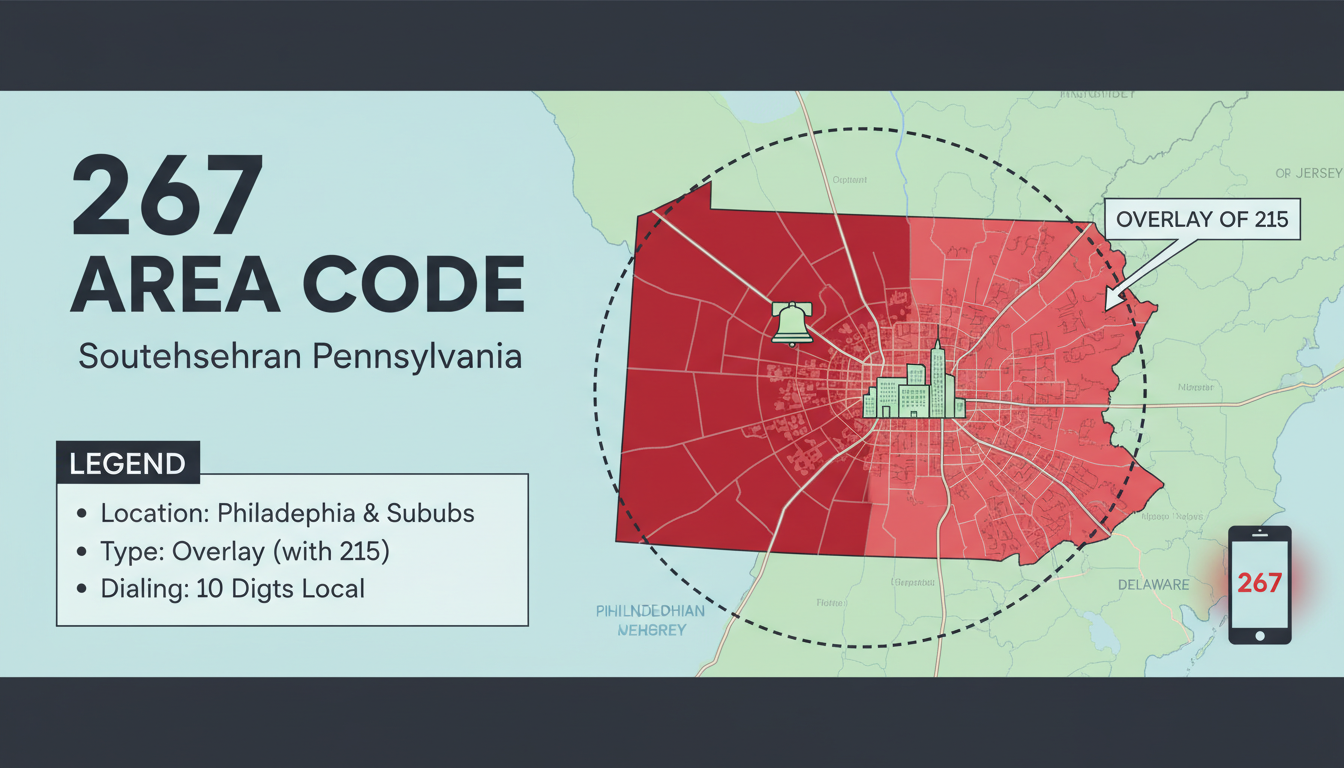
Understanding area codes may sound mundane—yet, for anyone dealing with phone numbers, marketing, or regional identity in the U.S., they’re surprisingly meaningful. Take the 267 area code: it’s not just a string of digits—it’s a portal into Philadelphia’s telecom history, growth patterns, and even cultural quirks. Let’s unwrap it, meandering just enough to feel human but still landing you with smart, helpful insight.
Why 267 Shows Up—and What an Overlay Means
It’s easy to assume new area codes are just random additions, but in truth they often address a real-world crunch: more phones than there are available numbers. That’s where overlays come in.
The Roots: 267 as Relief for 215
Originally, Philadelphia and its surroundings were under area code 215—one of the first ones in the North American Numbering Plan (established in 1947) . By the late 1990s, demand surged—thanks in part to cell phones and fax machines—and numbers were running out. Overlay area code 267 was assigned in 1998 and went live on July 1, 1999, to relieve the 215 region without making anyone change their number .
Another Layer: 445 Comes Along
Even with 267 added, growth continued. So in 2018, area code 445 joined the overlay family with 215 and 267—adding a third layer to the same region . Instead of geographic splits, overlays preserve the map, which arguably helps business and social continuity.
“Overlay codes like 267 and 445 are a testament to evolving telecom demand—they spare people the hassle of changing numbers while scaling capacity.”
What Areas 267 Serves—Not Just Philly
You might think 267 is solely Philly, but its reach stretches into several counties and communities.
Counties and Key Cities
- It covers all of Philadelphia County, plus significant portions of Bucks and Montgomery Counties, small parts of Berks and Lehigh Counties .
- Notable towns include Levittown, Lansdale, Warminster, Abington, Bensalem, Bristol, Cheltenham, and Lower Makefield .
- According to some data sources, the overlay serves a population of around 3.6 million residents across about 55 cities .
Time Zone—and Why That Matters
Located entirely in the Eastern Time Zone, 267 aligns with Philadelphia’s economic schedule, which matters for businesses juggling call centers, customer service hours, and regional coordination .
Real-World Dynamics and Personal Touches
Overlay area codes can feel strangely impersonal—but for Philadelphians, 267 has woven into everyday life.
- On forums, nostalgic voices recall how “267… we were like aw hell no!” when dialing norms changed .
- Someone learning area codes for U.S. trivia notes that while 215 is iconic, overlays like 267 and 445 inevitably pop up—and are worth knowing if you really dive in .
These reactions reveal how telecentric shifts become part of regional identity—tongue-in-cheek resistance, personal nostalgia, or pragmatic acceptance.
Numbers Behind the Digits
Some nerdy details are surprisingly human, too.
- According to one source, 267 boasts 736 active prefixes, with about 64 being inactive. Most are landlines .
- Prefixes are spread across the region—from Philadelphia proper to King of Prussia, Norristown, Allentown, and more .
- Though precise stats vary, it’s clear that population-to-prefix distribution reflects area density—with Philadelphia dominating but surrounding suburbs well-represented .
Yet, these figures shift over time—and not every source lines up precisely. In practice, this means dialing norms and available prefixes are dynamic, shaped by carrier allocation and population trends.
Broader Implications: Business, Branding, and Stability
For local businesses, opting for a 267 number can signal a Philadelphia connection—without the vintage flair of 215 or the novelty of 445. Overlay stability also matters: NANP projections suggest no new codes needed before 2050 .
In marketing, a local area code boosts trust—especially in territories where phone scams are common. And because overlays retain location-based identity, they’re, well, more friendly than forcing people to adjust numbers.
How to Keep It Simple When You Don’t Want to Overthink It
If remembering three codes feels like overkill, that’s valid.
- Many local businesses or old-school folks still default to 215 in mental shorthand—but mobile and new numbers increasingly hit 267 or 445 .
- If you’re dialing local contacts, stick to ten-digit dialing—and let your device manage the rest.
It’s like updating your playlist—you jostle in new tracks, but comfort songs stay around.
Conclusion
The 267 area code might seem like just another set of digits, but it’s really a snapshot of telecom evolution, population dynamics, and local identity in the Philadelphia region. Born in 1999 to rescue the overloaded 215 zone, then layered again in 2018 with 445, it’s both practical and emblematic. It spreads across multiple counties, ties into cultural memory, and supports business continuity—all while quietly handling millions of calls.
Think of it as part of Philly’s silent infrastructure: not flashy, but absolutely essential.
FAQs
What year did area code 267 go into service?
Assigned in mid‑1998, area code 267 became operational on July 1, 1999, as an overlay to alleviate numbering pressure in the 215 region.
Does 267 cover all of Philadelphia?
Yes, it includes all of Philadelphia County, plus parts of Bucks, Montgomery, and small portions of Lehigh and Berks Counties.
Why was area code 445 added?
445 was introduced in 2018 as a third overlay to accommodate continued growth in phone number demand—without disrupting existing numbers.
Do Philadelphians still use 215?
Absolutely. Many people and businesses still recognize 215 as the classic Philadelphia code, though newer or mobile numbers often use 267 or less frequently 445.
Will there be another area code next?
At least for now, projections show no new overlay is needed until well beyond 2050, meaning the 215/267/445 complex should remain stable for decades.
Do I need to dial all ten digits for local calls?
Yes. Since overlays were introduced, ten-digit dialing has become mandatory for local calls across these area codes—just dial the full number, area code included.

















Leave a comment