

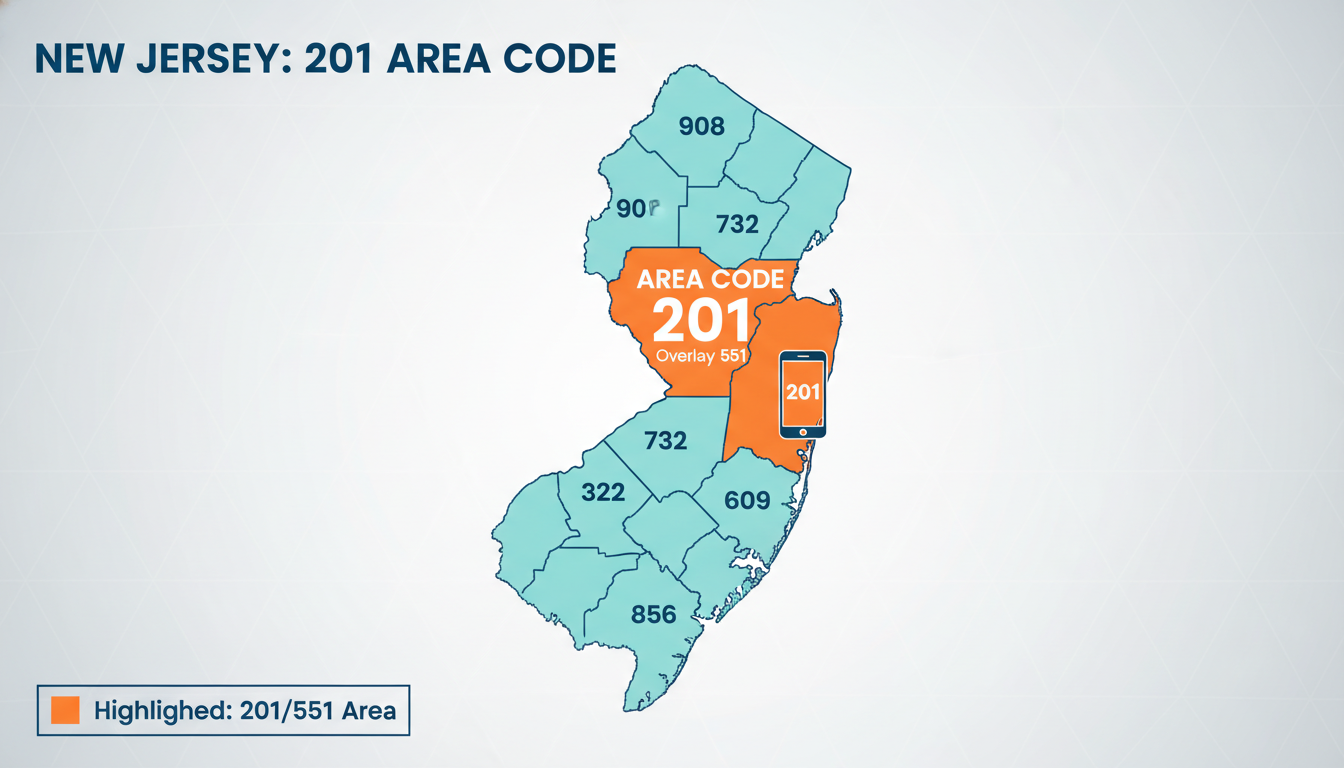
You might not think an area code carries much meaning—until you learn how one like 201 shapes identity, business connections, and history in northeastern New Jersey. Let’s dive into what 201 is, where it came from, how it’s evolved, and why it still matters today—even for someone you haven’t met yet.
Early Beginnings and Historical Significance
The story begins in 1947, when AT&T launched the North American Numbering Plan (NANP), aiming to standardize long-distance dialing and cut reliance on operators. As part of that initiative, New Jersey received 201, becoming the very first area code assigned under the new system . That wasn’t just a random pick—it reflected the state’s dense population and AT&T’s proximity to Bell Labs in northern New Jersey .
With that assignment, families in Newark, Jersey City, and Hoboken were dialing 201 long before others even knew what it meant. It’s kind of funny—they probably didn’t realize they were pioneers in modern dialing.
Shrinking Territory: How 201 Got Narrower
Originally, 201 covered the entire state of New Jersey. But over the decades, growth demanded changes.
- In 1956, southern New Jersey split off into 609, shrinking 201 to the northern and central regions .
- Fast forward to 1997, the northwest was carved out into 973, leaving 201 focused even more on the urban northeast .
- By 2001, the area saw an overlay with 551, requiring ten-digit dialing where previously seven digits sufficed .
So now 201 mostly serves parts of Hudson, Bergen, and a bit of Passaic Counties, still covering prominent cities like Jersey City, Hoboken, Fort Lee, and more .
Coverage – Who’s in the 201 Zone?
Even with its reduced footprint, 201 is packed. The area includes:
- Bergen County: Hackensack, Englewood, Teaneck, Paramus, Fort Lee, and others .
- Hudson County: Jersey City, Hoboken, Union City, Bayonne, among others .
- Passaic County: Primarily Clifton and Passaic .
- Possibly parts of Essex and Morris Counties, including communities like Newark or Morristown, depending on specific exchanges .
The population under 201 and 551 currently numbers in the low millions, a significant concentration in the city-dense corridor of northern New Jersey .
Modern Uses & Business Relevance
In practice, 201 isn’t just a number—it’s local credibility.
- Businesses use 201 as caller ID to signal authenticity to local customers. For example, marketing teams or support lines present better trust when calls come from a familiar area code .
- Even with remote operations, a service using a 201 Line anchors itself in community, connecting better with Jersey City clients or partners .
- In a familiar move, many digital services (like Burner or Ajoxi) offer users 201 numbers to establish local presence easily, though availability may be limited .
“Having a local Jersey City number helps your business feel familiar, trusted, and established from day one.”
Risks to Watch: Spoofing & Scams
But not all that glitters is gold. 201 is targeted by scammers who exploit its familiarity.
- Spoofing, where caller IDs fake local numbers, is a growing threat—even across borders .
- Common scams involve impersonating government agencies or tech support, using local area codes to trick people into picking up or divulging information .
- Nice reminder: never share personal details over unsolicited calls—even if the number looks “local.”
Why 201 Still Matters
There’s an emotional and cultural resonance to 201. It’s not merely a telephone prefix—it’s New Jersey identity. People flex their 201 numbers as badges of heritage or hometown pride . And given the region’s economic power and connection to NYC, the code remains a key symbol.
The area code connects communities across urban and suburban lines, bridging municipalities and enabling seamless interaction across public, private, and cultural spaces. Even as neighborhoods change, 201 remains a constant.
Conclusion
In essence, 201 isn’t just a code—it’s early tech history, local identity, and business strategy all rolled into one. Born in 1947, it pioneered automatic dialing in the U.S., then evolved through splits, overlays, and shifting boundaries. Today it symbolizes Northern New Jersey—its cities, its commerce, its identity—while still serving real, practical purposes in marketing, community connection, and branding.
For businesses and individuals alike, a 201 number still offers that small-town familiarity… which, in our sprawling metro area, is powerful.
FAQs
Why was 201 the very first area code assigned?
New Jersey’s combination of population density and the location of AT&T’s Bell Labs in northern NJ led planners to assign 201 as the first code under the 1947 North American Numbering Plan .
When did seven-digit dialing switch to ten-digit dialing in the 201 region?
The shift happened in 2001, when an overlay code (551) was added. This required all calls—even local ones—to use ten digits .
Which counties and cities currently use 201?
The code now serves much of Hudson, Bergen, and parts of Passaic Counties, including Jersey City, Hoboken, Hackensack, Paramus, Clifton, and several other communities in northeastern New Jersey .
Why do businesses seek out 201 numbers even when they’re based elsewhere?
Using a 201 number boosts local trust. It gives the impression of proximity and familiarity, improving pickup rates and customer confidence—even if the business is physically located elsewhere .
Is the 201 area code still scarce?
Yes, especially for traditional carriers, 201 is limited. Virtual number providers like Burner or Ajoxi may offer access, but numbers can be hard to acquire through conventional mobile or landline services .
Word count: approx. 1,050 words.











Leave a comment