
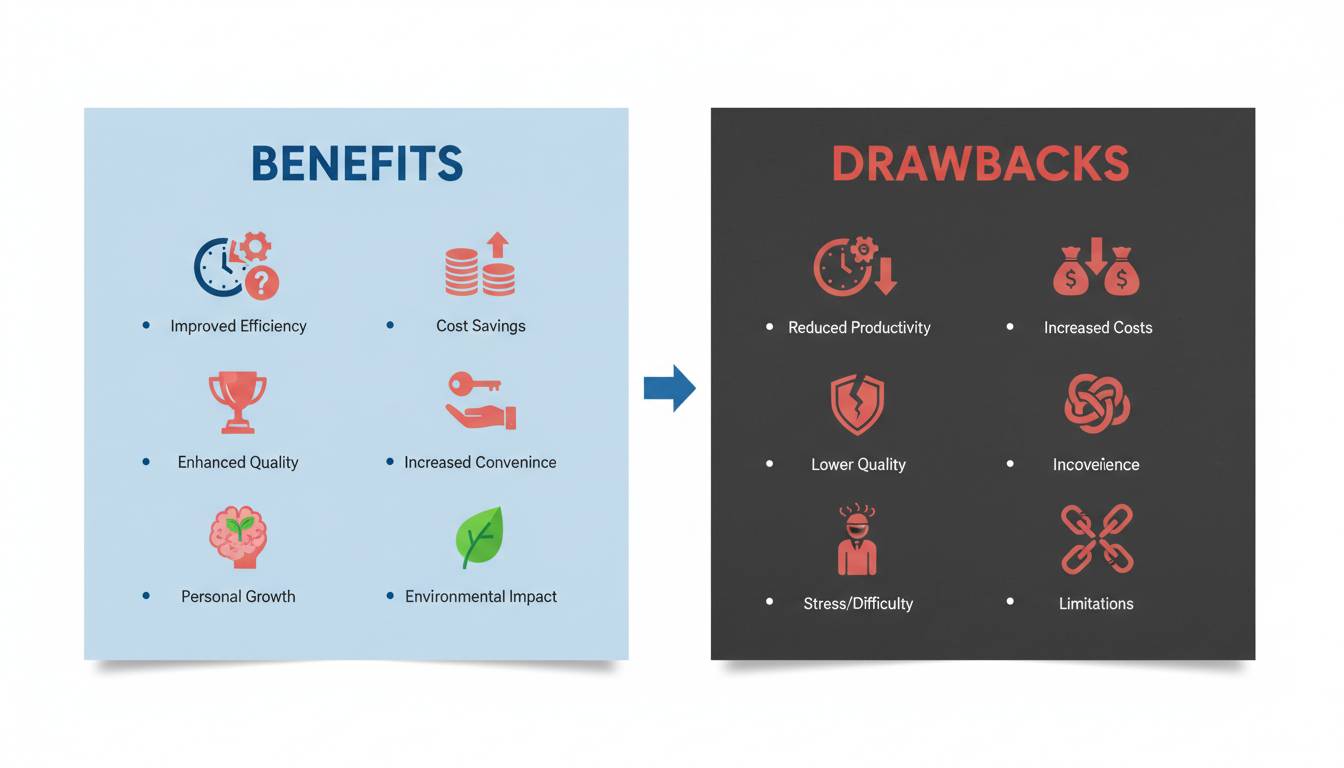
Making decisions—whether choosing a career path, purchasing a major item, or selecting a service—requires weighing what you gain against what you sacrifice. A systematic benefits and drawbacks analysis helps you move beyond gut feelings and emotional impulses to make choices aligned with your actual priorities. Yet most people approach this process haphazardly, either overemphasizing short-term gains or fixating on potential losses. The result? Decision fatigue, analysis paralysis, or buyer’s remorse.
This guide teaches you how to evaluate benefits and drawbacks systematically, avoid common cognitive traps, and make confident choices in any situation.
Understanding the Benefits-Drawbacks Framework
At its core, a benefits and drawbacks analysis is a decision-making tool that forces you to list and evaluate the positive and negative consequences of a choice. The simplicity of the framework is its strength—anyone can create a pros and cons list—but its simplicity also creates room for critical errors.
Benefits represent the advantages, gains, or positive outcomes you expect from a decision. These can be tangible (financial savings, time efficiency) or intangible (peace of mind, improved relationships).
Drawbacks represent the disadvantages, costs, or negative consequences. Like benefits, they can be concrete (higher prices, longer commute times) or abstract (stress, uncertainty).
The goal isn’t merely to compile lists—it’s to assign meaningful weight to each factor based on your personal values and circumstances. A $5,000 salary increase might be a major benefit for one person and negligible for another, depending on their financial situation, career stage, and priorities.
Why Most People Get This Wrong
Research in behavioral economics consistently shows that humans are poor intuitive statisticians. We tend to weight certain factors inappropriately, leading to decisions we later regret.
Cognitive Biases That Distort Analysis
Loss aversion causes people to feel the pain of a drawback more intensely than the pleasure of an equivalent benefit. Studies by psychologists Daniel Kahneman and Amos Tversky found that losses loom approximately twice as large as equivalent gains. This means if a decision offers $10,000 in benefits but carries a $5,000 risk, you might irrationally avoid the choice despite the clear positive expected value.
Confirmation bias leads you to seek evidence supporting what you already want to do. If you’re excited about a new job opportunity, you might unconsciously emphasize its benefits while dismissing drawbacks as temporary or surmountable.
Recency bias causes you to overweight recent information. A single vivid negative story about a product might overshadow statistical evidence showing it’s generally excellent.
Status quo bias makes any change feel risky, artificially inflating perceived drawbacks of new options while undervaluing benefits.
A Five-Step Method for Effective Analysis
Rather than simply listing pros and cons, follow this structured approach:
Step 1: Define Your Decision Clearly
Before analyzing benefits and drawbacks, ensure you understand exactly what you’re choosing. “Should I change jobs?” is too vague. “Should I accept the marketing manager position at Company X, or stay in my current role at Company Y?” provides the specificity needed for meaningful analysis.
Write your decision question at the top of your document. Include relevant constraints: “Should I accept Position X given my need for work-life balance and my desire to stay in Chicago?”
Step 2: Generate a Comprehensive List
Spend time brainstorming without judgment initially. Write every potential benefit and drawback that comes to mind, no matter how small. Others can inspire more ideas.
For major decisions, consider these categories:
- Financial impacts: Income, expenses, investments, long-term financial health
- Time and convenience: Commute, hours required, flexibility
- Career and growth: Skills developed, advancement opportunities, industry exposure
- Relationships and personal life: Impact on family, friendships, personal wellbeing
- Health and stress: Physical health, mental health, work-life balance
- Values and fulfillment: Alignment with personal values, sense of purpose
Step 3: Assign Realistic Weights
Not all factors carry equal importance. Create a simple weighting system:
| Weight | Description |
|---|---|
| 1 | Minor consideration |
| 2 | Moderate importance |
| 3 | Very important |
| 4 | Critical, deal-breaker level |
Multiply each benefit and drawback by its weight to get a more accurate picture. A minor drawback (weight 1) that occurs 10% of the time scores differently than a critical drawback (weight 4) with 50% probability.
Step 4: Consider Probability and Timeframe
A 10% chance of a major drawback might be acceptable, but a 10% chance of a catastrophic failure likely isn’t. Similarly, a benefit that lasts five years differs from one that lasts twenty.
Distinguish between:
- Guaranteed vs. probabilistic outcomes: Will this definitely happen, or is it a possibility?
- Short-term vs. long-term impacts: How will this decision affect you in 6 months? 5 years? 20 years?
- Reversible vs. irreversible choices: Can you change your mind later if things don’t work out?
Step 5: Look Beyond the Numbers
Quantitative analysis provides structure, but it cannot capture everything. After completing your weighted analysis, step back and consider:
- Intuition: What does your gut tell you after reviewing the analysis?
- Worst-case scenario: Can you live with the worst possible outcome?
- Opportunity cost: What are you giving up by choosing this option instead of alternatives?
- Values alignment: Does this choice reflect who you are and who you want to become?
Common Drawbacks Analysis Mistakes
Even when people attempt structured analysis, certain errors repeatedly undermine their effectiveness.
Treating All Items Equally
A list containing 15 benefits and 5 drawbacks for Option A, versus 8 benefits and 7 drawbacks for Option B, doesn’t automatically make A the better choice. The quality and magnitude of each item matters far more than quantity. One life-changing benefit or one catastrophic drawback can outweigh numerous minor factors.
Ignoring Hidden Costs
Drawbacks often hide beneath surface-level analysis. A product with a low price tag might carry high maintenance costs, expensive consumables, or compatibility limitations. A job offering higher salary might require longer hours, frequent travel, or relocation—costs that don’t appear in the initial comparison.
Overlooking Intangibles
Money is easily quantifiable, but what about reduced stress, increased happiness, better work-life balance, or enhanced reputation? These intangible benefits and drawbacks often matter more in the long run, yet people consistently underweight them because they’re difficult to measure.
Failing to Update Analysis
Your analysis represents a snapshot based on current information and circumstances. As you gather new data, revisit and revise your assessment. A factor you initially dismissed as minor might become critical after learning more.
Making Final Decisions From Your Analysis
Completed your analysis? Here’s how to translate it into action.
The Confidence Test
For each critical weighted factor, ask: “Would I still choose this option if this single factor were the only consideration?” If you can confidently answer yes for enough factors—and particularly for your highest-weighted items—you’ve found alignment.
The Reversibility Check
For decisions that can be undone, you can afford to be more experimental. For irreversible choices, apply higher scrutiny to potential drawbacks, especially those with severe consequences.
The Regret Minimization Framework
Author Jeff Bezos popularizes a technique asking: “Will I regret not doing this?” at age 80. This perspective often reveals that drawbacks feel less significant over time while untaken opportunities become sources of lasting regret.
When Analysis Fails
Sometimes despite thorough analysis, you still feel torn. This typically indicates either:
- Missing critical information (return to research)
- Values conflict (two good options with different value propositions)
- Insufficient data for probabilistic factors
In such cases, seeking advice from trusted mentors, making a smaller initial commitment to test the waters, or setting a decision deadline can help break through analysis paralysis.
Benefits and Drawbacks Across Different Contexts
The framework adapts to various decision types, though emphasis shifts based on context.
Financial Decisions
Focus heavily on concrete financial impacts, but don’t ignore opportunity cost—the returns you might earn from alternative uses of money. Factor in inflation, taxes, and long-term value, not just immediate costs.
Career Choices
Career decisions involve far more than salary. Growth potential, learning opportunities, company culture, manager quality, work-life balance, and geographic location all significantly impact your long-term satisfaction and advancement.
Major Purchases
Separate needs from wants, consider total cost of ownership (not just purchase price), and evaluate the seller’s reliability and support quality. Factor in how your needs might change over the product’s lifespan.
Life and Relationship Decisions
These choices often resist pure analysis. While you can identify factors, trust and emotional intelligence play larger roles. Ensure you’re not ignoring red flags while searching for silver linings.
Frequently Asked Questions
How do I weigh benefits and drawbacks when they’re not comparable?
Use a common denominator by converting everything to impact on your priorities. If you value financial security, time flexibility, and career growth, score each factor by how much it advances or threatens each priority. This reveals hidden trade-offs and helps you understand what you’re truly sacrificing.
What’s more important: the number of benefits or their magnitude?
Magnitude overwhelmingly matters more. A single transformative benefit (like doubling your income) or one catastrophic drawback (like serious health risks) should outweigh numerous minor factors. Always prioritize quality over quantity in your analysis.
How do I account for uncertainty in my analysis?
Assign probability estimates to probabilistic benefits and drawbacks. A guaranteed $5,000 gain is worth more than a 50% chance at $12,000 (expected value: $6,000). However, your personal risk tolerance also matters—risk-averse individuals should weight certain losses more heavily than statistical expected value suggests.
Should I involve others in my benefits-drawbacks analysis?
Yes, particularly for major decisions. Others provide different perspectives, challenge your assumptions, and may identify factors you overlooked. However, the final decision should reflect your own values and priorities, not someone else’s.
How detailed should my analysis be?
Match depth to decision importance. A $100 purchase might need only a few minutes of thought. A career change or major financial commitment warrants extensive analysis with multiple drafts. A good rule: invest time proportional to the decision’s long-term consequences.
What if my analysis shows one option is clearly better, but I still feel drawn to the other?
This signals a values conflict—the logical choice might contradict what you actually want. Revisit your weights to understand why. Sometimes emotional factors deserve higher weighting than rational analysis allows. Alternatively, you may need more information before trusting your conclusion.
Conclusion
A benefits and drawbacks analysis is only as valuable as the thought you put into it. By understanding common cognitive biases, following a structured methodology, and honestly evaluating magnitude rather than simply counting items, you transform a simple pros-and-cons list into a powerful decision-making tool.
Remember that perfect decisions rarely exist. The goal isn’t to eliminate all risk but to make informed choices that align with your values, circumstances, and long-term objectives. Use this framework consistently, and you’ll find decision-making becomes less stressful and more effective—whether you’re choosing a career, making a major purchase, or evaluating any significant opportunity.
The best decision-makers aren’t those who never make mistakes but those who learn to think clearly about trade-offs before committing. Master this process, and you’ll navigate choices with confidence regardless of what you’re choosing.
















Leave a comment