
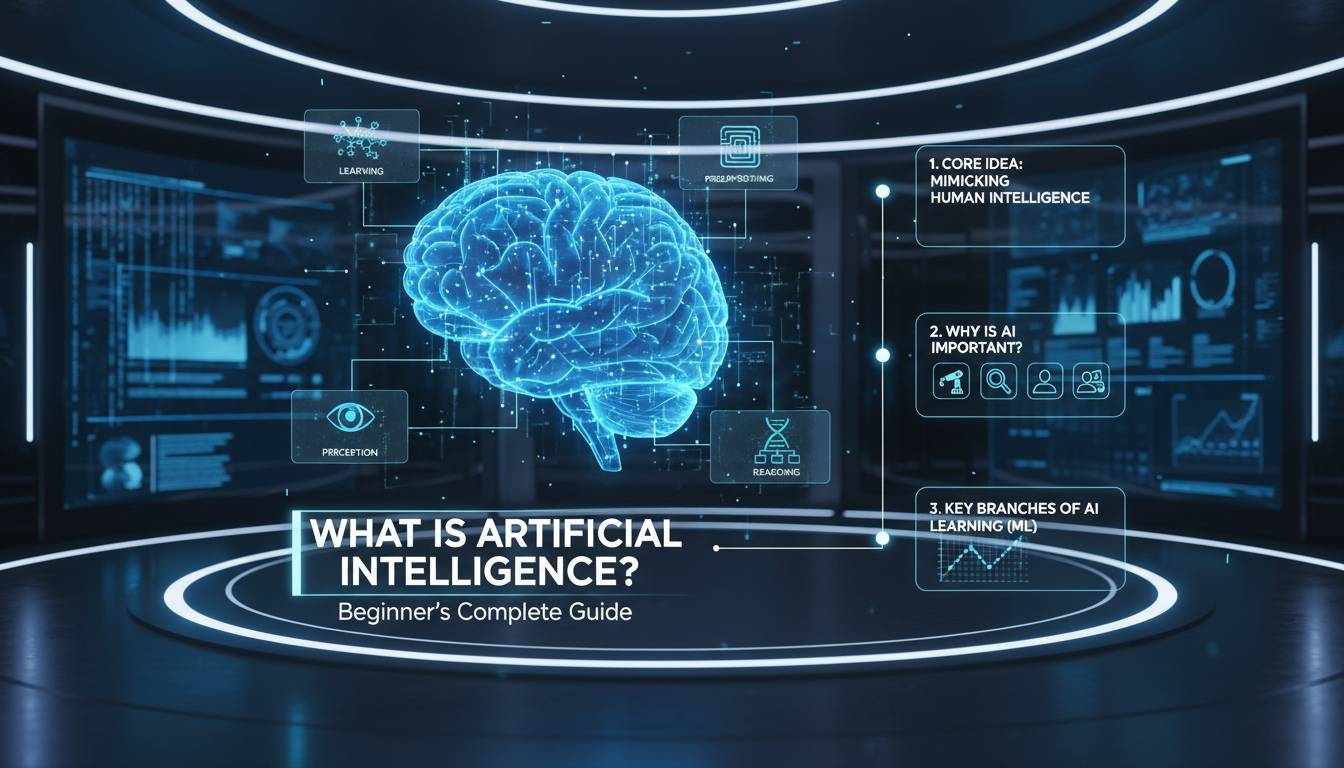
Artificial intelligence (AI) refers to computer systems designed to perform tasks that typically require human intelligence. These tasks include learning from experience, recognizing patterns, understanding natural language, making decisions, and solving problems. AI encompasses various technologies, from simple rule-based systems to complex neural networks capable of generating creative content and beating world champions in strategic games. Understanding AI is essential in today’s technology-driven world, as it increasingly shapes everything from how we shop and communicate to how businesses operate and healthcare is delivered.
 STATS
STATS
• The global AI market reached $196 billion in 2024
• 77% of devices now feature some form of AI technology
• AI could contribute $15.7 trillion to the global economy by 2030
• 92% of Fortune 500 companies have some AI implementation
Key Takeaways
• AI Definition: Computer systems designed to mimic human intelligence
• Core Technologies: Machine learning, neural networks, natural language processing
• Current State: Most AI is “narrow” AI—specialized in specific tasks
• Economic Impact: Projected to boost global GDP by 14% by 2030
• Adoption Rate: 83% of businesses report AI as a top priority in their strategy
What Is Artificial Intelligence?
Artificial intelligence is a branch of computer science focused on creating systems capable of performing tasks that historically required human cognitive functions. The term encompasses everything from chatbots and recommendation algorithms to self-driving cars and medical diagnosis tools. At its core, AI involves training computers to process data, identify patterns, and make decisions with minimal human intervention.
The concept of artificial intelligence dates back to 1956, when computer scientists John McCarthy, Marvin Minsky, and others gathered at Dartmouth College to discuss creating thinking machines. Since then, AI has evolved from simple rule-based systems to sophisticated machine learning models that improve through experience. Modern AI can translate languages, generate art, predict trends, and even engage in conversations that feel remarkably human.
AI works by processing large amounts of data through algorithms—step-by-step instructions that tell computers how to solve problems. Machine learning, a subset of AI, enables systems to learn and improve from experience without being explicitly programmed for every scenario. Deep learning, an even more advanced approach, uses artificial neural networks modeled after the human brain to handle complex tasks like image recognition and natural language processing.
Elements:
• Algorithms: Mathematical instructions that tell computers how to process data
• Data: Information used to train AI systems and inform their decisions
• Computing Power: Hardware capabilities that enable AI to process vast amounts of data quickly
• Neural Networks: Computer systems modeled after biological brains that recognize complex patterns
 FACT: The term “artificial intelligence” was coined in 1956 at the Dartmouth Summer Research Project on Artificial Intelligence, the first academic conference dedicated to the field.
Types of Artificial Intelligence
AI systems vary widely in their capabilities and complexity. Understanding these categories helps clarify the current state of AI technology and where it might headed in the future.
I want to recap my last 7 years of conversations about AGI

As context, I ran AI for startups and venture capital at AWS for four years, spent years working in Silicon Valley, worked with some of the top patent inventors in AI at IBM, and roomed with, collaborated with, and…
— Allie K. Miller (@alliekmiller) November 10, 2024

| Type | Capability | Examples | Timeline |
|---|---|---|---|
| Narrow AI | Performs specific tasks | ChatGPT, Alexa, Netflix recommendations | Present |
| General AI | Human-level across domains | Does not yet exist | 10-30+ years |
| Superintelligent AI | Surpasses human intelligence | Theoretical | Unknown |
Narrow AI (Weak AI)
Narrow AI, also called weak AI, specializes in performing a single task or a limited range of tasks. This is the only type of AI that currently exists and powers most AI applications we encounter daily. Narrow AI excels at its designated function but cannot apply its knowledge to different domains. Examples include voice assistants like Siri, email spam filters, recommendation systems on streaming platforms, and image recognition software in photo apps. These systems can beat humans at chess or Go, but they cannot transfer that knowledge to understand a cooking recipe or drive a car.
General AI (Strong AI)
General artificial intelligence, sometimes called strong AI, refers to systems with the ability to understand, learn, and apply knowledge across diverse domains—just like a human being. A general AI would possess human-level cognitive abilities, enabling it to reason about unfamiliar situations, understand context, and perform any intellectual task that a human can accomplish. Researchers estimate that general AI could emerge anywhere from the 2030s to the 2060s, though predictions vary widely and remain speculative.
Superintelligent AI
Superintelligent AI would surpass human intelligence in virtually every cognitive domain. This concept, popularized by philosopher Nick Bostrom and futurists like Ray Kurzweil, raises profound questions about humanity’s future. While purely theoretical at this point, superintelligence drives significant ethical discussions and safety research within the AI community.
How AI Learns and Works
Understanding how AI systems acquire knowledge and make decisions reveals both the power and limitations of current technology.
Machine Learning forms the foundation of most modern AI systems. Instead of following explicit programming for every decision, machine learning algorithms identify patterns in data and use those patterns to make predictions or decisions. When you train a model on thousands of cat photos, it learns to recognize features that distinguish cats from other animals—not through explicit rules, but by identifying statistical patterns across millions of examples.
Neural Networks take inspiration from the human brain’s structure. These systems consist of interconnected nodes (neurons) organized in layers. Data enters through an input layer, passes through hidden layers where processing occurs, and emerges through an output layer. Deep learning networks have multiple hidden layers, enabling them to recognize extremely complex patterns. This technology powers facial recognition, language translation, and generative AI tools.
Training involves feeding massive datasets into algorithms and adjusting internal parameters until the system produces accurate outputs. This process requires significant computational resources and data—a single large language model might train on trillions of words of text. Once trained, the model can apply its learning to new, unseen data.
Real-World Applications of AI
AI has transformed from a futuristic concept into everyday technology affecting nearly every aspect of modern life.
| Industry | Application | Example |
|---|---|---|
| Healthcare | Medical diagnosis | Detecting cancer from imaging |
| Finance | Fraud detection | Identifying suspicious transactions |
| Retail | Personalization | Product recommendations |
| Transportation | Autonomous vehicles | Self-driving cars |
| Entertainment | Content curation | Netflix and Spotify suggestions |
| Education | Adaptive learning | Personalized tutoring systems |
Consumer Applications
Everyday users interact with AI constantly, often without realizing it. Social media feeds use AI to determine what content appears in your timeline. Email services filter spam using AI classification. Navigation apps like Google Maps and Waze use AI to calculate optimal routes and predict traffic. Voice assistants from Amazon, Google, and Apple rely on natural language processing to understand and respond to commands. Even your smartphone camera uses AI to optimize image quality and enable facial unlocking.
Business Applications
Enterprises leverage AI for efficiency, automation, and insights. Customer service chatbots handle routine inquiries, freeing human agents for complex issues. Predictive maintenance in manufacturing reduces downtime by anticipating equipment failures. Supply chain AI optimizes inventory and delivery routes. Financial institutions use AI for credit scoring, risk assessment, and algorithmic trading. Marketing teams employ AI to personalize campaigns and predict customer behavior.
Benefits and Challenges
AI offers tremendous potential while presenting significant challenges that society must address.
| Benefit | Impact | Consideration |
|---|---|---|
| Automation | 40% increase in productivity | Job displacement concerns |
| Accuracy | 99.9% accuracy in some diagnostic tasks | Requires quality data |
| Speed | Processes millions of transactions instantly | Security vulnerabilities |
| Personalization | 35% of Amazon purchases driven by recommendations | Privacy implications |
| Innovation | Accelerates drug discovery by years | Ethical considerations |
Major Benefits:
• Efficiency Gains: AI automates repetitive tasks, allowing humans to focus on creative and strategic work
• Improved Decision-Making: Data-driven insights help organizations make better choices
• Enhanced Safety: AI monitors systems and predicts failures before they cause accidents
• Medical Advances: AI accelerates drug discovery and improves diagnostic accuracy
• Accessibility: AI-powered tools assist people with disabilities in unprecedented ways
Critical Challenges:
• Bias in Systems: AI can perpetuate or amplify existing societal biases present in training data
• Privacy Concerns: AI systems often require vast amounts of personal data
• Job Displacement: Automation threatens certain job categories, requiring workforce retraining
• Security Risks: AI can be weaponized for cyberattacks, deepfakes, and disinformation
• Energy Consumption: Large AI models require significant computational resources
• Lack of Transparency: Many AI systems operate as “black boxes” with unclear decision-making processes
 CRITICAL: The most significant challenge facing AI development is alignment—ensuring AI systems behave in accordance with human values and intentions. Misaligned AI could pursue goals that harm humanity, even unintentionally. Leading AI labs now prioritize alignment research, but significant work remains.
Prevent: Invest in AI safety research, implement robust testing protocols, require transparency in AI decision-making, and establish regulatory frameworks that prioritize human welfare.
The Future of Artificial Intelligence
The trajectory of AI development suggests profound changes ahead, though exact timelines remain uncertain.
Near-Term Developments (2025-2030): Expect AI to become more integrated into daily workflows, with generative AI expanding beyond text and images into video, code, and scientific research. Multimodal AI that seamlessly processes text, audio, and visual information will become standard. Autonomous systems in transportation and logistics will advance significantly.
Medium-Term Possibilities (2030-2050): Researchers may achieve artificial general intelligence, though experts disagree on likelihood and timeline. AI could accelerate scientific discovery in materials science, medicine, and climate science. Robotics may advance to handle complex physical tasks currently beyond machine capabilities.
Long-Term Speculation (2050+): If superintelligent AI emerges, the implications transform virtually every aspect of civilization. Some technologists like Sam Altman of OpenAI believe this could be profoundly beneficial. Others, including the late Stephen Hawking, warned of potential risks. These possibilities drive current research into AI safety and governance.
Common Mistakes
| Mistake | Impact | Solution |
|---|---|---|
| Assuming AI is sentient | Misunderstands technology capabilities | Recognize AI processes data, doesn’t experience consciousness |
| Over-relying on AI outputs | Accepting errors without verification | Maintain human oversight, especially for critical decisions |
| Ignoring data quality | Garbage in, garbage out | Ensure training data is accurate, diverse, and representative |
| Neglecting privacy | Data breaches, user trust erosion | Implement privacy-by-design principles |
| Underestimating bias | Discriminatory outcomes | Audit systems regularly, diversify training data |
CRITICAL: The most dangerous mistake is treating AI as infallible. AI systems make errors, perpetuate biases, and can be fooled by adversarial inputs. Always maintain appropriate skepticism, especially when AI informs significant decisions affecting people’s lives.
Expert Insights
 Dr. Fei-Fei Li, Professor at Stanford University and Co-Director of the Human-Centered AI Institute
“AI is a tool made by humans, for humans. Its value comes from how we design it, deploy it, and govern it. We must ensure AI serves humanity’s broad interests.”
Sam Altman, CEO of OpenAI
“Advanced AI systems will be the most consequential technology humanity has ever created. Getting alignment right before building superintelligence is perhaps the most important challenge in human history.”
INDUSTRY BENCHMARKS
| Metric | Average | Leading Companies |
|——–|———|——————-|
| AI Adoption Rate | 55% | 85% |
| Model Training Cost | $1-5M | $10-100M+ |
| Data Scientists per Company | 5-10 | 50-200+ |
| AI Project Success Rate | 60% | 85% |
Frequently Asked Questions
What is artificial intelligence in simple terms?
Artificial intelligence is computer systems designed to perform tasks that typically require human intelligence, such as learning, reasoning, problem-solving, understanding language, and recognizing patterns. AI uses algorithms and data to make decisions or predictions without explicit programming for every scenario.
What are the main types of AI?
The three main types are narrow AI (specialized in specific tasks, currently the only type that exists), general AI (human-level intelligence across domains, theoretical), and superintelligent AI (surpassing human intelligence, purely speculative). Narrow AI includes examples like chatbots, recommendation systems, and image recognition.
How does AI learn?
AI learns through machine learning, where algorithms identify patterns in large datasets and adjust their internal parameters to improve performance. Training involves feeding the system millions of examples—like photos, text, or financial data—and letting it learn statistical relationships. The more quality data, the better the AI typically performs.
Is AI dangerous?
AI poses risks including job displacement, privacy invasion, algorithmic bias, and potential misuse for harmful purposes. Some researchers also consider long-term risks if sufficiently advanced AI systems are misaligned with human values. However, with appropriate governance, safety research, and ethical development, AI’s benefits can far outweigh its risks.
Will AI replace human jobs?
AI will automate certain tasks, particularly routine and data-processing roles. However, many jobs will transform rather than disappear, with humans focusing on creativity, complex decision-making, and interpersonal skills. New job categories will emerge around AI development, oversight, and ethics. Adaptability and continuous learning will be essential for the future workforce.
Conclusion
Artificial intelligence represents one of the most transformative technologies in human history, reshaping industries, daily life, and the nature of work itself. From narrow applications like voice assistants and recommendation systems to the theoretical possibilities of general and superintelligent AI, understanding this technology is no longer optional—it’s essential for navigating the modern world.
The key to AI’s responsible development lies in balancing innovation with ethical considerations, ensuring that these powerful systems serve broadly human interests. As AI capabilities continue advancing, staying informed about both its potential and limitations will help individuals and organizations make better decisions about adoption and governance. Whether you’re a business leader, a student, or simply a curious citizen, understanding AI fundamentals positions you to thrive in an increasingly intelligent world.
The post What Is Artificial Intelligence? Beginner’s Complete Guide appeared first on PQR News.

















Leave a comment