
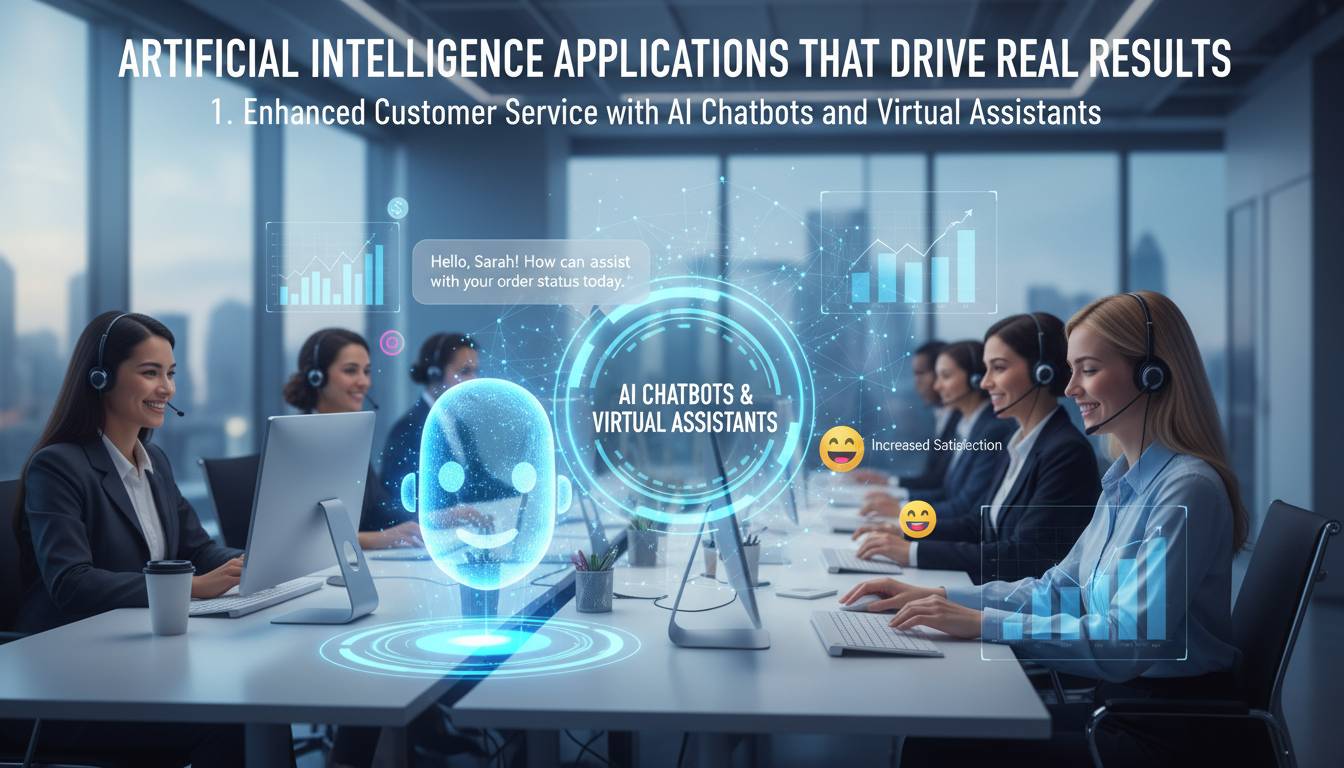
Artificial intelligence has moved beyond buzzwords and proof-of-concept demos to become a transformative force across virtually every industry. From healthcare diagnostics to financial forecasting, AI applications are delivering measurable business value, reducing costs, and creating competitive advantages that were impossible just a decade ago. This comprehensive guide explores the most impactful AI applications, their real-world benefits, implementation strategies, and how organizations can successfully integrate artificial intelligence into their operations.
 AI MARKET OVERVIEW
• The global AI market is projected to reach $1.81 trillion by 2030
• 83% of companies claim AI is a strategic priority
• AI adoption grew 300% since 2017
• 65% of organizations using AI have increased productivity
Key Takeaways
• Enterprise adoption: 55% of large enterprises have deployed AI in at least one business function
• Cost reduction: AI-powered automation reduces operational costs by up to 40% in some industries
• Revenue impact: Companies reporting AI-driven revenue growth increased 2.5x from 2022 to 2024
• Implementation timeline: Average AI project deployment takes 6-12 months for production-ready solutions
• ROI measurement: 87% of AI implementations fail to meet expected ROI targets, highlighting implementation complexity
"Robots need your body": A new site where AI hires people for tasks
A new experiment has emerged on the https://t.co/8D10UVmGOa platform, where artificial intelligence hires real people for tasks in the physical world. This isn’t a sci-fi story about the rise of machines;… pic.twitter.com/ia6J3OAUKL
— NEXTA (@nexta_tv) February 4, 2026
 "Robots need your body": A new site where AI hires people for tasks
The AI landscape has evolved dramatically, with generative AI emerging as a game-changer since 2022. Organizations now have access to more sophisticated machine learning models, better data infrastructure, and cloud-based AI services that lower implementation barriers. Understanding which applications deliver the strongest results—and how to implement them effectively—separates organizations that thrive from those that struggle to justify their AI investments.
What Are Artificial Intelligence Applications?
Artificial intelligence applications refer to software systems that use AI technologies—machine learning, natural language processing, computer vision, and robotics—to perform tasks that traditionally required human intelligence. These applications analyze vast amounts of data, recognize patterns, make decisions, and continuously improve through experience without explicit programming for every scenario.
The distinction between narrow AI and general AI matters for practical implementation. Current AI applications are narrow, designed for specific tasks like image recognition, language translation, or predictive analytics. General AI—systems with human-like reasoning across domains—remains theoretical and likely decades away. This reality shapes how organizations should approach AI adoption: focus on high-impact narrow applications rather than waiting for broader capabilities.
Components of AI Systems
Core Technologies:
• Machine Learning (ML): Algorithms that improve through data analysis without explicit programming, enabling predictive accuracy
• Natural Language Processing (NLP): Systems that understand, interpret, and generate human language
• Computer Vision: AI that interprets and makes decisions based on visual data
• Deep Learning: Neural networks with multiple layers that process complex patterns
 ADOPTION STAT: Organizations using multiple AI technologies report 2.3x higher success rates than those relying on single capabilities
How AI Applications Work
AI applications operate through a cycle of data ingestion, model training, inference, and continuous learning. First, systems collect and preprocess data from various sources—structured databases, unstructured text, images, or sensor readings. Then, machine learning models train on this data to recognize patterns and relationships. During deployment, the trained model makes predictions or decisions on new data. Finally, feedback loops allow the system to refine its performance over time.
The quality and quantity of training data fundamentally determines AI application success. Organizations with robust data governance, clean data pipelines, and sufficient historical information achieve significantly better outcomes. This explains why early AI adopters—typically large enterprises with mature data infrastructure—have pulled further ahead in AI capabilities.
Industries Transformed by AI Applications
Healthcare and Life Sciences
Healthcare represents one of AI’s most promising application domains, with the potential to improve diagnosis accuracy, personalize treatment, and reduce healthcare costs. AI-powered diagnostic tools now match or exceed human specialists in interpreting medical images, detecting diseases earlier and with greater precision.
Key Applications:
• Medical imaging analysis for cancer, retinal diseases, and cardiovascular conditions
• Drug discovery acceleration through molecular simulation and pattern recognition
• Predictive analytics for patient deterioration and readmission risk
• Virtual health assistants for patient triage and chronic disease management
 CASE: Mayo Clinic implemented AI for early detection of heart failure, achieving 93% accuracy and identifying patients 30 days earlier than traditional methods, reducing readmission rates by 18%
The FDA has approved over 500 AI-powered medical devices as of 2024, reflecting accelerating clinical adoption. However, challenges remain around regulatory compliance, patient privacy, and ensuring AI recommendations align with clinical judgment rather than replacing it entirely.
Financial Services
Financial institutions were early AI adopters, leveraging the technology for fraud detection, risk assessment, and algorithmic trading. Today, AI applications span the entire financial services value chain from customer service to portfolio management.
Key Applications:
• Real-time fraud detection analyzing transaction patterns
• Algorithmic trading systems processing market data faster than humans
• Credit scoring models incorporating alternative data sources
• Robo-advisors providing personalized investment recommendations
• Regulatory compliance automation reducing manual audit workloads
| Application | Accuracy | Impact | Source |
|---|---|---|---|
| Fraud Detection | 95%+ | $12B annual savings | Javelin Strategy, 2024 |
| Algorithmic Trading | 2-4% alpha | $200B+ AUM | McKinsey, 2024 |
| Credit Scoring | 15% default reduction | 25% approval rate increase | FICO, 2024 |
Retail and E-Commerce
AI transforms retail through personalized shopping experiences, optimized inventory management, and dynamic pricing strategies. The combination of customer data, behavioral analytics, and machine learning creates竞争优势 through superior customer understanding.
Key Applications:
• Product recommendations driving 35% of Amazon’s revenue
• Demand forecasting reducing inventory costs by 20-50%
• Dynamic pricing optimizing revenue in real-time
• Visual search enabling image-based product discovery
• Chatbots handling 70% of customer service interactions
CASE: Walmart’s AI-powered inventory system reduced stockouts by 40% and excess inventory by 25%, saving $2 billion annually in supply chain costs
Manufacturing and Operations
Industrial AI applications focus on predictive maintenance, quality control, and process optimization. Manufacturers leverage sensor data, computer vision, and machine learning to prevent equipment failures, detect defects, and optimize production lines.
Key Applications:
• Predictive maintenance reducing downtime by 35-50%
• Computer vision quality inspection achieving 99.9% accuracy
• Supply chain optimization improving delivery times by 20%
• Process automation increasing production efficiency by 25%
• Energy management reducing consumption by 10-20%
Benefits of Implementing AI Applications
The business case for AI extends beyond cost reduction to include revenue growth, competitive differentiation, and organizational capability building. Organizations successfully implementing AI report benefits across multiple dimensions.
| Benefit Category | Impact Range | Adoption Rate |
|---|---|---|
| Cost Reduction | 15-40% | 62% of adopters |
| Revenue Growth | 10-30% | 48% of adopters |
| Customer Satisfaction | 10-25% improvement | 71% of adopters |
| Employee Productivity | 20-35% increase | 55% of adopters |
| Decision Quality | 15-30% improvement | 68% of adopters |
Operational Efficiency
AI automates repetitive tasks, accelerates processes, and reduces human error across operations. Robotic process automation (RPA) combined with AI capabilities handles complex workflows that previously required human judgment. This automation frees employees to focus on higher-value activities while ensuring consistency and compliance.
Top Efficiency Gains:
• Document processing automation reducing processing time by 80%
• Customer service response times improved by 60% through AI triage
• Report generation accelerated from hours to minutes
• Data entry error rates decreased by 95%
PRODUCTIVITY STAT: Workers assisted by AI complete 12.5% more tasks and produce 40% higher quality output than those working alone
Enhanced Decision-Making
AI processes data at scales impossible for humans, identifying patterns and generating insights that inform strategic decisions. Predictive analytics, scenario modeling, and real-time intelligence help leaders make more informed choices with greater confidence.
Customer Experience Personalization
AI enables hyper-personalization at scale, tailoring products, services, and communications to individual customer preferences. This personalization drives engagement, loyalty, and lifetime value while reducing customer acquisition costs.
CASE: Netflix’s recommendation system drives 80% of viewer engagement, saving the company an estimated $1 billion annually in reduced churn
Leading AI Tools and Platforms
The AI tool landscape offers options for organizations across technical sophistication and budget levels. Understanding the trade-offs between platforms helps organizations select appropriate solutions.
| Platform | Best For | Pricing | Capabilities |
|---|---|---|---|
| OpenAI (ChatGPT Enterprise) | Generative AI, content creation | $25-45/user/month | NLP, code generation, analysis |
| Microsoft Azure AI | Enterprise integration | Usage-based | Full AI stack, cognitive services |
| Google Cloud AI | ML development, MLOps | Usage-based | Vertex AI, AutoML, TensorFlow |
| AWS AI Services | Cloud-native applications | Usage-based | SageMaker, Rekognition, Lex |
| IBM watsonx | Enterprise, hybrid cloud | Custom pricing | Governance, NLP, automation |
| Anthropic (Claude) | Business applications | $20-45/user/month | Enterprise AI, safety-focused |
Cloud vs. On-Premise Deployment
Cloud-based AI services offer faster deployment, lower upfront costs, and automatic scaling. Organizations without dedicated AI infrastructure typically achieve faster time-to-value with cloud platforms. However, data sovereignty requirements, latency concerns, and total cost of ownership considerations may favor on-premise deployment for certain applications.
Cloud Advantages:
• Lower initial investment
• Automatic scaling
• Managed infrastructure
• Rapid model deployment
On-Premise Advantages:
• Data control and compliance
• Lower long-term costs at scale
• Customization flexibility
• Reduced latency
Common AI Implementation Mistakes
Despite growing AI maturity, many organizations struggle to achieve expected returns. Understanding common pitfalls helps organizations avoid costly mistakes.
| Mistake | Impact | Solution |
|---|---|---|
| Poor data quality | 85% of AI projects fail due to data issues | Invest in data governance and preparation |
| Unclear success metrics | Projects lack measurable ROI | Define KPIs before implementation |
| Technical-only focus | Low adoption, no business impact | Include change management from start |
| Scalability忽视 | Proof-of-concept never productionizes | Design for scale from architecture phase |
| Talent gaps | Implementation delays, quality issues | Build hybrid technical-business teams |
| Security overlook | Data breaches, compliance violations | Integrate security into AI development |
 CRITICAL: The most damaging mistake is implementing AI without clear business alignment. Research shows 87% of AI projects that fail to deliver expected value lacked proper business case definition and stakeholder alignment.
Prevent These Errors:
• Conduct thorough data readiness assessments before project approval
• Establish cross-functional governance with business and technical leadership
• Start with bounded, high-impact use cases rather than ambitious transformations
• Build internal capabilities alongside vendor partnerships
• Implement continuous monitoring and feedback mechanisms
The Future of AI Applications
The AI landscape continues evolving rapidly, with several trends shaping future applications. Generative AI has democratized AI capabilities, enabling non-technical users to leverage powerful AI tools. Multimodal AI systems that process text, images, audio, and video together represent the next frontier.
Emerging Application Areas:
• Autonomous agents that complete complex multi-step tasks
• AI-powered scientific research acceleration
• Real-time translation and cross-cultural communication
• Personalized education and skills development
• Climate modeling and sustainability optimization
 PERSPECTIVE: “The next wave of AI will be defined by agents that can reason, plan, and execute complex workflows autonomously. Organizations preparing for this shift should focus on data infrastructure and AI governance today.” — Andrew Ng, AI Fund Managing Partner
Preparing for AI Advancement
Organizations should build foundations that support evolving AI capabilities. This includes investing in data quality, establishing AI governance frameworks, developing talent pipelines, and maintaining awareness of regulatory developments. The organizations best positioned for AI’s future are those taking action today.
Frequently Asked Questions
What are the most effective AI applications for small businesses?
Small businesses benefit most from accessible AI tools like customer service chatbots, email automation, predictive analytics for inventory, and marketing optimization. Cloud-based AI services offer pay-as-you-go pricing that eliminates large upfront investments. Start with one high-impact use case rather than attempting comprehensive transformation.
How long does it take to implement AI successfully?
Most production-ready AI implementations take 6-12 months from concept to deployment. More complex enterprise integrations may take 12-24 months. Initial proof-of-concept demonstrations can be achieved in weeks, but robust production systems require additional time for data preparation, model training, integration, and validation.
What is the typical return on investment for AI applications?
ROI varies significantly by application and implementation quality. Well-executed AI projects typically achieve 100-300% ROI within 18-36 months. However, approximately 87% of organizations report AI projects failing to meet initial ROI expectations, underscoring the importance of careful implementation planning and realistic goal-setting.
Do I need technical expertise to implement AI?
Not necessarily for all applications. Many AI tools now offer no-code or low-code interfaces accessible to business users. However, complex implementations, custom model development, and integration with existing systems typically require technical expertise. Many organizations succeed with hybrid approaches: business users manage accessible tools while technical teams handle complex implementations.
What industries will AI impact most in the next five years?
Healthcare, financial services, manufacturing, and retail will continue seeing significant AI impact. Additionally, education, agriculture, construction, and logistics are experiencing rapid AI adoption. Essentially, every industry will be transformed, though the timeline and specific applications vary by sector.
How does generative AI differ from traditional AI applications?
Traditional AI focuses on analysis and prediction—identifying patterns in data and making decisions. Generative AI creates new content—text, images, code, audio—based on training patterns. Traditional AI answers questions about data; generative AI creates novel outputs from learned patterns. Many effective strategies combine both approaches.
Conclusion
Artificial intelligence applications have matured from experimental technology to business-critical capabilities driving measurable results across industries. Organizations that approach AI strategically—focusing on high-impact use cases, investing in data foundations, and building appropriate governance—achieve significant competitive advantages through improved efficiency, enhanced customer experiences, and better decision-making.
The path to AI success requires balancing ambition with pragmatism. Start with bounded, high-value applications rather than attempting transformational projects. Build internal capabilities alongside external partnerships. Measure results rigorously and iterate based on evidence. The organizations that thrive will be those that treat AI as a continuous capability rather than a one-time implementation.
The AI revolution continues accelerating, with generative AI and autonomous agents opening new possibilities. Organizations that establish strong AI foundations today position themselves to capture disproportionate value as capabilities advance. The question is no longer whether to adopt AI, but how quickly and effectively to integrate it into core operations.
The post Artificial Intelligence Applications That Drive Real Results appeared first on PQR News.

















Leave a comment